AI communication intelligence
Every organization has great ideas.
Some become company-wide initiatives.
Others disappear after a single presentation.
The difference isn’t always the quality of the idea.
It’s whether the audience understands why the idea matters.
Many organizations assume better ideas naturally win.
In reality, the ideas that gain traction are the ones that connect with the people making the decision.
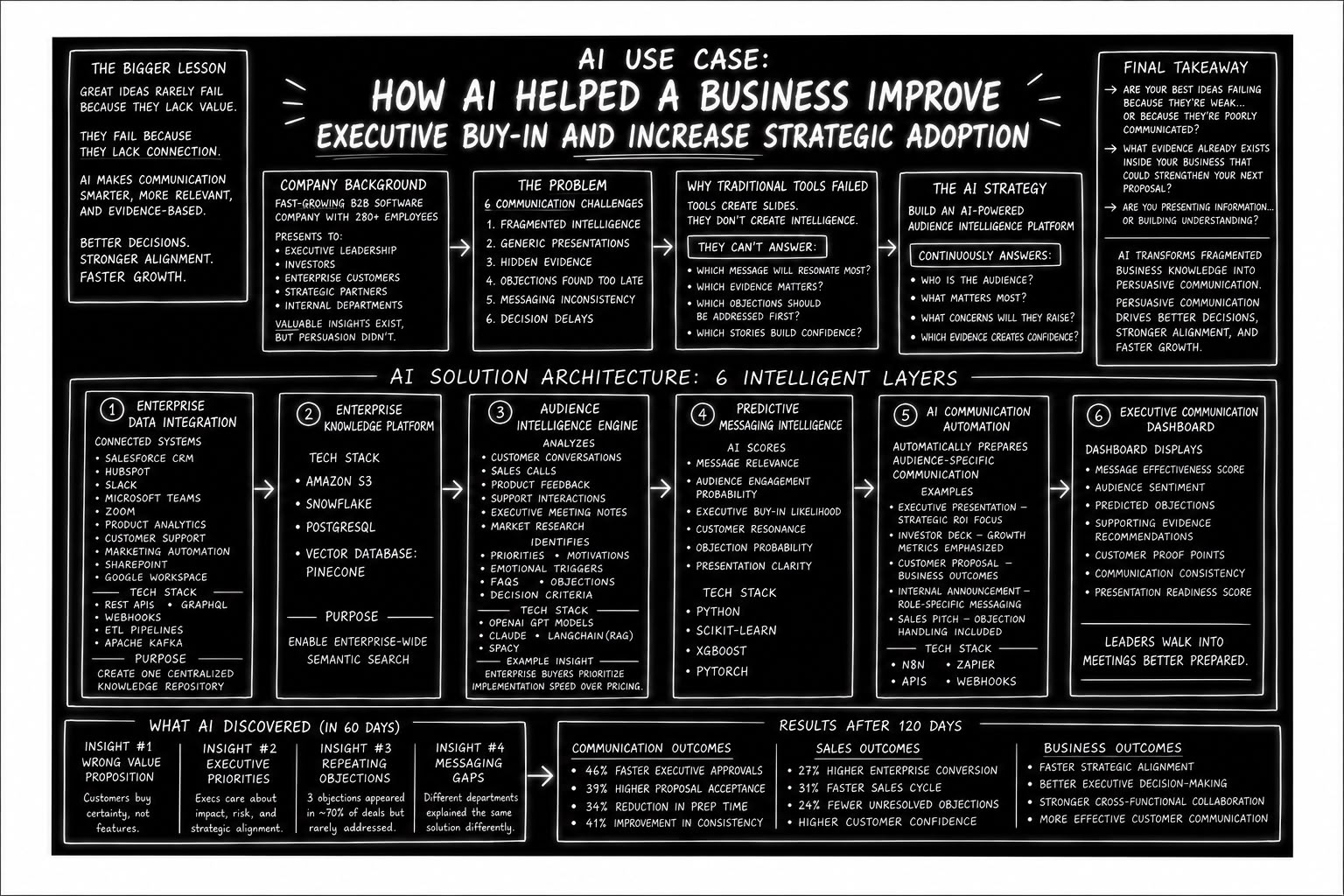
This case study explores how a growing technology company used AI to transform fragmented business knowledge into audience-specific messaging that improved executive buy-in, customer adoption, and sales success.
Company Background
A fast-growing B2B software company with over 280 employees was preparing for its next stage of growth.
The organization regularly presented new initiatives to:
* Executive leadership
* Investors
* Enterprise customers
* Strategic partners
* Internal departments
The company generated valuable insights every day.
Information came from:
* Sales conversations
* Customer support
* Product analytics
* Customer success
* Marketing research
* CRM data
Yet despite having strong ideas, many initiatives struggled to gain support.
Leadership noticed a recurring pattern.
The information existed.
The persuasion didn’t.
The Problem
The organization faced six communication challenges.
Business Intelligence Was Fragmented
Critical evidence existed across multiple systems:
* CRM
* Customer support
* Sales calls
* Product feedback
* Survey responses
* Meeting notes
No single person had the complete picture.
2. Generic Presentations
Teams created the same presentation for every audience.
Executives wanted strategic impact.
Customers wanted business outcomes.
Investors wanted growth.
Employees wanted clarity.
Everyone received nearly identical messaging.
3. Valuable Evidence Stayed Hidden
Sales teams heard recurring customer objections.
Support teams understood common frustrations.
Product teams knew adoption patterns.
These insights rarely appeared in executive presentations.
4. Objections Were Discovered Too Late
Most objections surfaced during meetings.
Instead of preparing responses beforehand, presenters reacted in real time.
5. Messaging Inconsistency
Different departments explained the same initiative differently.
This created confusion.
6. Decision Delays
Leadership requested additional meetings because proposals lacked sufficient supporting evidence.
Strategic decisions slowed.
Why Traditional Presentation Tools Failed
The organization already used:
* Microsoft PowerPoint
* Google Slides
* Salesforce
* HubSpot
* Microsoft Teams
The issue wasn’t presentation software.
The issue was intelligence.
The tools helped create slides.
They couldn’t answer:
* Which message will resonate most?
* Which evidence matters to this audience?
* Which objections should be addressed first?
* Which customer stories best support this proposal?
That required AI.
The AI Strategy
The company built an AI-Powered Audience Intelligence Platform.
Instead of creating presentations from scratch, AI assembled evidence, insights, and messaging based on the audience.
The platform continuously answered:
* Who is the audience?
* What matters most to them?
* What concerns are they likely to raise?
* Which evidence will create confidence?
AI Solution Architecture
The solution consisted of six intelligent layers.
Layer 1: Enterprise Data Integration
AI continuously collected business intelligence.
Connected Systems
* Salesforce CRM
* HubSpot
* Slack
* Microsoft Teams
* Zoom
* Product Analytics
* Customer Support Platform
* Marketing Automation Platform
* SharePoint
* Google Workspace
Tech Stack
* REST APIs
* GraphQL
* Webhooks
* ETL Pipelines
* Apache Kafka
Purpose:
Create one centralized knowledge repository.
Layer 2: Enterprise Knowledge Platform
Structured and unstructured information flowed into one environment.
Tech Stack
* Amazon S3
* Snowflake
* PostgreSQL
* Vector Database:
* Pinecone
Purpose:
Enable enterprise-wide semantic search.
Layer 3: Audience Intelligence Engine
AI analyzed:
* Customer conversations
* Sales calls
* Product feedback
* Support interactions
* Executive meeting notes
* Market research
It automatically identified:
* Audience priorities
* Buying motivations
* Emotional triggers
* Frequently asked questions
* Common objections
* Decision criteria
Example insight:
Enterprise buyers consistently prioritized implementation speed over pricing.
Tech Stack
* OpenAI GPT Models
* Claude
* Retrieval-Augmented Generation using LangChain
* spaCy
Layer 4: Predictive Messaging Intelligence
Machine learning predicted communication effectiveness.
AI scored:
* Message relevance
* Audience engagement probability
* Executive buy-in likelihood
* Customer resonance
* Objection probability
* Presentation clarity
Tech Stack
* Python
* Scikit-learn
* XGBoost
* PyTorch
Layer 5: AI Communication Automation
AI automatically prepared audience-specific communication.
Examples:
* Executive presentation → Strategic ROI focus
* Investor deck → Growth metrics emphasized
* Customer proposal → Business outcomes prioritized
* Internal announcement → Role-specific messaging generated
* Sales pitch → Objection handling recommendations included
Tech Stack
* n8n
* Zapier
* APIs
* Webhooks
Layer 6: Executive Communication Dashboard
Leadership received AI-powered communication intelligence.
Dashboard displayed:
* Message effectiveness score
* Audience sentiment
* Predicted objections
* Supporting evidence recommendations
* Customer proof points
* Communication consistency
* Presentation readiness score
Leaders walked into meetings better prepared.
What AI Discovered
Within 60 days, AI identified several hidden communication problems.
Hidden Insight #1: Wrong Value Proposition
Sales teams emphasized product features.
Customer conversations consistently emphasized implementation speed and business outcomes.
Insight
Customers weren’t buying features.
They were buying certainty.
Hidden Insight #2: Executive Priorities
Executive leadership consistently asked about:
* Financial impact
* Risk reduction
* Strategic alignment
Presentations spent most of their time discussing functionality.
Insight
The message and the audience were misaligned.
Hidden Insight #3: Repeating Objections
Three objections appeared in nearly 70% of enterprise sales opportunities.
Yet they were rarely addressed proactively.
Insight
Preparing for predictable objections significantly improved persuasion.
Hidden Insight #4: Department Messaging Gaps
Marketing, Sales, and Product described the same solution differently.
Insight
Inconsistent messaging weakened credibility.
Results After 120 Days
The AI implementation delivered measurable improvements.
Communication Outcomes
* 46% faster executive approvals
* 39% higher proposal acceptance
* 34% reduction in presentation preparation time
* 41% improvement in message consistency
Sales Outcomes
* 27% higher enterprise conversion rate
* 31% faster sales cycle
* 24% fewer unresolved objections
* Higher customer confidence during evaluations
Business Outcomes
* Faster strategic alignment
* Better executive decision-making
* Stronger cross-functional collaboration
* More effective customer communication
The Bigger Lesson
Great ideas rarely fail because they lack value.
They fail because they lack connection.
The most persuasive message isn’t the one with the most information.
It’s the one that speaks directly to what the audience cares about.
That’s where AI creates real leverage.
Not by replacing human communication.
By making communication smarter, more relevant, and evidence-based.
Final Takeaway
Ask yourself:
* Are your best ideas failing because they’re weak…
or because they’re poorly communicated?
* What evidence already exists inside your business that could strengthen your next proposal?
* Are you presenting information…
or building understanding?
Businesses rarely lose opportunities because they lack intelligence.
They lose opportunities because valuable ideas fail to land.
AI changes that.
It transforms fragmented business knowledge into persuasive communication.
And persuasive communication drives better decisions, stronger alignment, and faster growth.


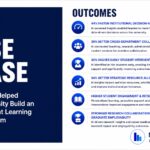
See this article on Linkedin too
https://www.linkedin.com/pulse/ai-use-case-how-helped-business-improve-executive-buy-in-mirania-b99pc/