AI Decision Intelligence
Every business makes mistakes.
That is unavoidable.
Hiring decisions go wrong.
Product launches miss the mark.
Marketing campaigns underperform.
Strategic bets fail.
Customer initiatives stall.
That alone isn’t what hurts a business.
The real danger comes afterward.
Did the business actually learn from the mistake?
Or did it simply absorb the loss and move on?
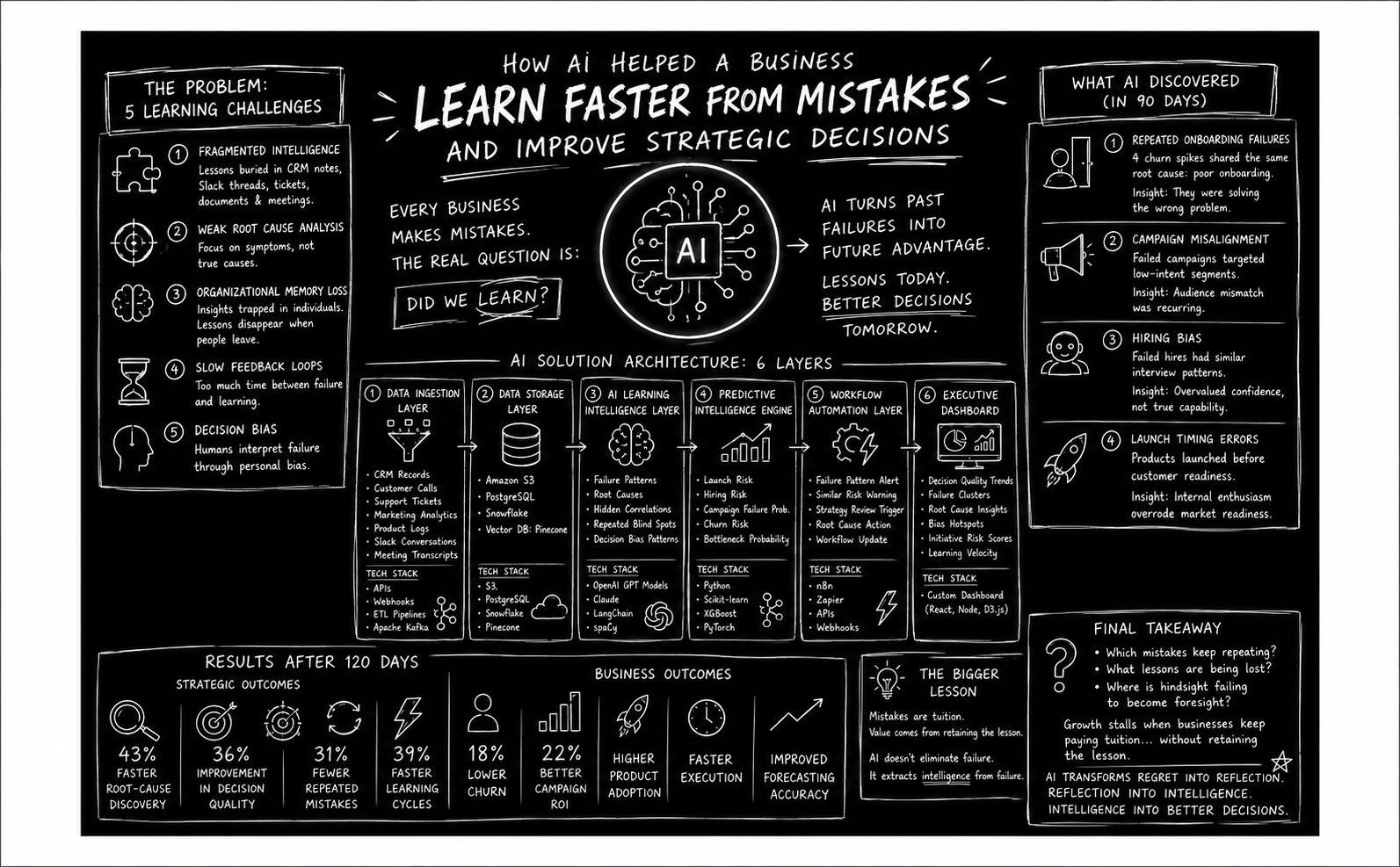
This case study shows how a growing company used AI to extract intelligence from failed decisions, identify recurring blind spots, and improve strategic decision-making.
Company Background
A mid-sized B2B SaaS company with 220+ employees had grown rapidly over four years.
The company operated across:
– Sales
– Marketing
– Product
– Customer Success
– Operations
– Leadership
Revenue growth remained healthy.
Yet leadership noticed an expensive pattern.
The company kept repeating similar mistakes.
Not identical mistakes.
But highly related ones.
Examples included:
– Failed campaigns with similar root causes
– Product launches with repeated adoption issues
– Hiring mistakes in similar roles
– Recurring onboarding friction
– Repeated operational bottlenecks
This raised a critical question:
Why are we paying the same tuition twice?
The Problem
The company faced five major learning challenges.
1. Fragmented Post-Mortem Intelligence
Lessons from failures existed across multiple systems:
– CRM notes
– Meeting recordings
– Slack threads
– Support tickets
– Internal documents
– Dashboards
There was no centralized learning layer.
2. Weak Root Cause Analysis
Teams often focused on symptoms.
Examples:
– Low adoption
– High churn
– Campaign failure
– Missed targets
But root causes remained unclear.
3. Organizational Memory Loss
Insights stayed trapped inside individuals.
When teams changed or employees left, lessons disappeared.
The same mistakes resurfaced.
4. Slow Feedback Loops
By the time leaders understood what went wrong, months had passed.
Learning cycles were too slow.
5. Decision Bias
Humans naturally protect existing beliefs.
Leaders often interpreted failure through personal bias.
This reduced objective learning.
Why Traditional Analytics Failed
The company already had modern analytics systems.
They used:
– Salesforce
– HubSpot
– Tableau
– Google Analytics
These tools answered:
– What happened
– When it happened
– How big the impact was
But they struggled to answer:
– Why did it happen?
– What pattern keeps repeating?
– What lesson are we missing?
That’s where AI came in.
The AI Strategy
The objective was clear:
Build an AI-powered Decision Learning System.
The system needed to answer:
– Why did this initiative fail?
– What patterns repeat across failures?
– What blind spots keep recurring?
– What should we change next time?
AI became an organizational learning engine.
AI Solution Architecture
The solution was built across six layers.
Layer 1: Data Ingestion Layer
AI collected decision-related signals from all business systems.
Data sources included:
– CRM records
– Customer calls
– Support tickets
– Marketing analytics
– Product usage logs
– Slack conversations
– Meeting transcripts
Tech Stack
– APIs
– Webhooks
– ETL pipelines
– Event streaming via Apache Kafka
Purpose:
Centralize fragmented learning signals.
Layer 2: Data Storage Layer
All structured and unstructured data flowed into centralized storage.
Tech Stack
– Amazon S3
– PostgreSQL
– Snowflake
– Vector DB: Pinecone
Purpose:
Store historical decision data for analysis and semantic retrieval.
Layer 3: AI Learning Intelligence Layer
AI analyzed decisions and outcomes across time.
It identified:
– Failure patterns
– Root causes
– Hidden correlations
– Repeated blind spots
– Decision bias patterns
Example insight:
> “Three failed launches shared the same onboarding friction pattern.”
Tech Stack
– OpenAI GPT Models
– Claude
– RAG via LangChain
– spaCy
Layer 4: Predictive Intelligence Engine
AI predicted likely failure risk in new initiatives.
It scored:
– Launch risk
– Hiring risk
– Campaign failure probability
– Churn risk
– Operational bottleneck probability
Tech Stack
– Python
– Scikit-learn
– XGBoost
– PyTorch
Layer 5: Workflow Automation Layer
AI triggered proactive learning workflows.
Examples:
– Repeated failure pattern → leadership alert
– Similar risk detected → strategy review
– New initiative resembles past failure → warning
– Root cause detected → workflow update
Tech Stack
– n8n
– Zapier
– APIs
– Webhooks
Layer 6: Executive Decision Dashboard
Leadership received AI-generated learning intelligence.
Dashboard displayed:
– Decision quality trends
– Failure clusters
– Recurring root causes
– Bias hotspots
– Initiative risk scores
– Learning velocity metrics
Leadership gained visibility into organizational learning.
What AI Discovered
Within 90 days, AI surfaced major hidden patterns.
Hidden Pattern #1: Repeated Onboarding Failures
Four separate churn spikes shared the same root cause:
Poor onboarding.
Leadership previously blamed pricing.
Insight
They were solving the wrong problem.
Hidden Pattern #2: Campaign Misalignment
Failed marketing campaigns consistently targeted low-intent segments.
Insight
Audience mismatch was recurring.
Hidden Pattern #3: Hiring Bias
Failed hires shared similar interview patterns.
Hiring managers overvalued confidence.
Insight
Bias was influencing talent decisions.
Hidden Pattern #4: Launch Timing Errors
Product launches repeatedly happened before customer readiness.
Insight
Internal enthusiasm was overriding market readiness.
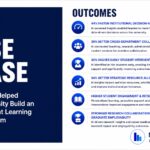
Results After 120 Days
The AI implementation delivered measurable impact.
Strategic Outcomes
– 43% faster root-cause discovery
– 36% improvement in decision quality
– 31% fewer repeated mistakes
– 39% faster learning cycles
Business Outcomes
– 18% lower churn
– 22% better campaign ROI
– Higher product adoption
– Improved forecasting accuracy
– Faster execution
The Bigger Lesson
The strongest organizations are not the ones that avoid mistakes.
They are the ones that learn faster.
Mistakes are tuition.
But tuition only creates value if you retain the lesson.
That’s where AI creates real leverage.
Not by eliminating failure.
By extracting intelligence from failure.
Final Takeaway
Ask yourself:
– Which mistakes keep repeating in your business?
– What lessons are being lost?
– Where is hindsight failing to become foresight?
Growth rarely stalls from one bad decision alone.
It stalls when businesses keep paying tuition…
Without retaining the lesson.
AI changes that.
It transforms regret into reflection.
Reflection into intelligence.
And intelligence into better decisions.


⭐ Top Rated AI Growth & Efficiency Strategist on Upwork
upwork.com/fl/navinmirania
AI Transformation Consultant | AI Automation & Workflow Optimization | 25+ Years in Business & Technology | Helping Businesses Scale with Practical AI
DM me if you need help with AI Intelligence and business Analytics.