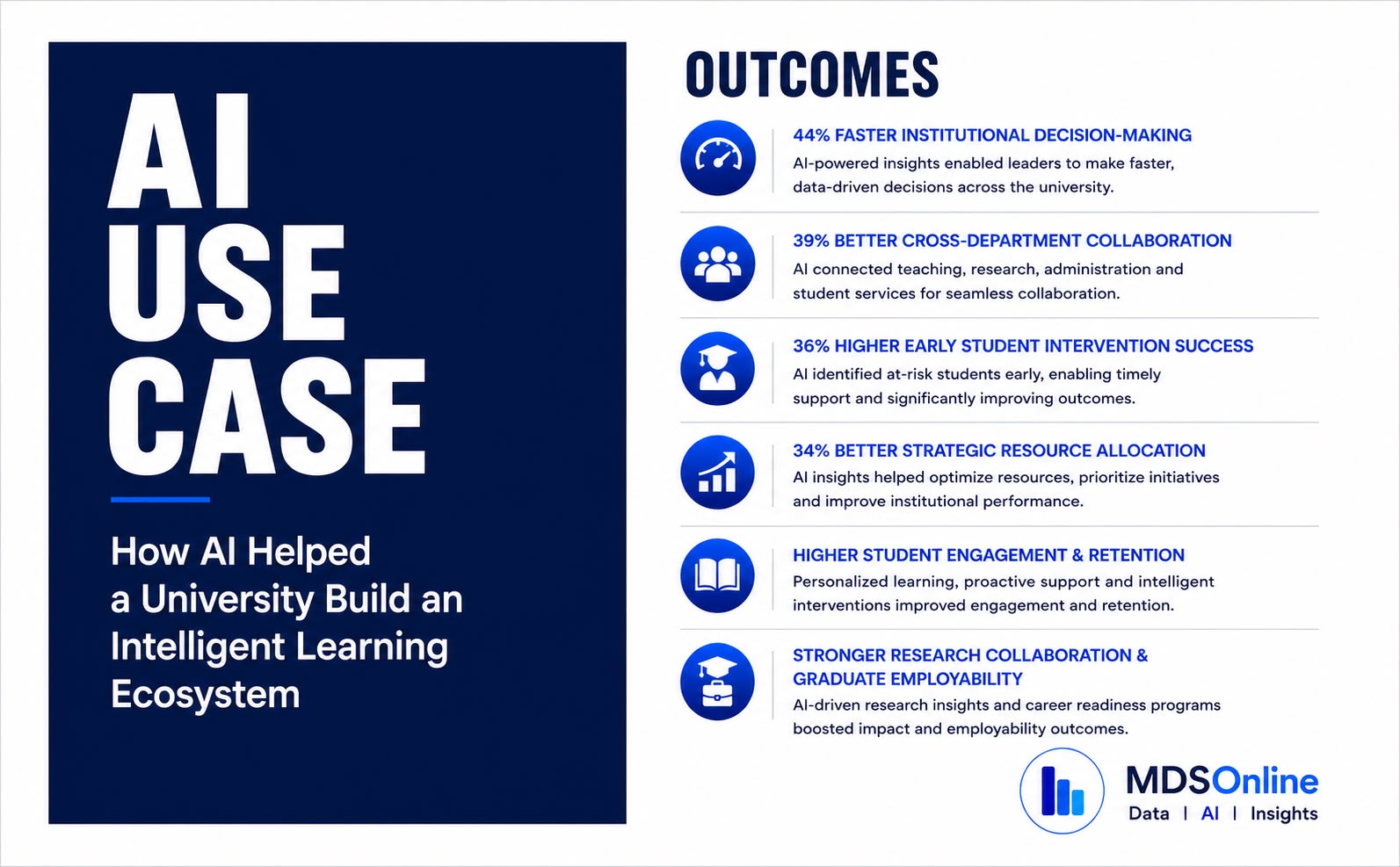
AI Learning Ecosystem
Artificial Intelligence is rapidly changing education.
Many universities are experimenting with AI.
Some have introduced AI chatbots for admissions.
Others use AI to assist with grading.
Some are deploying AI-powered tutoring tools.
These initiatives create value.
But they don’t transform the institution.
The universities that will lead the next decade won’t simply deploy more AI.
They’ll redesign how teaching, research, student services, and administration work together through an intelligent AI ecosystem.
This case study explores how a leading university transformed disconnected AI initiatives into an Enterprise AI Learning Intelligence Platform, creating a connected ecosystem that improved student outcomes, empowered educators, and modernized institutional decision-making.
Institution Background
A multidisciplinary university with over 38,000 students, 3,500 faculty members, and 2,000 administrative staff operated across multiple campuses.
The institution managed:
* Student Admissions
* Academic Programs
* Learning Management
* Student Services
* Research
* Career Development
* Finance
* Human Resources
* Alumni Relations
* Executive Leadership
Over three years, the university invested in several AI initiatives, including:
* Admissions chatbot
* AI-assisted grading
* Student helpdesk
* Research assistants
* Scheduling automation
* Library search tools
While each project improved individual functions, institutional performance remained fragmented.
Leadership recognized a larger opportunity.
The university didn’t need more AI tools.
It needed an AI-enabled operating model.
The Problem
The university faced six strategic challenges.
1. AI Projects Operated Independently
Different departments implemented AI for different purposes.
Admissions improved applicant support.
Faculty experimented with AI-assisted teaching.
Student Services deployed virtual assistants.
Research teams adopted AI tools independently.
None shared knowledge or insights across the institution.
2. Student Information Was Fragmented
Critical information existed across:
* Student Information System (SIS)
* Learning Management System (LMS)
* Library Platform
* Career Services
* Student Support
* Finance
* Research Systems
* Collaboration Platforms
No single system understood the complete student journey.
3. Student Success Was Measured Too Late
Academic difficulties, declining engagement, and wellbeing concerns often became visible only after performance had already deteriorated.
Interventions were reactive rather than proactive.
4. Faculty Spent Too Much Time on Administrative Work
Educators devoted significant time to:
* Course administration
* Student enquiries
* Manual reporting
* Scheduling
* Document preparation
Less time remained for teaching, mentoring, and research.
5. AI Literacy Was Inconsistent
Some faculties integrated AI into teaching.
Others avoided it entirely.
Graduates entered the workforce with vastly different levels of AI readiness.
6. Leadership Lacked Institutional Intelligence
Executives reviewed separate reports for:
* Admissions
* Academic performance
* Finance
* Student services
* Research
No unified view connected institutional performance across the university.
Why Traditional AI Adoption Failed
The university already operated modern digital platforms including:
* Canvas LMS
* Microsoft 365 Education
* Workday Education
* Student Information Systems
* Research Management Platforms
These systems digitized university operations.
They couldn’t answer:
* Which students are most at risk of disengagement?
* Which teaching approaches improve learning outcomes?
* Where should academic support be prioritized?
* Which research collaborations have the greatest potential?
* How can institutional decisions improve the overall student experience?
The university had digital systems.
It lacked institutional intelligence.
The AI Strategy
Leadership implemented an Enterprise AI Learning Intelligence Platform.
Rather than deploying AI independently across departments, the university created a connected intelligence layer spanning teaching, student services, research, administration, and executive leadership.
AI continuously learned from:
* Student engagement
* Academic performance
* Faculty interactions
* Research activity
* Administrative operations
* Career outcomes
* Student wellbeing
* Industry partnerships
Its objective was simple:
Create an AI-enabled university where every decision improves learning outcomes.
AI Solution Architecture
The platform consisted of six intelligent layers.
Layer 1: Enterprise Education Data Integration
AI connected every major institutional system.
Connected Systems
* Student Information System (SIS)
* Learning Management System (LMS)
* Microsoft Teams
* Library Systems
* Student Support Platform
* Research Management System
* HR System
* Finance Platform
* Career Services
* Alumni CRM
Tech Stack
* REST APIs
* GraphQL APIs
* Webhooks
* ETL Pipelines
* Apache Kafka
Purpose
Create a unified, real-time view of the university ecosystem.
Layer 2: Institutional Knowledge Repository
Academic resources, research publications, policies, course materials, student support resources, and institutional knowledge were centralized.
Tech Stack
* Amazon S3
* Snowflake
* PostgreSQL
* Vector Database:
* Pinecone
Purpose
Provide trusted institutional knowledge for students, faculty, researchers, and administrators.
Layer 3: AI Learning Intelligence Engine
AI continuously analyzed:
* Student engagement
* Attendance
* Assessment performance
* Course participation
* Research activity
* Student support interactions
* Faculty workload
* Career outcomes
* Institutional KPIs
The platform automatically:
* Identified at-risk students
* Recommended personalized learning pathways
* Suggested early interventions
* Matched students with support services
* Highlighted research collaboration opportunities
* Generated executive institutional insights
Example insight:
“First-year engineering students who miss three consecutive laboratory sessions have a significantly higher probability of failing the semester. Early academic mentoring within seven days could substantially improve retention.”
Tech Stack
* OpenAI GPT Models
* Claude
* Retrieval-Augmented Generation (RAG) using LangChain
* spaCy
Layer 4: Predictive Student Success Intelligence
Machine learning continuously predicted institutional outcomes.
AI generated:
* Student Success Score
* Learning Engagement Index
* Student Retention Risk
* Academic Progress Score
* Faculty Workload Index
* Research Collaboration Score
* Graduate Employability Forecast
Tech Stack
* Python
* Scikit-learn
* XGBoost
* PyTorch
* Neo4j for mapping relationships between students, courses, faculty, and research networks
Layer 5: Intelligent Academic Workflow Automation
AI transformed insights into coordinated action.
Examples:
* Student disengagement detected → Academic advisor notified automatically
* Assessment performance declines → Personalized learning resources recommended
* Faculty workload exceeds threshold → Teaching support allocated
* Research collaboration opportunity identified → Cross-faculty introductions initiated
* Career readiness gap identified → Industry mentoring programme triggered
Tech Stack
* n8n
* Zapier
* APIs
* Webhooks
Layer 6: Executive University Intelligence Dashboard
University leadership gained a real-time view of institutional performance.
Dashboard displayed:
* Student Success Index
* Student Retention Forecast
* Learning Engagement Trends
* Faculty Productivity
* Research Impact
* Graduate Employability Metrics
* AI Literacy Progress
* Institutional Performance Score
* Strategic Improvement Opportunities
Instead of monitoring disconnected reports, executives viewed the university as one intelligent learning ecosystem.
What AI Discovered
Within 120 days, AI uncovered four important insights.
Hidden Insight #1: Student Success Depends on Connected Support
Academic performance improved most when teaching, wellbeing, advising, and career services worked together.
Insight
Student success is an institutional outcome – not a departmental one.
Hidden Insight #2: Faculty Needed Time, Not More Technology
Reducing administrative workload allowed educators to focus more on teaching, mentoring, and research.
Insight
AI created its greatest value by amplifying educators.
Hidden Insight #3: AI Literacy Needed Institution-Wide Adoption
Embedding AI into every faculty produced more consistent graduate outcomes than isolated technology courses.
Insight
AI fluency became a core graduate capability.
Hidden Insight #4: Institutional Intelligence Outperformed Individual AI Tools
The greatest improvements came from connecting teaching, research, administration, and student services—not from deploying standalone AI applications.
Insight
An AI ecosystem created more value than isolated AI use cases.
Results After 120 Days
Leadership Outcomes
* 44% faster institutional decision-making
* 39% improvement in cross-department collaboration
* 36% increase in early student intervention success
* 34% better strategic resource allocation
Operational Outcomes
* Faster student support response times
* Reduced administrative workload for faculty
* Improved collaboration across academic departments
* Earlier identification of at-risk students
* More efficient institutional operations
Educational Outcomes
* Higher student engagement
* Improved student retention
* Better learning outcomes
* Increased graduate employability
* Stronger research collaboration
* Greater institutional competitiveness
The Bigger Lesson
AI won’t transform education through isolated applications.
It will transform education by creating intelligent institutions.
Universities that connect teaching, research, administration, student support, and industry collaboration into one AI-enabled ecosystem won’t simply become more efficient.
They’ll become better at helping students succeed.
Final Takeaway
Ask yourself:
* Is your institution implementing isolated AI use cases—or building an AI-powered operating model?
* Are your AI initiatives improving individual departments—or strengthening the entire learning ecosystem?
* If every university adopted the same AI tools tomorrow, what would truly differentiate yours?
The future of education won’t belong to the institutions with the most AI.
It will belong to those that use AI to create smarter learning, better decisions, and stronger outcomes for every student.



Exploring how AI can transform beyond isolated pilots? Let’s connect.
Visit MDSOnline.co.in