AI Runtime Governance
Most organizations spend months evaluating AI models.
Should they use GPT?
Claude?
Gemini?
But once an AI agent goes live, the challenge changes completely.
The question is no longer:
“How intelligent is the model?”
It’s:
“How do we safely operate thousands of AI decisions every day?”
Unlike traditional software, AI agents don’t simply respond to requests.
They execute workflows.
Call APIs.
Access enterprise systems.
Coordinate with other agents.
Make decisions.
Without proper runtime governance, a single malfunctioning AI agent can rapidly consume resources, create operational disruptions, and generate unexpected costs.
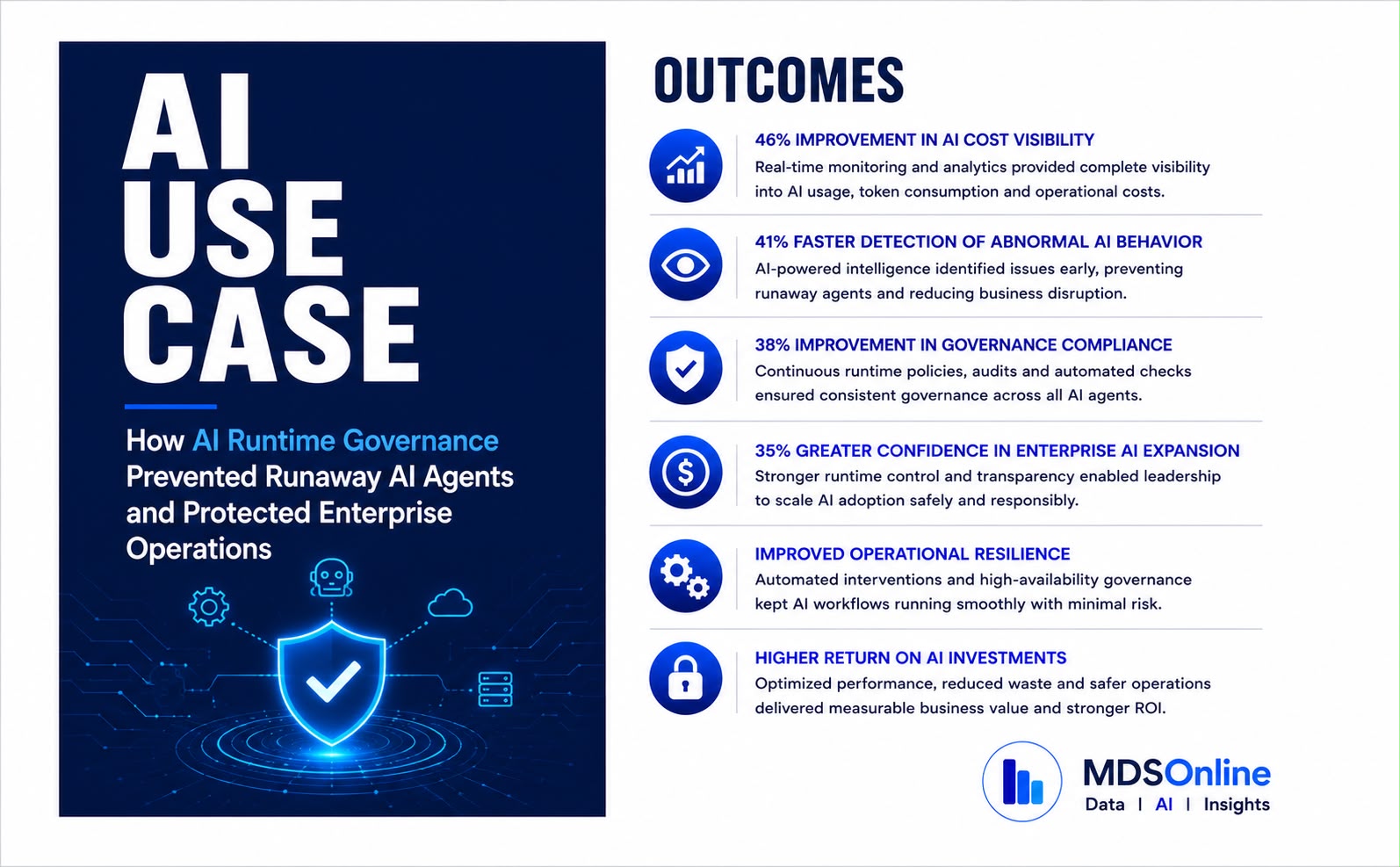
This case study explores how a global financial services company implemented an Enterprise AI Runtime Governance Platform that enabled AI agents to operate safely, efficiently, and responsibly at enterprise scale.
Company Background
A multinational financial services organization with over 15,000 employees operated across North America, Europe, and Asia-Pacific.
Its AI ecosystem supported:
* Customer Service
* Claims Processing
* Compliance
* Risk Management
* Fraud Detection
* Finance
* Human Resources
* IT Operations
* Sales
* Executive Reporting
More than 1,200 AI agents had been deployed across business functions.
These agents:
* Retrieved enterprise knowledge
* Generated reports
* Automated workflows
* Approved low-risk requests
* Coordinated customer communications
* Triggered downstream systems
* Interacted with external APIs
While productivity improved significantly, leadership identified a new operational challenge.
Managing AI after deployment.
The Problem
The organization encountered six critical operational risks.
1. AI Agents Generated Unpredictable Costs
Individual AI agents occasionally entered repetitive execution cycles, triggering excessive model requests and increasing infrastructure costs before operational teams became aware.
2. No Visibility Into AI Runtime Activity
Leadership could measure application performance but lacked real-time insight into:
* AI agent behavior
* Model consumption
* Token usage
* Workflow execution
* API activity
* Operational costs
3. Autonomous Workflows Increased Operational Risk
AI agents increasingly interacted with multiple enterprise systems.
A single workflow error could cascade across finance, customer service, and operational platforms.
4. Governance Occurred Before Deployment—Not During Execution
Security reviews and testing occurred during development.
Once AI agents entered production, continuous runtime oversight was limited.
5. AI Budgets Were Difficult to Control
Business units adopted AI rapidly.
Executives struggled to understand:
* Which departments consumed the most AI resources
* Which agents generated measurable business value
* Where unnecessary costs originated
6. Platform Availability Became Business Critical
As AI agents became integrated into daily operations, governance systems themselves required high availability.
Organizations needed AI to continue operating safely, even if monitoring infrastructure experienced interruptions.
Why Traditional Monitoring Failed
The company already monitored:
* Infrastructure
* Networks
* Applications
* Databases
* APIs
* Cloud platforms
These systems measured technical performance.
They couldn’t answer questions such as:
* Why is this AI agent calling the same API hundreds of times?
* Which AI workflow exceeded its approved budget?
* Which autonomous decision created unexpected downstream activity?
* Which business process is generating abnormal AI costs?
Traditional observability wasn’t designed for autonomous AI.
The AI Strategy
Leadership implemented an Enterprise AI Runtime Governance Platform.
Rather than governing AI only during development, governance became a continuous operational capability.
The platform continuously monitored:
* AI agents
* Model interactions
* Tool usage
* API execution
* Workflow behavior
* Resource consumption
* Operational costs
* Policy compliance
Its objective was simple:
Enable AI agents to operate autonomously while remaining observable, accountable, secure, and cost-efficient.
AI Solution Architecture
The solution consisted of six intelligent layers.
Layer 1: Enterprise Runtime Integration
The platform continuously monitored AI activity across enterprise systems.
Connected Systems
* OpenAI GPT Models
* Claude
* Gemini
* Salesforce
* ServiceNow
* SAP
* Microsoft Teams
* Slack
* Kubernetes
* Cloud Infrastructure
* Internal APIs
* Workflow Automation Platforms
Tech Stack
* REST APIs
* GraphQL APIs
* Event Streams
* Webhooks
* Apache Kafka
Purpose
Capture every AI interaction in real time.
Layer 2: AI Operational Repository
Runtime activity was continuously stored for analysis.
Captured information included:
* Prompt history
* Agent execution logs
* API requests
* Token consumption
* Cost metrics
* Workflow traces
* Governance policies
* Audit records
Tech Stack
* Amazon S3
* Snowflake
* PostgreSQL
* Vector Database:
* Pinecone
Purpose
Create a complete operational history for every AI decision.
Layer 3: AI Runtime Intelligence Engine
AI continuously evaluated:
* Agent execution patterns
* Tool invocation frequency
* Model utilization
* Token consumption
* Workflow completion
* Decision confidence
* Cost trends
* Policy violations
The platform automatically:
* Detected execution loops
* Identified abnormal agent behavior
* Flagged excessive API usage
* Recommended workflow optimization
* Prioritized operational alerts
* Suggested governance improvements
Example insight:
“One procurement AI agent executed the same approval workflow 462 times within 18 minutes because of a failed downstream acknowledgement. Automatic intervention prevented unnecessary model requests and contained operational costs before wider business impact occurred.”
Tech Stack
* OpenAI GPT Models
* Claude
* Retrieval-Augmented Generation (RAG) using LangChain
* spaCy
Layer 4: Predictive Runtime Intelligence
Machine learning continuously predicted operational risks before they escalated.
AI generated:
* Runtime Health Score
* Agent Stability Index
* Cost Risk Score
* Execution Loop Probability
* Governance Compliance Score
* AI Budget Forecast
* Operational Resilience Index
Tech Stack
* Python
* Scikit-learn
* XGBoost
* PyTorch
* Neo4j for mapping relationships between AI agents, APIs, workflows, enterprise systems, and governance policies
Layer 5: Intelligent Runtime Automation
When predefined governance thresholds were exceeded, AI automatically initiated corrective actions.
Examples:
* Agent enters repetitive execution loop → Workflow paused automatically
* AI budget threshold reached → Additional model requests temporarily restricted
* Abnormal API activity detected → Runtime alert generated
* Policy violation identified → Governance team notified
* Monitoring platform unavailable → AI agents continue operating under cached governance policies until services are restored
Tech Stack
* n8n
* Zapier
* APIs
* Webhooks
Layer 6: Executive AI Operations Dashboard
Leadership gained continuous visibility into enterprise AI operations.
Dashboard displayed:
* AI Runtime Health
* Active AI Agents
* Cost by Business Unit
* Token Consumption Trends
* Execution Loop Alerts
* Runtime Policy Compliance
* API Utilization
* Governance Incidents
* AI Operational Availability
* Enterprise AI ROI
Instead of asking, “How many AI agents are deployed?” executives asked, “How safely, efficiently, and responsibly are our AI agents operating?”
What AI Discovered
Within 120 days, AI uncovered four important insights.
Hidden Insight #1: Small Runtime Errors Became Large Financial Risks
Most cost overruns originated from a small number of autonomous execution anomalies rather than widespread usage.
Insight
Continuous runtime monitoring prevented disproportionate operational costs.
Hidden Insight #2: Visibility Improved Trust
Business leaders were more willing to expand AI adoption when operational behavior, costs, and governance were transparent.
Insight
Observability accelerated enterprise confidence.
Hidden Insight #3: Runtime Governance Reduced Operational Risk
Real-time intervention prevented isolated AI issues from affecting broader business processes.
Insight
Governance shifted from reactive investigation to proactive protection.
Hidden Insight #4: Operating AI Became a Core Enterprise Capability
Building AI was only the beginning.
Long-term business value depended on operating AI safely at scale.
Insight
Runtime governance became as essential as cybersecurity.
Results After 120 Days
Leadership Outcomes
* 46% improvement in AI cost visibility
* 41% faster detection of abnormal AI behavior
* 38% improvement in governance compliance
* 35% greater confidence in enterprise AI expansion
Operational Outcomes
* Reduced unnecessary model requests
* Earlier detection of runtime anomalies
* Improved AI budget management
* Faster operational incident response
* Increased resilience of AI-powered workflows
Business Outcomes
* Better control of AI operating costs
* Safer deployment of autonomous AI agents
* Improved regulatory readiness
* Stronger enterprise governance
* Higher return on AI investments
* Increased organizational trust in AI
The Bigger Lesson
The hardest part of enterprise AI isn’t building intelligent agents.
It’s operating them responsibly every minute after deployment.
As AI becomes embedded into critical business processes, runtime governance will evolve from an operational best practice into essential enterprise infrastructure—just as cybersecurity did for digital systems.
Final Takeaway
Ask yourself:
* Do you know what every AI agent in your organization is doing after it goes live?
* Can you detect abnormal AI behavior before it impacts operations or costs?
* Are you governing AI during development—or continuously throughout its operational lifecycle?
The organizations that succeed with enterprise AI won’t simply build smarter agents.
They’ll build the operational discipline to run them safely, transparently, and at scale.


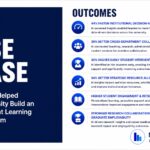
If you’re building AI-powered products, I’d love to show you a practical way to add cost controls and governance without changing your existing stack.
Let’s Talk