 Conflict has a bad reputation in business.
Many leaders instinctively try to reduce it.
They want alignment.
Speed.
Smooth execution.
Minimal friction.
That sounds logical.
But eliminating conflict entirely creates a hidden risk.
When disagreement disappears, so does healthy challenge.
And without challenge, blind spots grow.
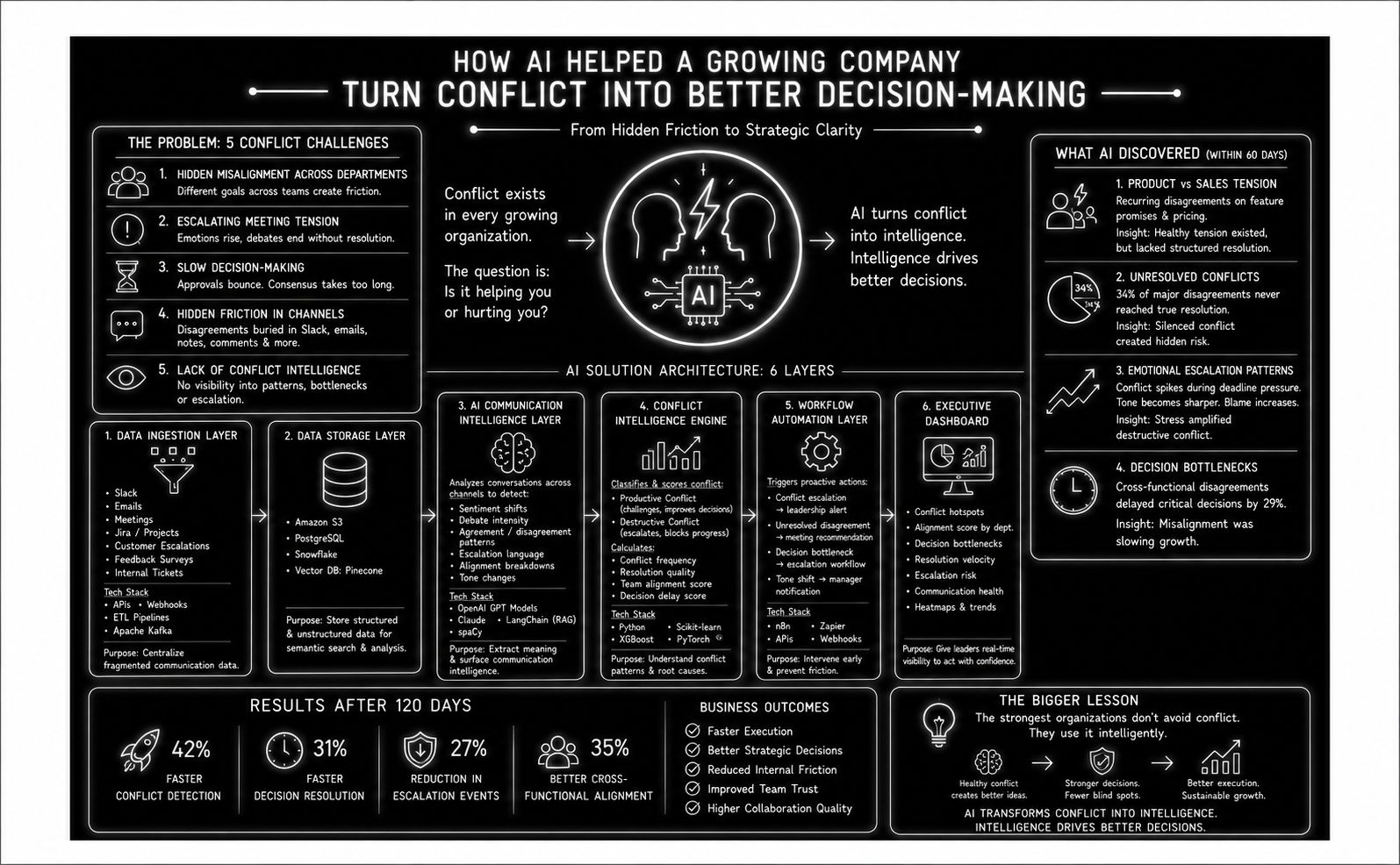
This case study shows how a growing company used AI to distinguish productive conflict from destructive conflict—and turn internal friction into better strategic decisions.
Company Background
A mid-sized B2B technology company with 280+ employees was scaling rapidly.
The company operated across multiple functions:
– Sales
– Product
– Engineering
– Operations
– Customer Success
– Leadership
Revenue was growing.
Customer demand was increasing.
But internal alignment was becoming harder.
Cross-functional meetings became longer.
Decision cycles slowed.
Leadership noticed increasing friction between teams.
The Problem
The company faced five major conflict-related challenges.
1. Hidden Misalignment Across Departments
Each team optimized for different outcomes.
Sales prioritized revenue growth.
Product focused on roadmap priorities.
Operations focused on efficiency.
Customer Success focused on retention.
Each perspective made sense individually.
Together, they created friction.
2. Escalating Meeting Tension
Important debates often happened during meetings.
Some discussions became emotional.
Others ended too quickly without real resolution.
Leadership struggled to determine:
– Which conflicts were healthy
– Which conflicts were harmful
– Which disagreements were unresolved
3. Slow Decision-Making
Important decisions stalled because alignment took too long.
Approvals bounced across departments.
Meetings increased.
Consensus became harder.
4. Hidden Friction in Communication Channels
Important disagreements often lived inside:
– Slack threads
– Emails
– Meeting notes
– Project comments
– Customer escalation discussions
This made conflict hard to track.
5. Lack of Conflict Intelligence
Leadership lacked visibility into:
– Recurring disagreement themes
– Decision bottlenecks
– Emotional escalation patterns
– Communication breakdowns
They could see symptoms.
They couldn’t see root causes.
Why Traditional Tools Failed
The company already used modern collaboration systems.
They relied on:
– Slack
– Zoom
– Jira
– Notion
– Salesforce
The problem wasn’t lack of communication tools.
The problem was this:
Communication data existed.
Conflict intelligence did not.
Leaders could see messages.
They couldn’t easily understand:
– Why teams disagreed
– Where tension repeated
– Which conflicts improved decisions
– Which conflicts harmed execution
That’s where AI came in.
The AI Strategy
The objective was clear:
Build an AI-powered Conflict Intelligence System.
The system needed to answer:
– Where is friction recurring?
– Which conflicts are productive?
– Which conflicts are escalating emotionally?
– Which decisions are blocked by misalignment?
– What requires leadership intervention?
AI became a strategic intelligence layer across team communication.
AI Solution Architecture
The solution was built across six layers.
Layer 1: Data Ingestion Layer
AI collected communication signals from every major collaboration system.
Data sources included:
– Slack messages
– Emails
– Meeting transcripts
– Project discussions
– Customer escalation threads
– Internal tickets
– Feedback surveys
Tech Stack
– APIs
– Webhooks
– ETL pipelines
– Event streaming via Apache Kafka
Purpose:
Centralize fragmented communication data.
Layer 2: Data Storage Layer
All structured and unstructured data flowed into centralized storage.
Tech Stack
– Amazon S3
– PostgreSQL
– Snowflake
– Vector DB: Pinecone
Purpose:
Enable semantic search and analytical processing.
Layer 3: AI Communication Intelligence Layer
AI analyzed conversations across channels.
It detected:
– Sentiment shifts
– Debate intensity
– Agreement/disagreement patterns
– Escalation language
– Communication tone changes
– Alignment breakdowns
Example insight:
> “Product and Sales show recurring disagreement on pricing strategy.”
Tech Stack
– OpenAI GPT Models
– Claude
– RAG via LangChain
– spaCy
Layer 4: Conflict Intelligence Engine
This became the reasoning engine.
AI classified conflict into:
Productive Conflict
– Challenges assumptions
– Surfaces risks
– Improves decisions
Destructive Conflict
– Emotional escalation
– Personal attacks
– Repeated unresolved tension
AI also calculated:
– Conflict frequency
– Resolution quality
– Team alignment score
– Decision delay score
Tech Stack
– Python
– Scikit-learn
– XGBoost
– PyTorch
Layer 5: Workflow Automation Layer
AI triggered proactive interventions.
Examples:
– Conflict escalation → leadership alert
– Unresolved disagreement → meeting recommendation
– Decision bottleneck → escalation workflow
– Communication tone shift → manager notification
Tech Stack
– n8n
– Zapier
– APIs
– Webhooks
Layer 6: Executive Dashboard
Leadership received real-time conflict intelligence.
Dashboard displayed:
– Conflict hotspots
– Alignment score by department
– Decision bottlenecks
– Resolution velocity
– Escalation risk heatmaps
This gave leaders visibility they never had before.
What AI Discovered
Within 60 days, AI surfaced critical insights.
Hidden Issue #1: Product vs Sales Tension
Recurring disagreements centered around feature promises.
Sales pushed aggressive commitments.
Product pushed feasibility constraints.
Insight
Healthy tension existed—but lacked structured resolution.
Hidden Issue #2: Unresolved Conflicts
34% of major disagreements never reached true resolution.
They simply disappeared from conversation.
Insight
Silenced conflict created hidden risk.
Hidden Issue #3: Emotional Escalation Patterns
AI detected conflict spikes during deadline pressure.
Communication tone became sharper.
Blame increased.
Insight
Stress amplified destructive conflict.
Hidden Issue #4: Decision Bottlenecks
Cross-functional disagreements delayed critical decisions by 29%.
Insight
Misalignment was slowing growth.
Results After 120 Days
The AI implementation delivered measurable improvements.
Operational Outcomes
– 42% faster conflict detection
– 31% faster decision resolution
– 27% reduction in escalation events
– 35% better cross-functional alignment
Business Outcomes
– Faster execution
– Better strategic decisions
– Reduced internal friction
– Improved team trust
– Higher collaboration quality
The Bigger Lesson
The strongest organizations don’t avoid conflict.
They use conflict intelligently.
Healthy conflict creates:
– Better ideas
– Stronger decisions
– Fewer blind spots
– Better execution
That’s where AI creates real leverage.
Not by replacing human judgment.
By helping leaders understand conflict with greater clarity.
Final Takeaway
Ask yourself:
– Which disagreements in your business remain hidden?
– Where is tension improving decisions?
– Where is tension quietly damaging trust?
Growth rarely stalls because of disagreement alone.
It often stalls when important conflict becomes invisible…
or personal instead of productive.
AI changes that.
It transforms conflict into intelligence.
And intelligence drives better decisions.