AI Workflow Automation
High-performing organizations often celebrate output.
More meetings.
More execution.
More urgency.
More responsiveness.
At first, this creates momentum.
But over time, something subtle happens.
Leaders become overwhelmed.
Their calendars fill up.
Operational noise increases.
Decision fatigue rises.
Strategic thinking declines.
The business still looks busy.
But busyness is not the same as effectiveness.
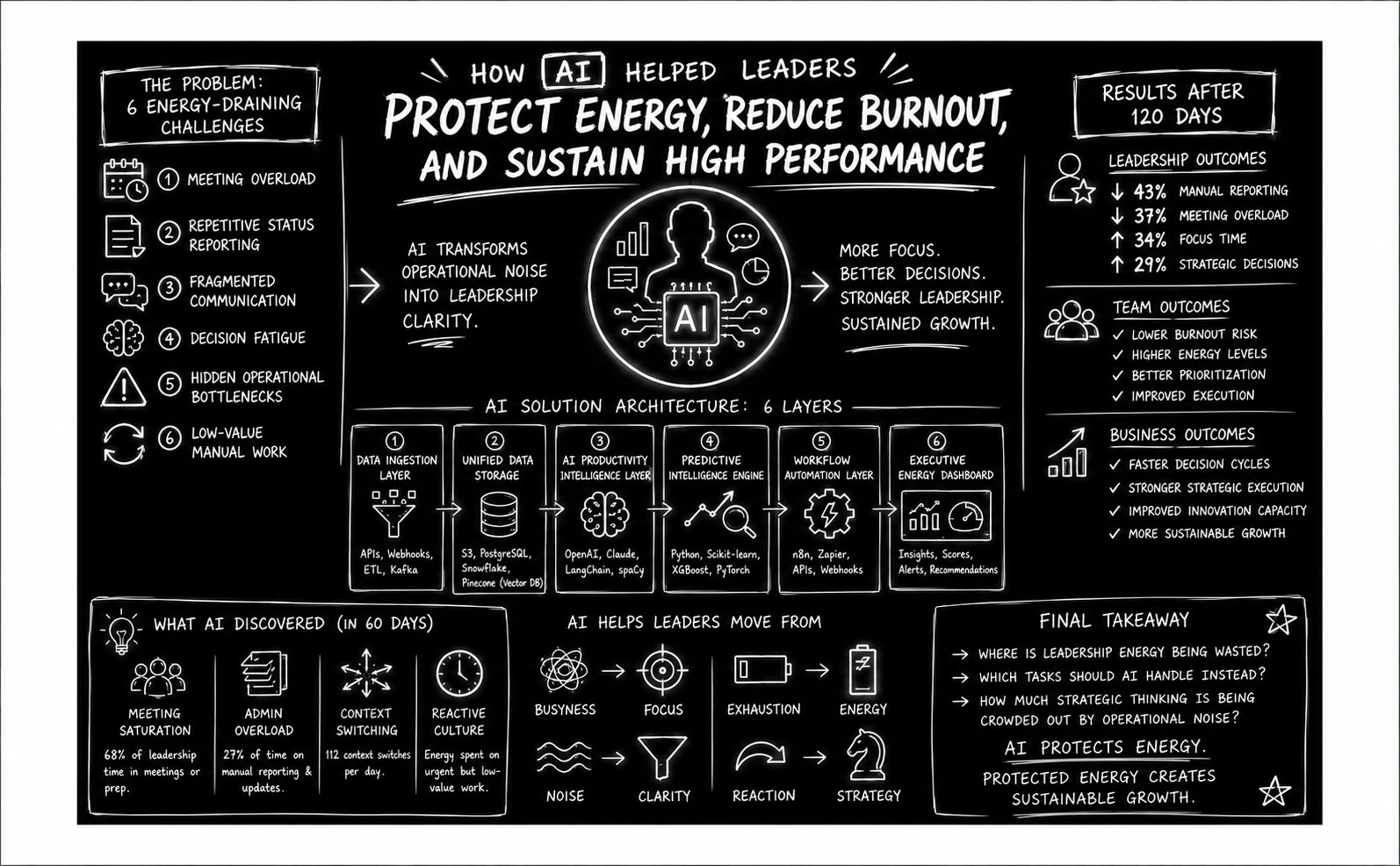
This case study shows how a growing company used AI to reduce operational overload, protect leadership energy, and improve sustainable performance.
Company Background
A fast-growing B2B SaaS company with 320+ employees was scaling aggressively.
The organization operated across:
– Sales
– Product
– Engineering
– Operations
– Customer Success
– Executive Leadership
Revenue growth remained strong.
But leadership noticed growing internal strain.
Common symptoms included:
– Executive burnout
– Meeting overload
– Slower decision-making
– Reduced creative thinking
– Rising team fatigue
Despite strong performance, something felt unsustainable.
The Problem
The company faced six major energy-draining challenges.
1. Meeting Overload
Leaders spent most of their week in meetings.
Average leadership meeting time:
34 hours/week
This left limited time for deep thinking.
2. Repetitive Status Reporting
Managers manually prepared updates for:
– Weekly reviews
– Board meetings
– Team standups
– Project reviews
Significant time was spent summarizing existing information.
3. Fragmented Communication
Critical context lived across:
– Slack
– Emails
– Zoom calls
– Project tools
– CRM systems
– Documentation platforms
Finding signal inside noise became exhausting.
4. Decision Fatigue
Leaders processed hundreds of inputs daily.
Questions constantly demanded attention:
– What matters most?
– What needs escalation?
– What can wait?
– Where is risk growing?
This created cognitive overload.
5. Hidden Operational Bottlenecks
Critical blockers often remained invisible until deadlines slipped.
Leaders spent too much energy reacting.
6. Low-Value Manual Work
Senior leaders handled tasks AI could automate:
– Summaries
– Reporting
– Prioritization
– Follow-up reminders
– Status consolidation
High-value people were doing low-value work.
Why Traditional Productivity Systems Failed
The company already used modern tools.
They relied on:
– Asana
– Notion
– Salesforce
– Google Workspace
– Slack
The problem wasn’t lack of software.
It was this:
Tools increased activity.
They didn’t reduce energy drain.
Traditional systems tracked work.
They didn’t protect attention.
That’s where AI came in.
The AI Strategy
The objective was clear:
Build an AI-powered Leadership Energy Optimization System.
The system needed to continuously answer:
– What deserves leadership attention now?
– What can be automated?
– Where is energy being wasted?
– Which workflows create burnout?
AI became an operational intelligence layer focused on preserving human energy.
AI Solution Architecture
The solution was built across six layers.
Layer 1: Data Ingestion Layer
AI collected signals from all work systems.
Data sources included:
– Calendar events
– Emails
– Slack conversations
– Meeting transcripts
– Project management tools
– CRM records
– Operational dashboards
Tech Stack
– APIs
– Webhooks
– ETL pipelines
– Event streaming via Apache Kafka
Purpose:
Centralize operational signals.
Layer 2: Unified Data Storage
All structured and unstructured data flowed into centralized infrastructure.
Tech Stack
– Amazon S3
– PostgreSQL
– Snowflake
– Vector DB: Pinecone
Purpose:
Enable deep analysis and semantic retrieval.
Layer 3: AI Productivity Intelligence Layer
AI analyzed leadership workflows.
It detected:
– Meeting overload
– Context switching
– Task fragmentation
– Repetitive work
– Decision bottlenecks
– Burnout indicators
Example insight:
> “VP Operations spends 41% of time on repetitive reporting.”
Tech Stack
– OpenAI GPT Models
– Claude
– RAG via LangChain
– spaCy
Layer 4: Predictive Intelligence Engine
Machine learning predicted energy drain and burnout risks.
AI scored:
– Burnout probability
– Meeting overload score
– Focus fragmentation score
– Decision fatigue score
– Team bottleneck probability
Tech Stack
– Python
– Scikit-learn
– XGBoost
– PyTorch
Layer 5: Workflow Automation Layer
AI automated low-value repetitive tasks.
Examples:
– Meeting summaries → auto-generated
– Weekly reports → automated
– Priority updates → AI-ranked
– Follow-up reminders → automated
– Bottleneck alerts → proactive escalation
Tech Stack
– n8n
– Zapier
– APIs
– Webhooks
Layer 6: Executive Energy Dashboard
Leadership received AI-powered workload intelligence.
Dashboard displayed:
– Burnout risk scores
– Meeting overload metrics
– Focus fragmentation index
– Low-value work percentage
– Strategic time allocation
– Recommended workflow changes
This gave leaders visibility into energy drain.
What AI Discovered
Within 60 days, AI surfaced major hidden problems.
Hidden Drain #1: Meeting Saturation
Senior leaders spent 68% of working hours in meetings or preparing for meetings.
Insight
Calendar overload was killing strategic thinking.
Hidden Drain #2: Admin Overload
Leadership teams spent 27% of time on manual reporting and updates.
Insight
Expensive talent was doing automatable work.
Hidden Drain #3: Context Switching
Frequent switching between tools destroyed focus.
Average leadership context switches:
112 per day
Insight
Fragmented attention reduced decision quality.
Hidden Drain #4: Reactive Work Culture
Most leadership energy went toward urgent but low-value issues.
Insight
Urgency was crowding out strategy.
Results After 120 Days
The AI implementation delivered measurable improvements.
Leadership Outcomes
– 43% reduction in manual reporting
– 37% reduction in meeting overload
– 34% improvement in focus time
– 29% faster strategic decision-making
Team Outcomes
– Lower burnout risk
– Higher energy levels
– Better prioritization
– Improved execution quality
Business Outcomes
– Faster decision cycles
– Stronger strategic execution
– Improved innovation capacity
– More sustainable growth
The Bigger Lesson
The highest-performing leaders are not the ones doing everything.
They are the ones protecting their energy intelligently.
That’s where AI creates real leverage.
Not by replacing human effort.
By ensuring human effort is spent where it matters most.
AI helps leaders move from:
Busyness → Focus
Exhaustion → Energy
Noise → Clarity
Reaction → Strategy
That’s where sustainable performance begins.
Final Takeaway
Ask yourself:
– Where is leadership energy being wasted?
– Which tasks should AI handle instead?
– How much strategic thinking is being crowded out by operational noise?
Burnout rarely comes from hard work alone.
It often comes from working hard on low-value tasks.
AI changes that.
It protects energy.
And protected energy creates sustainable growth.




See the same post on the LinkedIn platform
https://www.linkedin.com/pulse/ai-use-case-how-helped-leaders-protect-energy-reduce-burnout-mirania-5lboc/