AI operational visibility
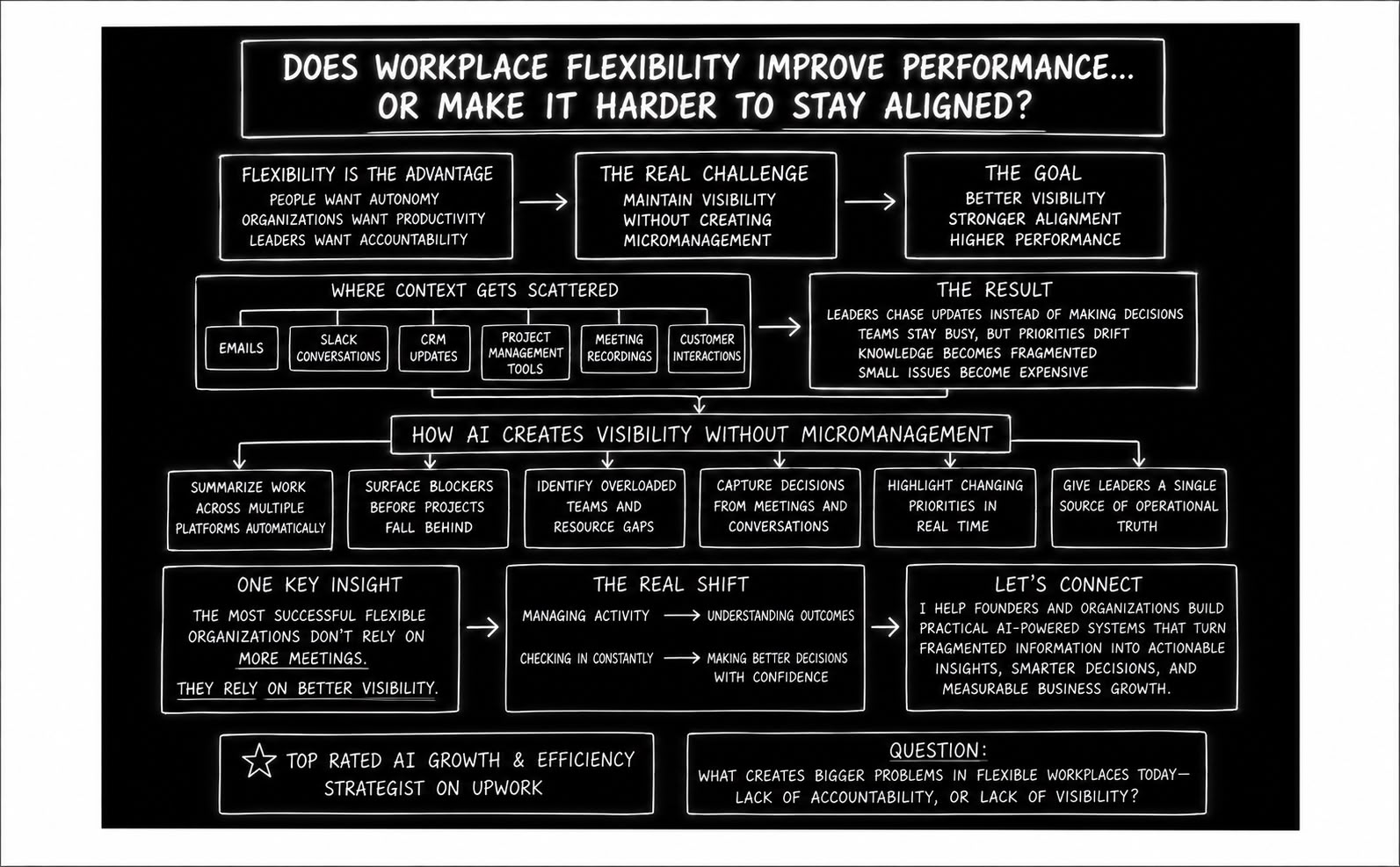
Flexible work has fundamentally changed how businesses operate.
Employees want greater autonomy.
Leaders want stronger accountability.
Organizations want higher productivity.
At first glance, these goals seem compatible.
But as businesses scale across remote, hybrid, and distributed teams, maintaining alignment becomes increasingly difficult.
Leaders often find themselves asking questions they never had to ask before.
* Is this project still on track?
* What’s blocking progress?
* Who needs help?
* Which priorities changed this week?
* Are teams aligned?
The problem isn’t that employees aren’t working.
The problem is that leaders lose visibility into how work is progressing.
This case study explores how one technology company used AI to improve operational visibility across a flexible workforce while preserving employee autonomy.
Company Background
A rapidly growing SaaS company with over 450 employees had adopted a hybrid work model.
Employees worked across:
* North America
* Europe
* Asia-Pacific
Departments included:
* Engineering
* Product
* Sales
* Marketing
* Customer Success
* Operations
The organization encouraged flexible schedules.
Employees were trusted to manage their own time.
Productivity remained high.
Yet leadership noticed execution becoming increasingly difficult.
The Problem
The organization faced six operational challenges.
⸻
1. Fragmented Communication
Important updates existed across numerous systems:
* Slack
* CRM
* Jira
* Asana
* Meeting recordings
* Internal documentation
Finding the complete picture required significant manual effort.
2. Leadership Spent Time Collecting Updates
Managers spent much of each week asking:
“Where are we?”
“What’s delayed?”
“What changed?”
Instead of making decisions, they were collecting information.
3. Hidden Project Risks
Projects appeared healthy until deadlines slipped.
Blockers often remained invisible for days.
Dependencies failed silently.
4. Knowledge Loss
Critical decisions made during meetings were rarely documented consistently.
Employees repeatedly searched for:
* Previous decisions
* Project rationale
* Customer commitments
* Ownership details
Knowledge became fragmented.
5. Resource Imbalance
Some teams became overloaded.
Others had available capacity.
Leadership couldn’t identify workload imbalance early enough.
6. Meeting Fatigue
Weekly alignment meetings kept increasing.
Ironically, more meetings created less clarity.
Why Traditional Collaboration Tools Failed
The company already used modern collaboration platforms.
Its technology stack included:
* Slack
* Microsoft Teams
* Asana
* Jira
* Salesforce
* Google Workspace
These platforms generated enormous amounts of information.
But they couldn’t answer leadership’s biggest questions:
* Where is execution slowing?
* What deserves attention today?
* Which teams need support?
* What changed since yesterday?
Data existed.
Operational visibility did not.
The AI Strategy
The company implemented an AI-powered Operational Visibility Platform.
Instead of tracking employees, AI focused on tracking work.
The objective was simple:
Give leaders complete visibility while allowing employees complete autonomy.
The AI continuously answered:
* What changed?
* What’s blocked?
* What’s at risk?
* What requires leadership attention?
AI Solution Architecture
The solution consisted of six intelligent layers.
Layer 1: Enterprise Data Integration
AI continuously collected operational signals.
Connected Systems
* Slack
* Microsoft Teams
* Jira
* Asana
* Salesforce
* Google Workspace
* Zoom
* Notion
* GitHub
* Customer Support Platform
Tech Stack
* REST APIs
* GraphQL APIs
* Webhooks
* ETL Pipelines
* Apache Kafka
Purpose:
Create one operational data stream.
Layer 2: Central Data Platform
All structured and unstructured information flowed into a unified environment.
Tech Stack
* Amazon S3
* Snowflake
* PostgreSQL
* Vector Database:
* Pinecone
Purpose:
Provide a single source of organizational knowledge.
Layer 3: AI Operational Intelligence
AI continuously analyzed:
* Conversations
* Tasks
* Meetings
* Customer interactions
* CRM activity
* Project updates
The platform automatically detected:
* Project delays
* Priority shifts
* Missing follow-ups
* Communication gaps
* Resource conflicts
* Emerging risks
Tech Stack
* OpenAI GPT Models
* Claude
* Retrieval-Augmented Generation using LangChain
* spaCy
Layer 4: Predictive Intelligence Engine
Machine learning identified future operational risks.
AI predicted:
* Delivery delays
* Team overload
* Resource shortages
* Customer escalation
* Project risk
* Priority conflicts
Tech Stack
* Python
* Scikit-learn
* XGBoost
* PyTorch
Layer 5: Intelligent Workflow Automation
Rather than waiting for managers to notice problems, AI acted proactively.
Examples:
* Project blocked for 48 hours → Manager notified
* Priority changes → Team updated automatically
* Missing meeting decisions → AI-generated action list
* Overloaded employee → Resource recommendation
* Customer issue escalation → Leadership alert
Tech Stack
* n8n
* Zapier
* APIs
* Webhooks
Layer 6: Executive Visibility Dashboard
Leadership received a real-time operational view.
Dashboard included:
* Project health
* Team workload
* Decision bottlenecks
* Blocker heatmaps
* Resource utilization
* Customer risk
* Alignment score
* Priority changes
Leaders no longer chased updates.
They managed outcomes.
What AI Discovered
Within 45 days, AI uncovered several hidden issues.
Hidden Issue #1: Meeting Overload
Managers spent nearly 40% of their week gathering status updates.
Insight
Meetings existed to compensate for poor visibility.
Hidden Issue #2: Invisible Project Delays
Nearly 22% of project delays originated from unresolved cross-team dependencies.
Insight
The biggest delays weren’t execution problems.
They were communication problems.
Hidden Issue #3: Uneven Workload
AI identified three departments operating at over 125% capacity, while two others had unused bandwidth.
Insight
Work distribution—not staffing—was the issue.
Hidden Issue #4: Lost Decisions
Over one-third of important meeting decisions were never documented.
Teams repeatedly revisited previously resolved topics.
Insight
Knowledge fragmentation slowed execution.
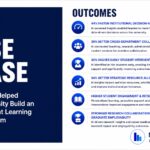
Results After 120 Days
The AI implementation produced measurable improvements.
Leadership Outcomes
* 48% less time spent collecting updates
* 36% faster decision-making
* 41% better visibility across departments
* 33% fewer executive meetings
Team Outcomes
* 29% fewer missed deadlines
* 35% faster blocker resolution
* 31% improvement in cross-functional alignment
* Higher employee autonomy
Business Outcomes
* Faster execution
* Better customer experience
* Lower operational friction
* Higher productivity without increased oversight
The Bigger Lesson
Flexible work doesn’t reduce performance.
Poor visibility does.
The best hybrid organizations don’t manage people more closely.
They understand work more clearly.
That’s where AI creates real leverage.
Not by monitoring employees.
By giving leaders the intelligence they need to remove friction, improve alignment, and make better decisions.
Final Takeaway
Ask yourself:
* How much time do your leaders spend chasing updates instead of making decisions?
* Where is important context getting lost?
* Which blockers stay invisible until they’re expensive?
Flexible work succeeds when visibility replaces micromanagement.
AI makes that possible.
It transforms fragmented activity into operational intelligence.
And operational intelligence enables high-performing, autonomous teams.


⭐ ⭐⭐⭐⭐
Top Rated AI Growth & Efficiency Strategist on Upwork
upwork.com/fl/navinmirania
AI Transformation Consultant | AI Automation & Workflow Optimization | 25+ Years in Business & Technology | Helping Businesses Scale with Practical AI
DM me if you need help with AI Intelligence and business Analytics.