AI Meeting Intelligence
Meetings are essential to business.
They align teams.
Resolve issues.
Drive collaboration.
But as organizations grow, meetings often become less productive.
People join with different information.
Conversations repeat previous discussions.
Decisions remain ambiguous.
Action items are forgotten.
Follow-up meetings get scheduled.
The meeting itself isn’t the biggest cost.
The real cost is the lost momentum between meetings.
This case study explores how a growing technology company used AI to transform meetings from time-consuming conversations into a strategic decision-making system.
Company Background
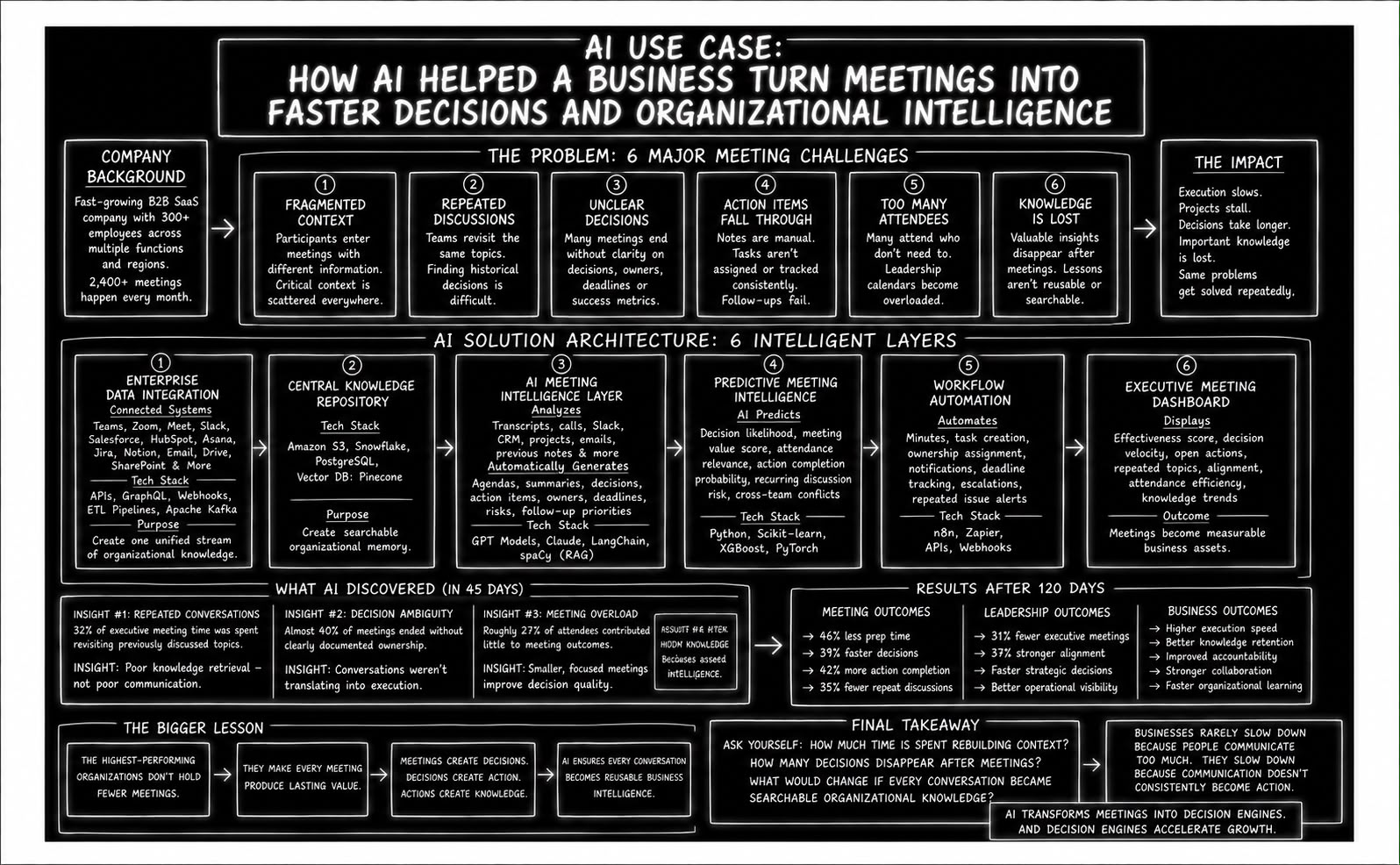
A rapidly growing B2B SaaS company with over 300 employees was expanding across multiple regions.
Teams operated across:
* Sales
* Product
* Engineering
* Marketing
* Customer Success
* Operations
* Executive Leadership
Collaboration depended heavily on meetings.
More than 2,400 meetings occurred each month.
Despite this level of communication, leadership noticed execution slowing.
Projects stalled.
The same discussions resurfaced.
Decisions took longer.
Important knowledge disappeared after meetings ended.
The Problem
The organization faced six major meeting challenges.
1. Fragmented Meeting Context
Participants entered meetings with different information.
Critical business context was scattered across:
* Emails
* Slack conversations
* CRM updates
* Customer calls
* Project management tools
* Shared documents
Meetings began with people trying to catch up.
2. Repeated Discussions
Teams frequently revisited topics already discussed in previous meetings.
Finding historical decisions was difficult.
Organizational memory depended on individuals.
3. Unclear Decisions
Many meetings ended without clarity around:
* What was decided
* Who owned each task
* When work was due
* What success looked like
Execution suffered.
4. Action Items Fell Through the Cracks
Meeting notes were manually written.
Tasks weren’t consistently assigned.
Follow-ups depended on memory.
5. Too Many Attendees
Many employees attended meetings that required little or no input.
Leadership calendars became overloaded.
Decision-making slowed.
6. Organizational Knowledge Was Lost
Thousands of valuable conversations disappeared once meetings ended.
Insights weren’t searchable.
Lessons weren’t reusable.
The organization repeatedly solved the same problems.
Why Traditional Meeting Tools Failed
The company already relied on modern collaboration platforms.
Its technology stack included:
* Microsoft Teams
* Zoom
* Google Meet
* Slack
* Notion
* Asana
These tools enabled communication.
They didn’t create intelligence.
They recorded conversations.
They couldn’t answer:
* What decisions have already been made?
* What discussions keep repeating?
* Which action items remain unfinished?
* Who actually needs this meeting?
* What customer insights should shape today’s agenda?
That’s where AI came in.
The AI Strategy
The company implemented an AI-Powered Meeting Intelligence Platform.
Instead of simply recording meetings, AI transformed every meeting into a searchable, continuously improving knowledge system.
The platform continuously answered:
* What should today’s meeting focus on?
* What decisions are still outstanding?
* What context does everyone need?
* What commitments require follow-up?
Meetings shifted from status updates to decision-making sessions.
AI Solution Architecture
The solution consisted of six intelligent layers.
Layer 1: Enterprise Data Integration
AI continuously gathered information from every collaboration platform.
Connected Systems
* Microsoft Teams
* Zoom
* Google Meet
* Slack
* Salesforce
* HubSpot
* Asana
* Jira
* Notion
* Google Drive
* SharePoint
Tech Stack
* REST APIs
* GraphQL APIs
* Webhooks
* ETL Pipelines
* Apache Kafka
Purpose:
Create one unified stream of organizational knowledge.
Layer 2: Central Knowledge Repository
All structured and unstructured meeting information flowed into one platform.
Tech Stack
* Amazon S3
* Snowflake
* PostgreSQL
* Vector Database:
* Pinecone
Purpose:
Create searchable organizational memory.
Layer 3: AI Meeting Intelligence Layer
AI analyzed:
* Meeting transcripts
* Customer conversations
* Slack discussions
* CRM activity
* Project updates
* Emails
* Previous meeting notes
The platform automatically generated:
* Meeting agendas
* Executive summaries
* Decisions made
* Action items
* Owners
* Deadlines
* Key risks
* Follow-up priorities
Example insight:
“Customer onboarding has been discussed in seven executive meetings over the last month without reaching a final decision.”
Tech Stack
* OpenAI GPT Models
* Claude
* Retrieval-Augmented Generation using LangChain
* spaCy
Layer 4: Predictive Meeting Intelligence
Machine learning evaluated meeting effectiveness.
AI predicted:
* Decision likelihood
* Meeting value score
* Attendance relevance
* Action completion probability
* Recurring discussion risk
* Cross-team dependency conflicts
Tech Stack
* Python
* Scikit-learn
* XGBoost
* PyTorch
Layer 5: Workflow Automation
AI automated post-meeting execution.
Examples:
* Meeting ends → Minutes generated automatically
* Decisions captured → Tasks created in Asana/Jira
* Owners assigned → Notifications sent
* Missed deadlines → Escalation triggered
* Repeated issue detected → Executive alert
Tech Stack
* n8n
* Zapier
* APIs
* Webhooks
Layer 6: Executive Meeting Dashboard
Leadership received AI-powered meeting intelligence.
Dashboard displayed:
* Meeting effectiveness score
* Decision velocity
* Open action items
* Repeated discussion topics
* Department alignment
* Attendance efficiency
* Organizational knowledge trends
Meetings became measurable business assets.
What AI Discovered
Within 45 days, AI uncovered major inefficiencies.
Hidden Insight #1: Repeated Conversations
Nearly 32% of executive meeting time was spent revisiting previously discussed topics.
Insight
Poor knowledge retrieval—not poor communication—was slowing progress.
Hidden Insight #2: Decision Ambiguity
Almost 40% of meetings ended without clearly documented ownership.
Insight
Conversations weren’t translating into execution.
Hidden Insight #3: Meeting Overload
Roughly 27% of attendees contributed little to meeting outcomes.
Insight
Smaller, more focused meetings improved decision quality.
Hidden Insight #4: Hidden Organizational Knowledge
Thousands of customer insights surfaced during meetings but never reached product or leadership teams.
Insight
Valuable intelligence was trapped inside conversations.
Results After 120 Days
The AI implementation delivered measurable improvements.
Meeting Outcomes
* 46% reduction in meeting preparation time
* 39% faster decision-making
* 42% increase in action item completion
* 35% fewer repeat discussions
Leadership Outcomes
* 31% fewer executive meetings
* 37% improvement in cross-functional alignment
* Faster strategic decisions
* Better operational visibility
Business Outcomes
* Higher execution speed
* Better knowledge retention
* Improved accountability
* Stronger collaboration
* Faster organizational learning
The Bigger Lesson
The highest-performing organizations don’t necessarily hold fewer meetings.
They make every meeting produce lasting value.
Meetings should create decisions.
Decisions should create action.
Actions should create organizational knowledge.
That’s where AI creates real leverage.
Not by replacing meetings.
By ensuring every conversation becomes reusable business intelligence.
Final Takeaway
Ask yourself:
* How much of your team’s meeting time is spent rebuilding context?
* How many valuable decisions disappear after the meeting ends?
* What would change if every conversation became searchable organizational knowledge?
Businesses rarely slow down because people communicate too much.
They slow down because communication doesn’t consistently become action.
AI changes that.
It transforms meetings into decision engines.
And decision engines accelerate growth.