AI workforce energy intelligence
Organizations often measure performance using visible metrics.
Hours worked.
Tasks completed.
Projects delivered.
Meetings attended.
These metrics are easy to track.
But they rarely explain why high-performing teams gradually lose momentum.
Performance doesn’t usually collapse overnight.
It declines quietly.
Decision quality weakens.
Creative thinking becomes reactive.
Collaboration feels heavier.
People continue working…
But not at their best.
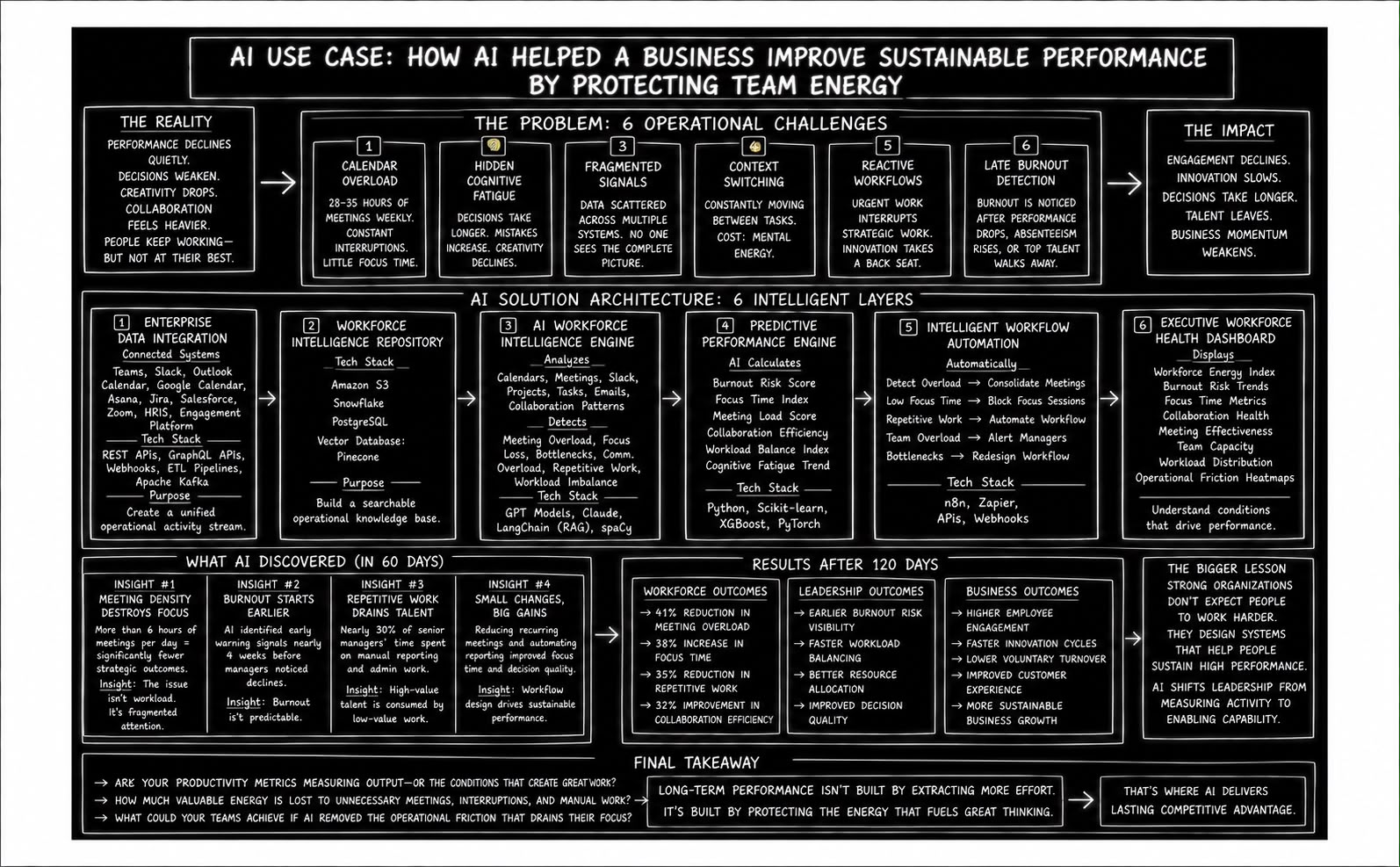
This case study explores how a growing technology company used AI to identify early signs of cognitive overload, reduce unnecessary operational friction, and build a healthier, more sustainable way of working.
Company Background
A rapidly growing B2B technology company with over 400 employees operated across three continents.
Its workforce included hybrid and remote employees working across:
* Product
* Engineering
* Sales
* Marketing
* Customer Success
* Operations
* Executive Leadership
Business growth remained strong.
Yet employee engagement scores were slowly declining.
Innovation had slowed.
Decision cycles were getting longer.
Leadership noticed an unusual trend.
People weren’t working less.
They were simply becoming mentally exhausted.
The Problem
The organization faced six operational challenges that traditional productivity metrics failed to explain.
1. Calendar Overload
Leadership calendars had become saturated.
Employees averaged:
* 28–35 hours of meetings each week
* Constant interruptions
* Little uninterrupted focus time
Deep work became increasingly rare.
2. Hidden Cognitive Fatigue
Teams completed their work.
But AI later revealed that:
* Decisions took longer
* Mistakes increased
* Creativity declined
* Response quality dropped
The warning signs weren’t visible through traditional KPIs.
3. Fragmented Operational Signals
Indicators of declining performance existed across multiple systems:
* Calendar activity
* Slack conversations
* Email traffic
* Project management tools
* Meeting transcripts
* HR engagement surveys
* Task completion history
No one saw the complete picture.
4. Continuous Context Switching
Employees moved constantly between:
* Meetings
* Emails
* Chat messages
* Documentation
* Customer conversations
* Project updates
The cost wasn’t time.
It was mental energy.
5. Reactive Workflows
Urgent work continually interrupted strategic work.
Teams operated in reaction mode.
Innovation became secondary.
6. Burnout Detection Came Too Late
Managers recognized burnout only after:
* Performance declined
* Absenteeism increased
* Employees disengaged
* Valuable people resigned
Leadership wanted earlier visibility.
Why Traditional Productivity Tools Failed
The organization already invested heavily in collaboration technology.
Its stack included:
* Microsoft Teams
* Slack
* Asana
* Jira
* Google Workspace
* Microsoft Outlook
These systems measured activity.
They couldn’t answer questions like:
* Which teams are approaching cognitive overload?
* Where are unnecessary interruptions occurring?
* Which meetings create the most value?
* Which workflows drain the most energy?
* How much focus time do teams actually have?
That’s where AI created value.
The AI Strategy
The company implemented an AI-Powered Workforce Energy Intelligence Platform.
Rather than monitoring employee productivity, AI focused on understanding the conditions that enabled sustainable performance.
The objective was simple:
Protect human energy before performance declined.
AI continuously answered:
* Which teams are overloaded?
* Where is focus time disappearing?
* Which workflows create unnecessary friction?
* What operational changes would improve energy and execution?
AI Solution Architecture
The solution consisted of six intelligent layers.
Layer 1: Enterprise Data Integration
AI continuously collected operational signals across the organization.
Connected Systems
* Microsoft Teams
* Slack
* Outlook Calendar
* Google Calendar
* Asana
* Jira
* Salesforce
* Zoom
* HRIS Platform
* Employee Engagement Platform
Tech Stack
* REST APIs
* GraphQL APIs
* Webhooks
* ETL Pipelines
* Apache Kafka
Purpose:
Create a unified operational activity stream.
Layer 2: Workforce Intelligence Repository
All structured and unstructured operational data was centralized.
Tech Stack
* Amazon S3
* Snowflake
* PostgreSQL
* Vector Database:
* Pinecone
Purpose:
Build a searchable operational knowledge base.
Layer 3: AI Workforce Intelligence Engine
AI analyzed:
* Calendar activity
* Meeting transcripts
* Slack conversations
* Project progress
* Collaboration patterns
* Task completion
* Email activity
It continuously detected:
* Meeting overload
* Focus-time loss
* Collaboration bottlenecks
* Communication overload
* Repetitive manual work
* Workload imbalance
Example insight:
Engineering managers lose an average of 17 hours of focus time every week because of fragmented meetings.
Tech Stack
* OpenAI GPT Models
* Claude
* Retrieval-Augmented Generation using LangChain
* spaCy
Layer 4: Predictive Performance Engine
Machine learning predicted future performance risks.
AI calculated:
* Burnout Risk Score
* Focus Time Index
* Meeting Load Score
* Collaboration Efficiency Score
* Workload Balance Index
* Cognitive Fatigue Trend
Tech Stack
* Python
* Scikit-learn
* XGBoost
* PyTorch
Layer 5: Intelligent Workflow Automation
AI proactively optimized work patterns.
Examples included:
* Meeting overload detected → Recommend schedule consolidation
* Focus time below target → Block uninterrupted work sessions
* Repetitive reporting identified → Automate reporting workflow
* Team overload detected → Notify resource managers
* Collaboration bottleneck identified → Recommend workflow redesign
Tech Stack
* n8n
* Zapier
* APIs
* Webhooks
Layer 6: Executive Workforce Health Dashboard
Leadership received real-time workforce intelligence.
Dashboard displayed:
* Workforce Energy Index
* Burnout Risk Trends
* Focus Time Metrics
* Collaboration Health
* Meeting Effectiveness
* Team Capacity
* Workload Distribution
* Operational Friction Heatmaps
Instead of measuring only output…
Leadership could finally understand the conditions driving sustainable performance.
What AI Discovered
Within 60 days, AI uncovered several hidden issues.
Hidden Insight #1: Meeting Density Was Destroying Focus
Employees with more than six hours of meetings per day produced significantly fewer strategic outcomes.
Insight
The issue wasn’t workload.
It was fragmented attention.
Hidden Insight #2: Burnout Started Weeks Earlier
AI identified early warning signals nearly four weeks before managers noticed declining performance.
Insight
Burnout was predictable.
Hidden Insight #3: Repetitive Work Was Draining Top Performers
Nearly 30% of senior managers’ time was spent on manual reporting, status updates, and administrative coordination.
Insight
High-value talent was consumed by low-value work.
Hidden Insight #4: Small Workflow Changes Produced Major Gains
Reducing recurring meetings and automating routine reporting significantly improved focus time and decision quality.
Insight
Sustainable performance depends more on workflow design than individual effort.
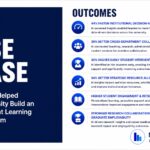
Results After 120 Days
The AI implementation delivered measurable improvements.
Workforce Outcomes
* 41% reduction in meeting overload
* 38% increase in uninterrupted focus time
* 35% reduction in repetitive administrative work
* 32% improvement in collaboration efficiency
Leadership Outcomes
* Earlier visibility into burnout risks
* Faster workload balancing
* Better resource allocation
* Improved decision quality
Business Outcomes
* Higher employee engagement
* Faster innovation cycles
* Lower voluntary turnover
* Improved customer experience
* More sustainable business growth
The Bigger Lesson
The strongest organizations don’t simply expect people to work harder.
They design systems that help people sustain high performance.
AI creates leverage by protecting the energy behind the work.
It shifts leadership from measuring activity…
To enabling capability.
From preventing burnout…
To building resilience.
Final Takeaway
Ask yourself:
* Are your productivity metrics measuring output—or the conditions that create great work?
* How much valuable energy is being lost to unnecessary meetings, interruptions, and manual work?
* What could your teams achieve if AI removed the operational friction that drains their focus?
Long-term performance isn’t built by extracting more effort.
It’s built by protecting the energy that fuels great thinking.
That’s where AI delivers lasting competitive advantage.


You can read full article here too
https://www.linkedin.com/pulse/ai-use-case-how-helped-business-improve-sustainable-team-mirania-igbec