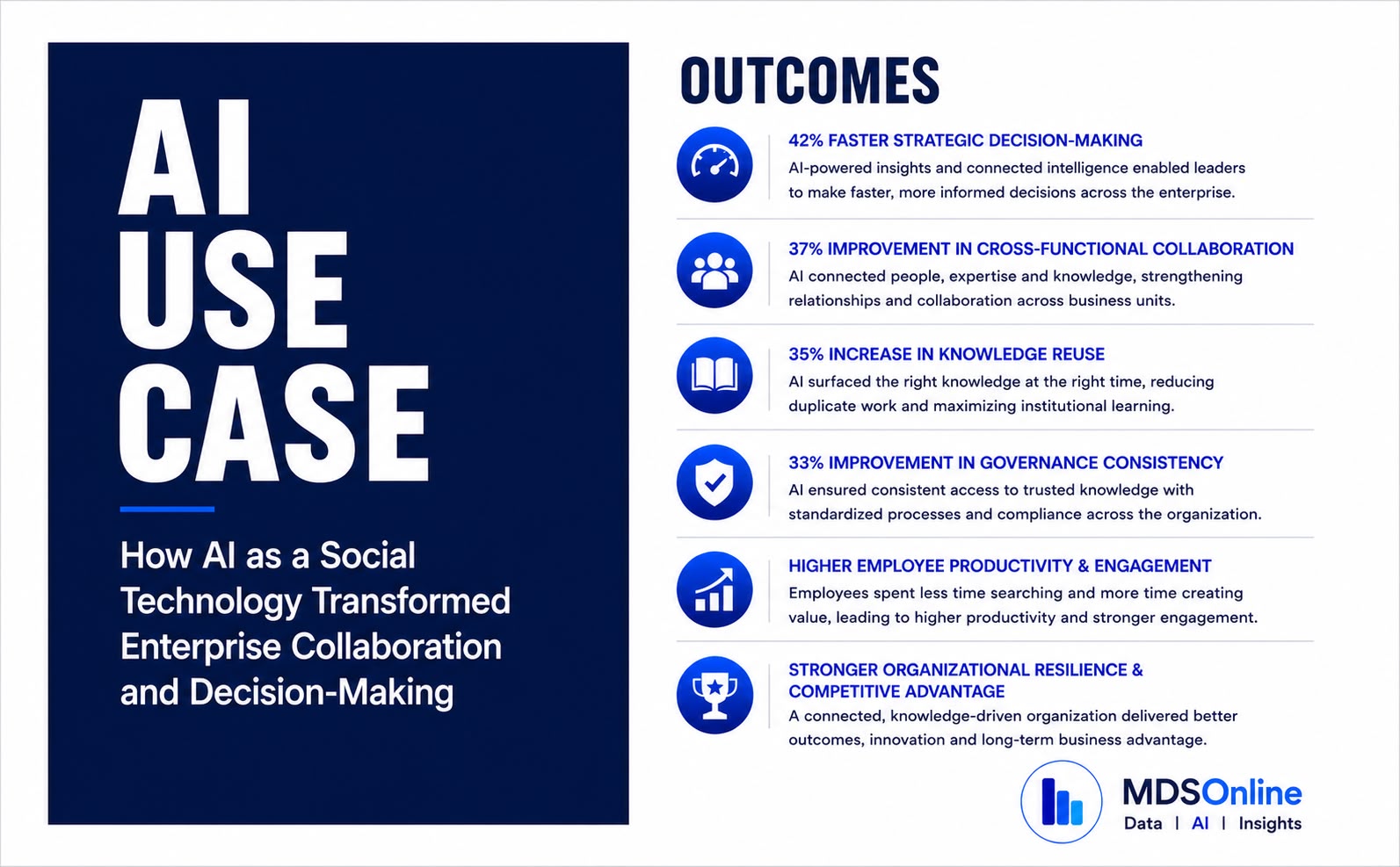
AI as a Social Technology
Most conversations about Artificial Intelligence focus on model performance.
Which model is faster?
Which model is more accurate?
Which model has the largest context window?
But for enterprises, the more important question is different.
How does AI change the way people work together?
The greatest business value doesn’t come from AI answering questions faster.
It comes from redesigning how knowledge flows across an organization, enabling better collaboration, smarter decisions, and stronger execution.
This case study explores how a global professional services company implemented an Enterprise AI Collaboration Intelligence Platform that transformed disconnected teams into a connected, knowledge-driven organization.
Company Background
A multinational consulting and technology services organization with over 11,000 employees operated across North America, Europe, Asia-Pacific, and the Middle East.
The company served clients across:
* Financial Services
* Healthcare
* Manufacturing
* Retail
* Government
* Technology
Its internal operations included:
* Sales
* Consulting
* Project Delivery
* Customer Success
* Human Resources
* Legal
* Finance
* IT
* Knowledge Management
* Executive Leadership
Although the company had invested heavily in collaboration tools, employees still struggled to locate expertise, share knowledge, and coordinate decisions across business units.
Leadership realized the challenge wasn’t communication.
It was organizational intelligence.
The Problem
The organization identified six barriers limiting collaboration and knowledge sharing.
1. Knowledge Was Trapped in Silos
Critical expertise existed across documents, emails, chats, project repositories, and individual employees.
Finding the right information often depended on knowing the right person.
2. Teams Repeated Work Already Done Elsewhere
Business units frequently recreated proposals, project plans, presentations, and client solutions because previous work was difficult to discover.
Valuable institutional knowledge remained hidden.
3. Decision-Making Was Slow
Managers gathered information from multiple departments before making strategic decisions.
Important context was often incomplete or outdated.
4. Collaboration Depended on Individual Networks
Employees relied on personal relationships rather than organizational knowledge.
When experienced staff left, valuable expertise disappeared with them.
5. AI Tools Produced Inconsistent Results
Different departments experimented with AI independently.
Without shared governance, trusted knowledge sources, and standardized workflows, AI responses varied in quality and reliability.
6. Leadership Couldn’t Measure Knowledge Flow
Executives tracked productivity and financial performance but had little visibility into how information moved across teams or where collaboration bottlenecks existed.
Why Traditional Collaboration Systems Failed
The organization already used enterprise platforms including:
* Microsoft Teams
* Slack
* SharePoint
* Salesforce
* Jira
* Document Management Systems
These platforms enabled communication.
They didn’t understand relationships between people, knowledge, and business decisions.
Information was stored.
It wasn’t intelligently connected.
The AI Strategy
Leadership introduced an Enterprise AI Collaboration Intelligence Platform.
Rather than focusing on automating individual tasks, the platform was designed to strengthen how people collaborated across the enterprise.
AI continuously connected:
* Employees
* Projects
* Documents
* Customer knowledge
* Business processes
* Decisions
* Expertise
* Best practices
Its objective was simple:
Enable every employee to benefit from the collective intelligence of the organization.
AI Solution Architecture
The platform consisted of six intelligent layers.
Layer 1: Enterprise Data Integration
AI continuously connected information across enterprise systems.
Connected Systems
* Microsoft Teams
* Slack
* SharePoint
* Salesforce CRM
* ServiceNow
* Jira
* Confluence
* HRIS
* ERP
* Document Repositories
* Project Management Platforms
Tech Stack
* REST APIs
* GraphQL APIs
* Webhooks
* ETL Pipelines
* Apache Kafka
Purpose
Create a unified enterprise collaboration layer.
Layer 2: Enterprise Knowledge Repository
AI centralized organizational knowledge including:
* Project documentation
* Standard operating procedures
* Policies
* Client deliverables
* Meeting summaries
* Best practices
* Technical documentation
* Lessons learned
Tech Stack
* Amazon S3
* Snowflake
* PostgreSQL
* Vector Database:
* Pinecone
Purpose
Build a trusted enterprise knowledge foundation.
Layer 3: AI Collaboration Intelligence Engine
AI continuously analyzed:
* Knowledge usage
* Cross-functional collaboration
* Decision patterns
* Project outcomes
* Communication trends
* Expertise networks
* Workflow dependencies
* Organizational learning
The platform automatically:
* Connected employees with relevant expertise
* Recommended reusable knowledge assets
* Summarized enterprise discussions
* Highlighted collaboration opportunities
* Identified knowledge gaps
* Surfaced context for faster decision-making
Example insight:
“Three project teams in different regions independently solved similar customer integration challenges. Consolidating their approaches into a shared playbook could reduce future implementation effort while improving delivery consistency.”
Tech Stack
* OpenAI GPT Models
* Claude
* Retrieval-Augmented Generation (RAG) using LangChain
* spaCy
Layer 4: Organizational Intelligence Analytics
Machine learning continuously evaluated collaboration across the enterprise.
AI generated:
* Collaboration Effectiveness Score
* Knowledge Accessibility Index
* Decision Velocity Score
* Cross-Functional Engagement Index
* Organizational Learning Score
* Expertise Network Health
* Knowledge Reuse Score
Tech Stack
* Python
* Scikit-learn
* XGBoost
* PyTorch
* Neo4j for mapping relationships between employees, knowledge assets, projects, and business processes
Layer 5: Intelligent Workflow Automation
AI transformed collaboration insights into coordinated action.
Examples:
* New project initiated → Similar projects and experts recommended automatically
* Policy updated → Relevant teams notified with contextual summaries
* Expertise gap detected → Learning recommendations assigned
* Repeated customer issue identified → Knowledge article created automatically
* Executive decision made → Impact communicated to affected departments
Tech Stack
* n8n
* Zapier
* APIs
* Webhooks
Layer 6: Executive Collaboration Intelligence Dashboard
Leadership gained visibility into how knowledge moved throughout the organization.
Dashboard displayed:
* Collaboration Effectiveness
* Knowledge Reuse Rate
* Decision Velocity
* Cross-Department Collaboration
* Expertise Distribution
* Knowledge Gaps
* AI Adoption
* Governance Compliance
* Organizational Intelligence Index
Instead of asking, “How many AI tools have we deployed?” executives asked, “How effectively are our people learning and working together?”
What AI Discovered
Within 120 days, AI uncovered four strategic insights.
Hidden Insight #1: Most Valuable Knowledge Already Existed
The organization possessed the expertise it needed.
Employees simply couldn’t find it efficiently.
Insight
Knowledge discovery created more value than knowledge creation.
Hidden Insight #2: Collaboration Improved Decision Quality
Teams that shared knowledge across departments consistently made faster and more informed business decisions.
Insight
Better collaboration produced better outcomes.
Hidden Insight #3: Trust Determined AI Adoption
Employees relied on AI recommendations only when responses were grounded in trusted enterprise knowledge and supported by clear governance.
Insight
Trust was the foundation of enterprise AI.
Hidden Insight #4: Organizational Design Mattered More Than Technology
The greatest improvements came from redesigning workflows and knowledge sharing—not from deploying additional AI models.
Insight
AI became a catalyst for organizational transformation.
Results After 120 Days
Leadership Outcomes
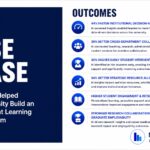
* 42% faster strategic decision-making
* 37% improvement in cross-functional collaboration
* 35% increase in knowledge reuse
* 33% improvement in governance consistency
Operational Outcomes
* Reduced time spent searching for information
* Faster onboarding of new employees
* Improved project delivery consistency
* Better coordination across departments
* Higher employee productivity
Business Outcomes
* Improved customer experience
* Faster innovation cycles
* Higher operational efficiency
* Better knowledge retention
* Stronger organizational resilience
* Increased competitive advantage
The Bigger Lesson
Enterprise AI is not just another software platform.
It is a social technology.
Its greatest value comes from strengthening the relationships between people, knowledge, and decisions.
Organizations that redesign how work happens—not just how technology is deployed—will create lasting competitive advantage.
Final Takeaway
Ask yourself:
* Is your AI strategy improving individual productivity—or transforming how people collaborate across the organization?
* Can employees easily access the collective knowledge of your business, or does expertise remain trapped in silos?
* Are you deploying AI tools, or building an intelligent organization where people and AI create better outcomes together?


If you’re exploring how to transform AI from a collection of tools into an enterprise capability that improves collaboration, decision-making, and measurable business outcomes, let’s connect.
Visit MDSOnline.co.in