Enterprise Business Intelligence
Most businesses don’t struggle because they lack customers.
They struggle because their information is scattered.
Sales lives in spreadsheets.
Customer conversations happen in WhatsApp.
Projects are tracked through email.
Finance operates in a separate system.
HR manages employee information somewhere else.
Each department works.
But the business doesn’t.
This case study explores how a growing manufacturing and distribution company replaced fragmented processes with an Enterprise AI Business Intelligence Platform, creating a connected business where every department worked from the same source of truth.
Company Background
A mid-sized manufacturing and distribution company with over 650 employees operated across multiple warehouses, regional sales offices, and service centers.
Its business included:
* Sales
* Customer Service
* Finance
* Procurement
* Inventory Management
* Operations
* Human Resources
* Production
* Executive Leadership
The company had invested in digital tools over several years.
However, each department selected its own applications.
The result wasn’t digital transformation.
It was digital fragmentation.
The Problem
Leadership identified six operational challenges.
1. Business Information Was Scattered
Critical information existed across:
* Excel spreadsheets
* CRM
* Accounting software
* Inventory systems
* HR applications
* Shared drives
Employees spent significant time searching for information rather than acting on it.
2. Customer Follow-Ups Were Inconsistent
Sales teams managed leads differently.
Some opportunities were tracked in spreadsheets.
Others remained inside WhatsApp conversations.
Important follow-ups were missed.
Revenue opportunities disappeared without visibility.
3. Decisions Were Based on Incomplete Information
Executives needed information from multiple departments before making decisions.
Reports often became outdated before they reached leadership.
4. Duplicate Work Increased Operational Costs
Departments recreated reports, entered customer information multiple times, and manually transferred data between systems.
Employees solved the same problems repeatedly.
5. Operational Visibility Was Limited
Managers couldn’t easily answer:
* Which orders were delayed?
* Which customers required attention?
* Which inventory shortages affected sales?
* Which projects were behind schedule?
Information existed.
Visibility didn’t.
6. Growth Increased Complexity
As the business expanded, disconnected systems multiplied.
Every new application created another information silo.
Scaling the business became increasingly difficult.
Why Traditional Systems Failed
The organization already used:
* CRM software
* Accounting software
* Inventory management
* HR platform
* Microsoft Excel
Each system worked well independently.
None understood the complete business.
The organization had software.
It lacked connected intelligence.
The AI Strategy
Leadership implemented an Enterprise AI Business Intelligence Platform.
Instead of replacing every business application, AI connected them.
The platform continuously synchronized information across departments, providing employees and executives with a unified operational view.
Its objective was simple:
Transform fragmented business data into actionable business intelligence.
AI Solution Architecture
The solution consisted of six intelligent layers.
Layer 1: Enterprise Data Integration
AI continuously synchronized operational data.
Connected Systems
* Zoho CRM
* Zoho Books
* Zoho Inventory
* Zoho Projects
* Zoho People
* WhatsApp Business
* Microsoft 365
* ERP
* Document Management
* Warehouse Management System
Tech Stack
* REST APIs
* GraphQL APIs
* Webhooks
* ETL Pipelines
* Apache Kafka
Purpose
Create one connected operational data layer.
Layer 2: Enterprise Knowledge Repository
Operational knowledge was centralized into a searchable business repository.
Tech Stack
* Amazon S3
* Snowflake
* PostgreSQL
* Vector Database:
* Pinecone
Purpose
Create a single source of business truth.
Layer 3: AI Business Intelligence Engine
AI continuously analyzed:
* Sales activity
* Customer conversations
* Financial transactions
* Inventory movement
* Purchase orders
* Project updates
* Employee activity
* Customer support interactions
The platform automatically:
* Connected related information
* Identified operational bottlenecks
* Summarized customer history
* Highlighted delayed actions
* Recommended next best actions
* Generated executive insights
Example insight:
“Three large customer opportunities remain inactive because quotation approvals are delayed across finance and sales. Accelerating approvals could significantly improve monthly revenue.”
Tech Stack
* OpenAI GPT Models
* Claude
* Retrieval-Augmented Generation (RAG) using LangChain
* spaCy
Layer 4: Predictive Operational Intelligence
Machine learning continuously predicted operational risks.
AI generated:
* Customer Health Score
* Sales Opportunity Score
* Inventory Risk Index
* Operational Efficiency Score
* Project Completion Forecast
* Financial Performance Index
* Business Growth Score
Tech Stack
* Python
* Scikit-learn
* XGBoost
* PyTorch
* Neo4j for mapping relationships between customers, products, employees, suppliers, and business processes
Layer 5: Intelligent Workflow Automation
AI converted insights into automated workflows.
Examples:
* New lead captured → CRM updated automatically
* WhatsApp enquiry received → Customer record matched
* Inventory shortage predicted → Procurement alerted
* Payment overdue → Finance workflow initiated
* Project delay detected → Manager notified with recommendations
* Executive KPI threshold exceeded → Leadership dashboard updated instantly
Tech Stack
* n8n
* Zapier
* APIs
* Webhooks
Layer 6: Executive Business Intelligence Dashboard
Leadership gained real-time visibility into business performance.
Dashboard displayed:
* Revenue Pipeline
* Customer Follow-Up Status
* Inventory Health
* Financial Performance
* Operational Bottlenecks
* Project Delivery
* Employee Productivity
* Workflow Automation Metrics
* Enterprise Performance Score
Instead of waiting for weekly reports, executives viewed the business in real time.
What AI Discovered
Within 90 days, AI uncovered four hidden insights.
Hidden Insight #1: Most Delays Were Caused by Information Gaps
Business processes slowed because teams lacked access to complete information.
Insight
Information fragmentation—not employee performance—created operational friction.
Hidden Insight #2: Missed Follow-Ups Reduced Revenue
Several high-value sales opportunities were delayed because customer conversations remained isolated in WhatsApp and email.
Insight
Connected customer intelligence increased sales effectiveness.
Hidden Insight #3: Duplicate Work Consumed Valuable Time
Employees repeatedly entered the same information into different systems.
Insight
Integration created greater productivity than additional software.
Hidden Insight #4: Leaders Needed Live Intelligence
Weekly reports no longer reflected business reality.
Real-time operational visibility enabled faster, more confident decisions.
Insight
Connected intelligence became a competitive advantage.
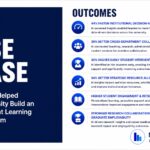
Results After 120 Days
Leadership Outcomes
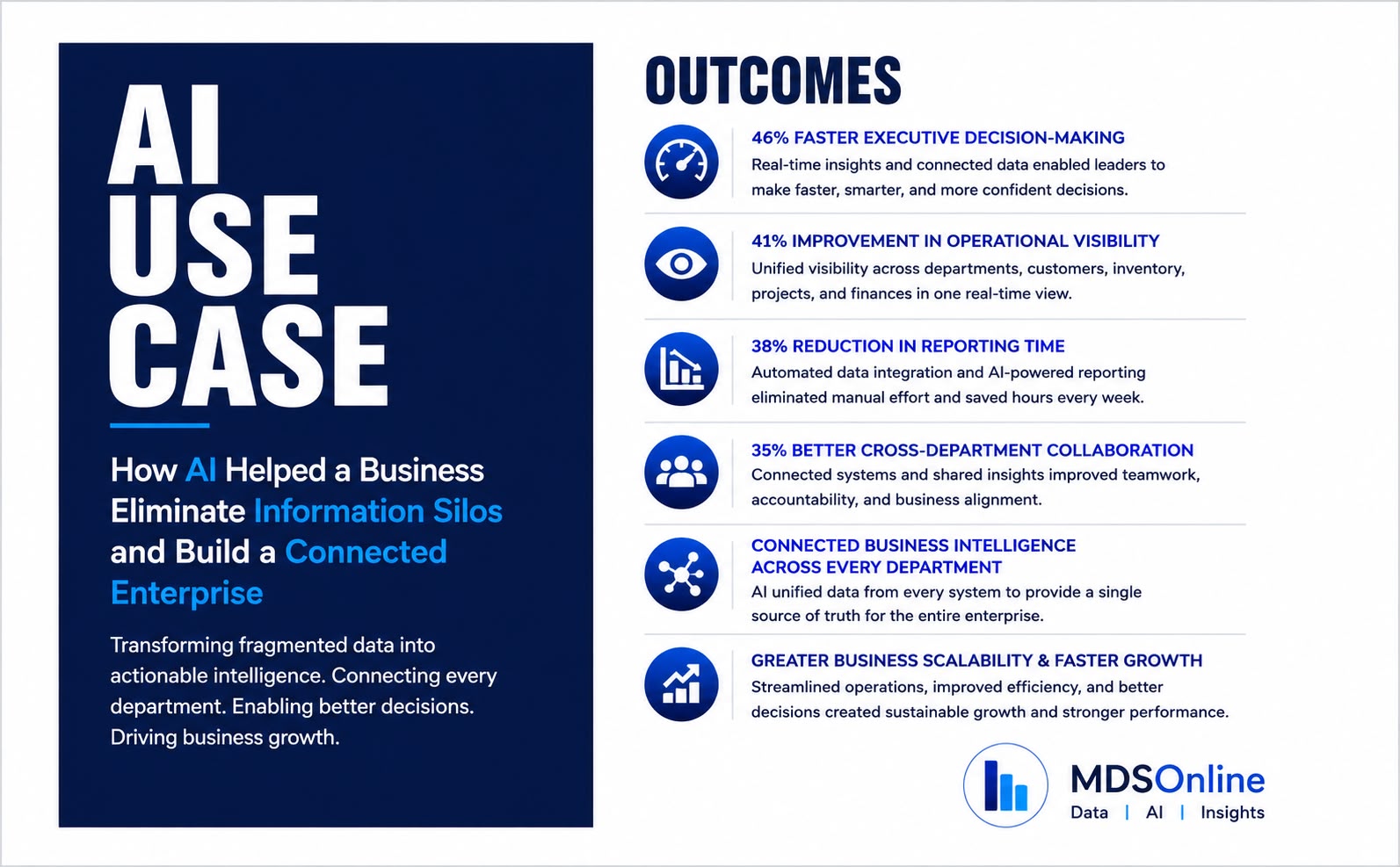
* 46% faster executive decision-making
* 41% improvement in operational visibility
* 38% reduction in reporting time
* 35% better cross-department collaboration
Operational Outcomes
* Higher CRM adoption
* Faster customer follow-ups
* Reduced manual data entry
* Improved inventory accuracy
* Better project coordination
* Fewer duplicated tasks
Business Outcomes
* Increased revenue opportunities
* Improved customer satisfaction
* Faster operational execution
* Lower administrative costs
* Stronger business scalability
* Better decision-making across every department
The Bigger Lesson
Digital transformation isn’t about replacing every system.
It’s about connecting them.
The businesses creating long-term competitive advantage aren’t buying more software.
They’re creating intelligent ecosystems where data flows freely, decisions happen faster, and every team works from the same operational reality.
That’s where AI creates its greatest value.
Not by replacing people.
By connecting the business.
Final Takeaway
Ask yourself:
* How much time does your team spend searching for information instead of acting on it?
* Are your business systems working together—or creating more silos?
* If every department described your business today, would they tell the same story?
The organizations that grow the fastest won’t necessarily have the most software.
They’ll have the most connected intelligence.
#ArtificialIntelligence #EnterpriseAI #BusinessIntelligence #DigitalTransformation #BusinessAutomation #KnowledgeManagement #BusinessStrategy #OperationalExcellence #WorkflowAutomation #ConnectedBusiness #DataIntegration #CRM #ERP #BusinessTransformation #DecisionMaking #Automation #AIInnovation #BusinessGrowth #EnterpriseTechnology #MDSOnline


If your business is still running across spreadsheets, WhatsApp, emails, and disconnected systems, it’s worth asking one question: What is that fragmentation really costing you?
Send me a DM if you’d like to discuss how an AI-powered connected business can eliminate information silos and improve decision-making.
Visit mdsonline.co.in