AI Brand Discoverability
The first impression of your business is changing.
For years, it began with your website.
Or a Google search.
Or perhaps an online review.
Today, an increasing number of customers start somewhere else.
They ask AI.
“Which vendor should I choose?”
“Who offers the best solution for my business?”
“Can you compare these providers?”
AI is becoming the first advisor in the customer journey.
Before a prospect visits your website…
Before they speak with your sales team…
Before they request a demo…
AI has already interpreted who your business is, what you offer, and whether you’re worth considering.
This case study explores how a global B2B technology company implemented an AI-Powered Brand Intelligence Platform to ensure AI systems consistently represented its expertise, monitored its digital reputation, and strengthened customer trust before the first human interaction.
Company Background
A global enterprise software company with over 950 employees served customers across North America, Europe, Asia-Pacific, and the Middle East.
Its business focused on:
* Enterprise SaaS
* Professional Services
* Customer Success
* Digital Consulting
* Managed Services
The company invested heavily in:
* Content marketing
* SEO
* Thought leadership
* Customer education
* Product documentation
* Online reputation management
Despite strong digital marketing performance, leadership noticed an emerging trend.
Prospective customers increasingly arrived with information they had received from AI assistants rather than search engines.
Some understood the company’s value accurately.
Others received outdated or incomplete information.
Leadership realized the customer journey had fundamentally changed.
The Problem
The organization faced six major AI discoverability challenges.
1. AI Became the First Customer Touchpoint
Customers increasingly relied on AI assistants to:
* Compare vendors
* Evaluate products
* Research industries
* Understand technical capabilities
* Shortlist suppliers
Many buying decisions were influenced before prospects visited the company’s website.
2. Brand Information Was Inconsistent
Different AI systems described the company differently.
Some referenced outdated products.
Others overlooked key differentiators.
Several emphasized capabilities that were no longer strategic priorities.
The company no longer controlled its first impression.
3. Customer Signals Were Fragmented
Valuable insights existed across:
* CRM
* Website analytics
* Product documentation
* Customer reviews
* Support conversations
* Sales calls
* Social media
* Industry publications
No single system connected these signals into a unified understanding of customer perception.
4. Emerging Market Trends Were Difficult to Detect
Customer questions changed rapidly.
New competitors appeared.
Industry terminology evolved.
Leadership often recognized these shifts only after they affected pipeline performance.
5. Marketing, Sales, and Customer Success Told Different Stories
Although each department communicated effectively, messaging evolved independently.
Customers encountered inconsistent positioning depending on where they interacted.
6. Executives Had Limited Visibility
Leadership couldn’t answer:
* How is AI describing our company?
* Which competitors are AI recommending alongside us?
* Which products are customers asking AI about?
* Where is our brand misunderstood?
* Which buying trends are emerging?
Traditional analytics provided website traffic.
They couldn’t explain AI-driven discovery.
Why Traditional Digital Marketing Failed
The organization already invested heavily in digital platforms, including:
* Google Analytics
* Salesforce
* HubSpot
* Google Search Console
* Semrush
These tools explained:
* Website traffic
* Search rankings
* Lead generation
* Campaign performance
They couldn’t answer:
* How do AI platforms describe our business?
* What information is AI using?
* Which customer questions influence AI recommendations?
* Where are inaccuracies damaging trust?
* How can we improve AI discoverability?
The company had digital marketing.
It lacked AI brand intelligence.
The AI Strategy
The organization implemented an AI-Powered Brand Intelligence & Discoverability Platform.
Rather than optimizing only for search engines, AI continuously monitored how the business was understood across AI-powered customer experiences.
The platform unified enterprise knowledge, customer feedback, digital content, and market intelligence into a single trusted knowledge ecosystem.
Its objective was simple:
Ensure AI described the business as accurately as the business described itself.
AI Solution Architecture
The solution consisted of six intelligent layers.
Layer 1: Enterprise Data Integration
AI continuously synchronized trusted business knowledge.
Connected Systems
* Salesforce
* HubSpot
* Microsoft Dynamics 365
* Website CMS
* Product Information Management (PIM)
* Zendesk
* Google Analytics
* Google Search Console
* Microsoft Teams
* SharePoint
* Confluence
* CRM
* Social Listening Platforms
* Customer Review Platforms
Tech Stack
* REST APIs
* GraphQL APIs
* Webhooks
* ETL Pipelines
* Apache Kafka
Purpose
Continuously synchronize customer, product, content, and operational knowledge.
Layer 2: Enterprise Knowledge Repository
Every approved product description, case study, customer success story, knowledge article, policy, and brand guideline was centralized.
Tech Stack
* Amazon S3
* Snowflake
* PostgreSQL
* Vector Database:
* Pinecone
Purpose
Create a trusted enterprise knowledge source that AI systems could consistently reference.
Layer 3: AI Brand Intelligence Engine
AI continuously analyzed:
* Customer questions
* Sales conversations
* Product documentation
* Website content
* Support interactions
* Customer reviews
* Market reports
* Competitor positioning
* AI-generated business descriptions
The platform automatically:
* Identified inaccurate AI descriptions
* Detected inconsistent messaging
* Recommended content improvements
* Highlighted emerging buying signals
* Identified new customer questions
* Suggested knowledge updates
Example insight:
“AI assistants frequently describe your platform as an analytics solution but rarely mention your workflow automation capabilities. Updating product documentation and customer success content could improve recommendation accuracy.”
Tech Stack
* OpenAI GPT Models
* Claude
* Retrieval-Augmented Generation (RAG) using LangChain
* spaCy
Layer 4: Predictive Brand Intelligence
Machine learning continuously evaluated discoverability and market perception.
AI calculated:
* AI Discoverability Score
* Brand Consistency Index
* AI Recommendation Frequency
* Customer Intent Score
* Competitive Visibility Index
* Content Freshness Score
* Emerging Trend Index
Tech Stack
* Python
* Scikit-learn
* XGBoost
* PyTorch
* Time-series forecasting using Prophet
Layer 5: Intelligent Workflow Automation
AI continuously strengthened discoverability.
Examples:
* Product documentation updated → Knowledge repository refreshed automatically
* New customer buying trend detected → Marketing team notified
* Brand inconsistency identified → Content owner assigned a review task
* Emerging competitor mentioned frequently → Competitive intelligence report generated
* High-value customer question repeated → FAQ and website content updated automatically
Tech Stack
* n8n
* Zapier
* APIs
* Webhooks
Layer 6: Executive AI Discoverability Dashboard
Leadership gained complete visibility into how AI represented the business.
Dashboard displayed:
* AI Discoverability Score
* Brand Consistency Index
* AI Recommendation Trends
* Customer Intent Analysis
* Emerging Buying Questions
* Competitive Visibility Map
* Knowledge Freshness Score
* Content Gap Analysis
* Executive AI Reputation Score
Instead of measuring only website performance, executives monitored how AI understood and recommended the business.
What AI Discovered
Within 120 days, AI revealed several hidden opportunities.
Hidden Insight #1: Customers Asked AI Different Questions Than They Asked Sales Teams
Prospective buyers often explored strategic and comparative questions through AI long before contacting the company.
Insight
Understanding AI-driven customer intent improved marketing and sales alignment.
Hidden Insight #2: Product Expertise Was Underrepresented
AI consistently highlighted the company’s core products but overlooked several high-value consulting and implementation services.
Insight
Improving enterprise knowledge increased AI recommendation quality.
Hidden Insight #3: Emerging Buying Trends Appeared Earlier in AI Conversations
Customer questions shifted weeks before those trends became visible in CRM reports.
Insight
AI became an early-warning system for market demand.
Hidden Insight #4: Consistent Enterprise Knowledge Improved Brand Trust
When every customer-facing system referenced the same trusted knowledge repository, AI-generated descriptions became significantly more accurate and consistent.
Insight
Brand integrity depends on the quality and consistency of enterprise knowledge.
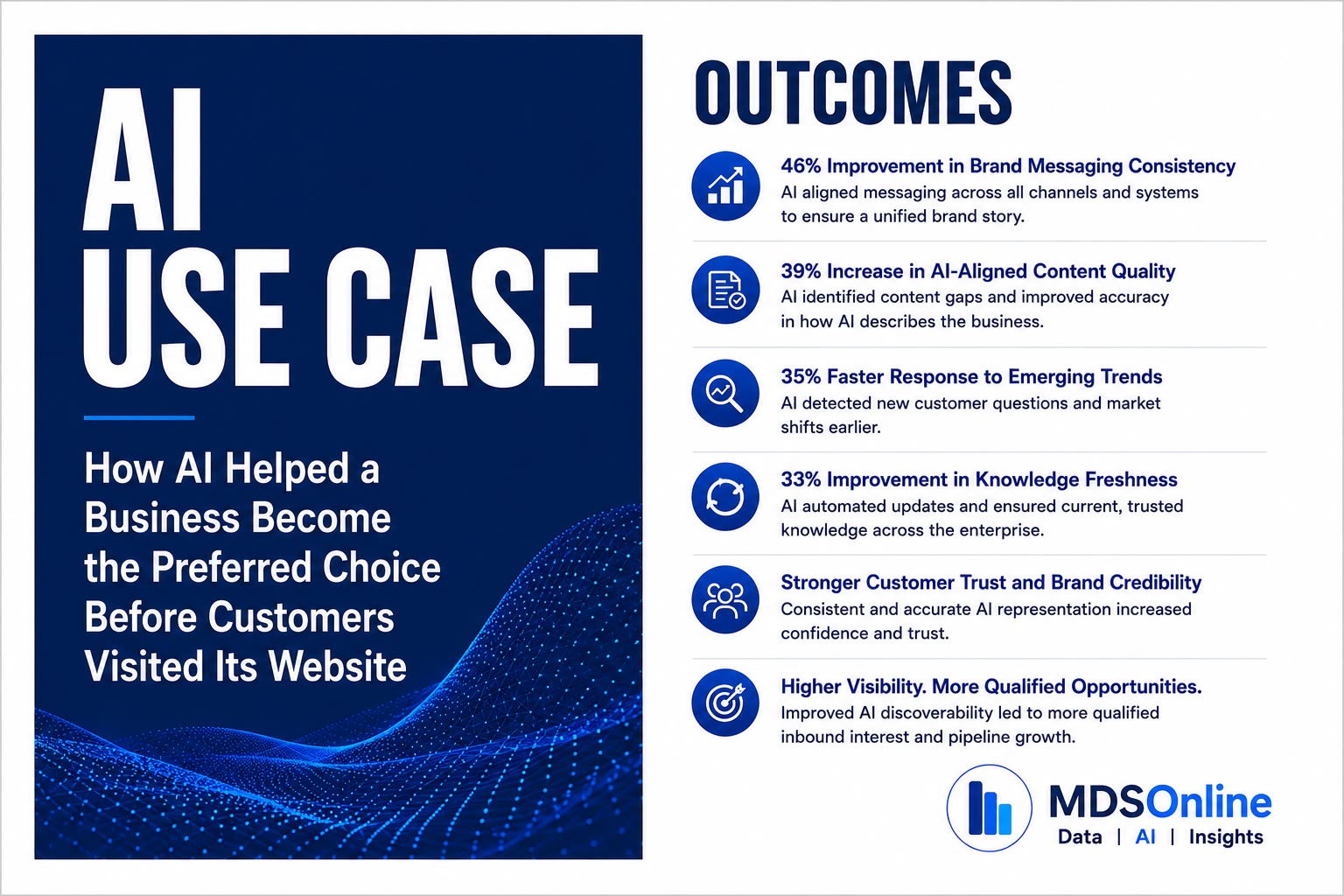
Results After 120 Days
Marketing Outcomes
* 46% improvement in brand messaging consistency
* 39% increase in AI-aligned content quality
* 35% faster response to emerging customer trends
* 33% improvement in knowledge freshness
Leadership Outcomes
* Real-time visibility into AI-driven customer discovery
* Better competitive intelligence
* Faster strategic content decisions
* Greater confidence in digital brand positioning
Business Outcomes
* Improved customer trust
* Stronger brand discoverability
* More qualified inbound opportunities
* Better alignment across marketing, sales, and customer success
* Higher competitive visibility
* Increased readiness for an AI-first buying journey
The Bigger Lesson
The first impression of your business is no longer created by your website alone.
It’s increasingly created by AI.
The organizations that succeed won’t simply produce more content.
They’ll build enterprise knowledge ecosystems that help AI understand, represent, and recommend their business accurately.
That’s where AI becomes more than a marketing tool.
It becomes a strategic channel for customer discovery and trust.
Final Takeaway
Ask yourself:
* If a customer asked AI to recommend the best company in your industry today, would your business be described accurately?
* Does every AI-accessible source tell the same story about your products, expertise, and value?
* Are you optimizing only for search engines—or for the AI systems increasingly shaping customer decisions?
The companies that win in an AI-first marketplace won’t just be easier to find.
They’ll be easier for AI to understand, recommend, and trust.


If you’re exploring how to build an AI ecosystem that strengthens discoverability, protects brand integrity, and helps customers make confident decisions, let’s connect. I’d be happy to discuss practical AI solutions that prepare your business for an AI-first marketplace.
Visit mdsonline.co.in