Every business has an identity.
At the beginning, that identity creates clarity.
It defines:
– Who the company serves
– How it operates
– What it values
– How it grows
This creates alignment.
It creates focus.
It creates consistency.
But over time, something changes.
The identity that once helped a business grow can quietly become the thing that limits it.
This case study shows how a growing company used AI to challenge legacy assumptions, identify shifting customer behavior, and evolve its operating model before growth stalled.
Company Background
A mid-sized B2B services company with 220+ employees had built its reputation over 12 years.
Its market identity was clear:
“We are a premium, relationship-driven company.”
This identity shaped everything.
The company believed:
– Customers preferred high-touch service
– Automation would reduce quality
– Manual control created trust
– Existing processes were a competitive advantage
For years, this worked.
Revenue grew.
Retention remained stable.
But the market began changing.
Customer expectations shifted.
Competitors adopted automation.
Buyer behavior evolved.
Growth began slowing.
Leadership initially blamed market conditions.
AI revealed something deeper.
The Problem
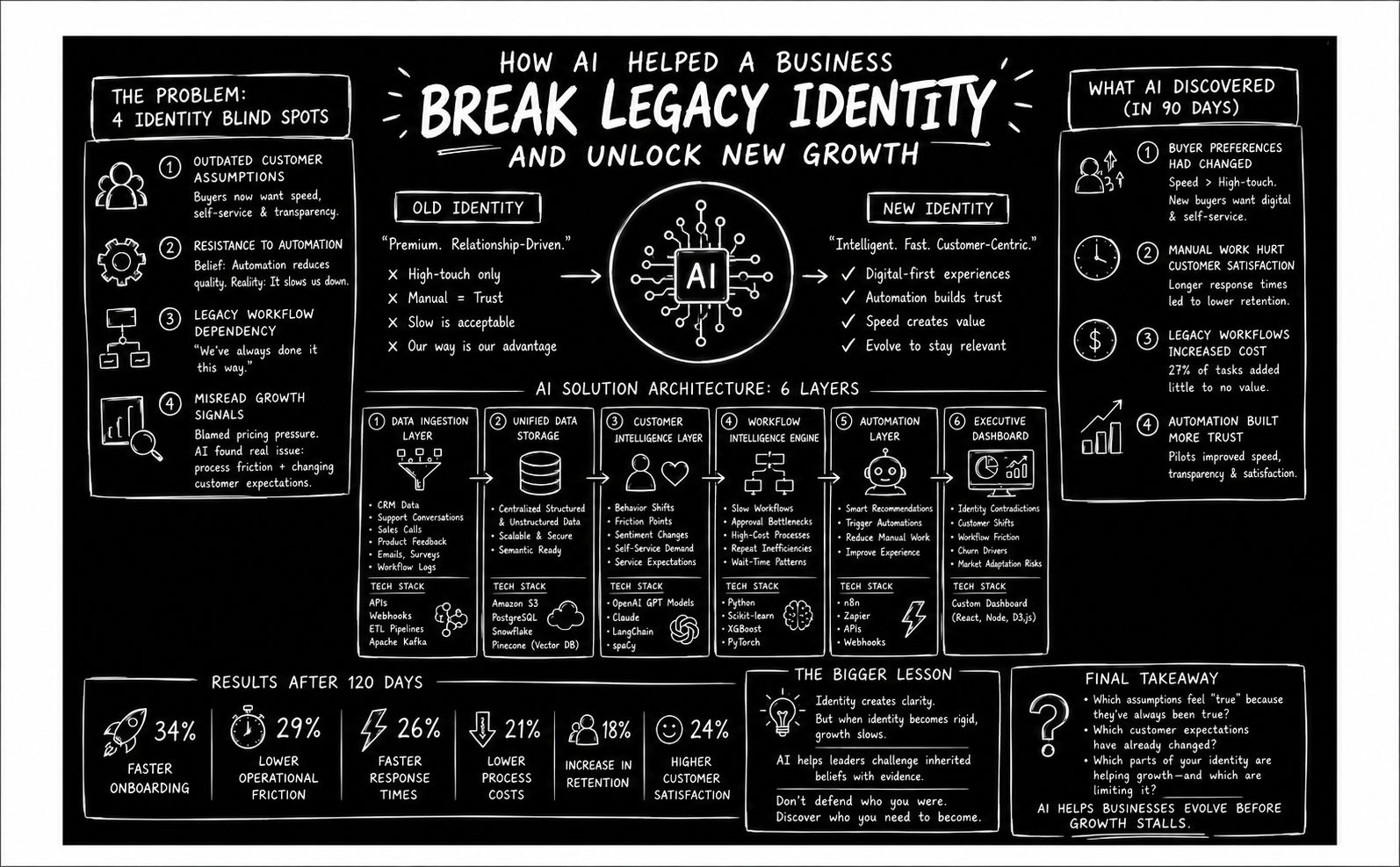
The company faced four major identity-driven blind spots.
1. Outdated Customer Assumptions
Leadership believed customers still wanted the same buying experience.
But newer buyers expected:
– Faster response times
– Self-service options
– Digital workflows
– More transparency
The company’s old model created friction.
2. Resistance to Automation
Internal teams believed automation would hurt quality.
As a result:
– Processes stayed manual
– Teams were overloaded
– Response times increased
– Costs rose
3. Legacy Workflow Dependency
Many workflows existed simply because:
“We’ve always done it this way.”
Nobody questioned whether they still created value.
4. Misread Growth Signals
Leadership assumed slower growth came from pricing pressure.
AI discovered the real problem was process friction and changing customer expectations.
Why Traditional Analytics Failed
The company had dashboards.
They tracked:
– Revenue
– Retention
– Customer satisfaction
– Pipeline health
– Response times
They used:
– Salesforce
– HubSpot
– Tableau
The problem?
Dashboards showed outcomes.
They didn’t challenge assumptions.
Leadership could see what happened.
They couldn’t see which beliefs were becoming outdated.
That’s where AI came in.
The AI Strategy
The objective was to build an AI-powered Identity Intelligence System.
The system needed to answer:
– Which beliefs no longer match customer behavior?
– Which workflows create unnecessary friction?
– What patterns contradict leadership assumptions?
– Where is the market changing faster than the company?
AI became a strategic intelligence layer.
AI Solution Architecture
The solution was built across six layers.
Layer 1: Data Ingestion Layer
AI ingested signals from across the organization.
Sources included:
– CRM data
– Customer support conversations
– Sales calls
– Product feedback
– Email interactions
– Workflow logs
– Customer surveys
Tech Stack
– APIs
– Webhooks
– ETL pipelines
– Event streaming via Apache Kafka
Purpose:
Centralize fragmented business signals.
Layer 2: Unified Data Storage
All structured and unstructured data was stored centrally.
Tech Stack
– Amazon S3
– PostgreSQL
– Snowflake
– Vector DB: Pinecone
Purpose:
Support analytical and semantic search.
Layer 3: Customer Intelligence Layer
AI analyzed customer behavior.
It detected:
– Buying preference shifts
– Friction points
– Sentiment changes
– Self-service demand
– Service expectations
Example insight:
> “New customer segments show 46% higher preference for faster digital onboarding.”
This contradicted leadership assumptions.
Tech Stack
– OpenAI GPT Models
– Claude
– LangChain
– spaCy
Layer 4: Workflow Intelligence Engine
AI analyzed internal operational friction.
It identified:
– Slow manual workflows
– Approval bottlenecks
– High-cost processes
– Repeat inefficiencies
– Customer wait-time patterns
Tech Stack
– Python
– Scikit-learn
– XGBoost
– PyTorch
Layer 5: Automation Layer
AI recommended and triggered automation opportunities.
Examples:
– Manual follow-up → automated sequence
– Delayed approvals → escalation trigger
– Repeat service requests → self-service workflow
– Customer onboarding friction → guided automation
Tech Stack
– n8n
– Zapier
– APIs
– Webhooks
Layer 6: Executive Dashboard
Leadership received AI-powered strategic insights.
Dashboard displayed:
– Identity assumption contradictions
– Customer behavior shifts
– Workflow friction points
– Churn drivers
– Market adaptation risks
Leadership could now see what old beliefs were hiding.
What AI Discovered
Within 90 days, AI surfaced critical insights.
Blind Spot #1: Customer Buying Preferences Had Changed
Buyers increasingly preferred speed over high-touch engagement.
Insight
The company’s premium model was creating friction.
Blind Spot #2: Manual Work Reduced Customer Satisfaction
Longer response cycles directly impacted retention.
Insight
Manual control was hurting trust – not improving it.
Blind Spot #3: Legacy Workflows Increased Cost
27% of operational tasks added little value.
Insight
Many processes existed because of habit, not strategy.
Blind Spot #4: Automation Increased Trust
Pilot automation improved:
– Speed
– Transparency
– Customer satisfaction
Insight
Automation strengthened the relationship instead of weakening it.
Results After 120 Days
The AI implementation delivered measurable impact.
Operational Results
– 34% faster onboarding
– 29% lower operational friction
– 26% faster response times
– 21% lower process costs
Business Results
– 18% increase in retention
– 24% higher customer satisfaction
– Faster adaptation to market demand
– Improved strategic agility
The Bigger Lesson
The strongest organizations aren’t the ones with the most fixed identities.
They’re the ones willing to evolve fastest.
Identity creates clarity.
But when identity becomes rigid, growth slows.
That’s where AI creates extraordinary leverage.
Not by replacing leadership.
By helping leaders challenge inherited beliefs with evidence.
Final Takeaway
Ask yourself:
– Which assumptions in your business feel “true” simply because they’ve always been true?
– Which customer expectations have already changed?
– Which parts of your identity are helping growth—and which are limiting it?
Growth rarely stalls because businesses stop working hard.
It often stalls because they stay loyal to identities that no longer serve them.
AI changes that.
It helps leaders move from defending who they were…
To discovering who they need to become.