AI Organizational Intelligence
Some leaders can inspire an entire organization.
Their vision motivates teams.
Their confidence accelerates decisions.
Their presence energizes execution.
But what happens when they aren’t in the room?
Many organizations discover an uncomfortable truth.
Too many decisions depend on too few people.
Projects slow.
Approvals wait.
Knowledge becomes inaccessible.
Momentum fades.
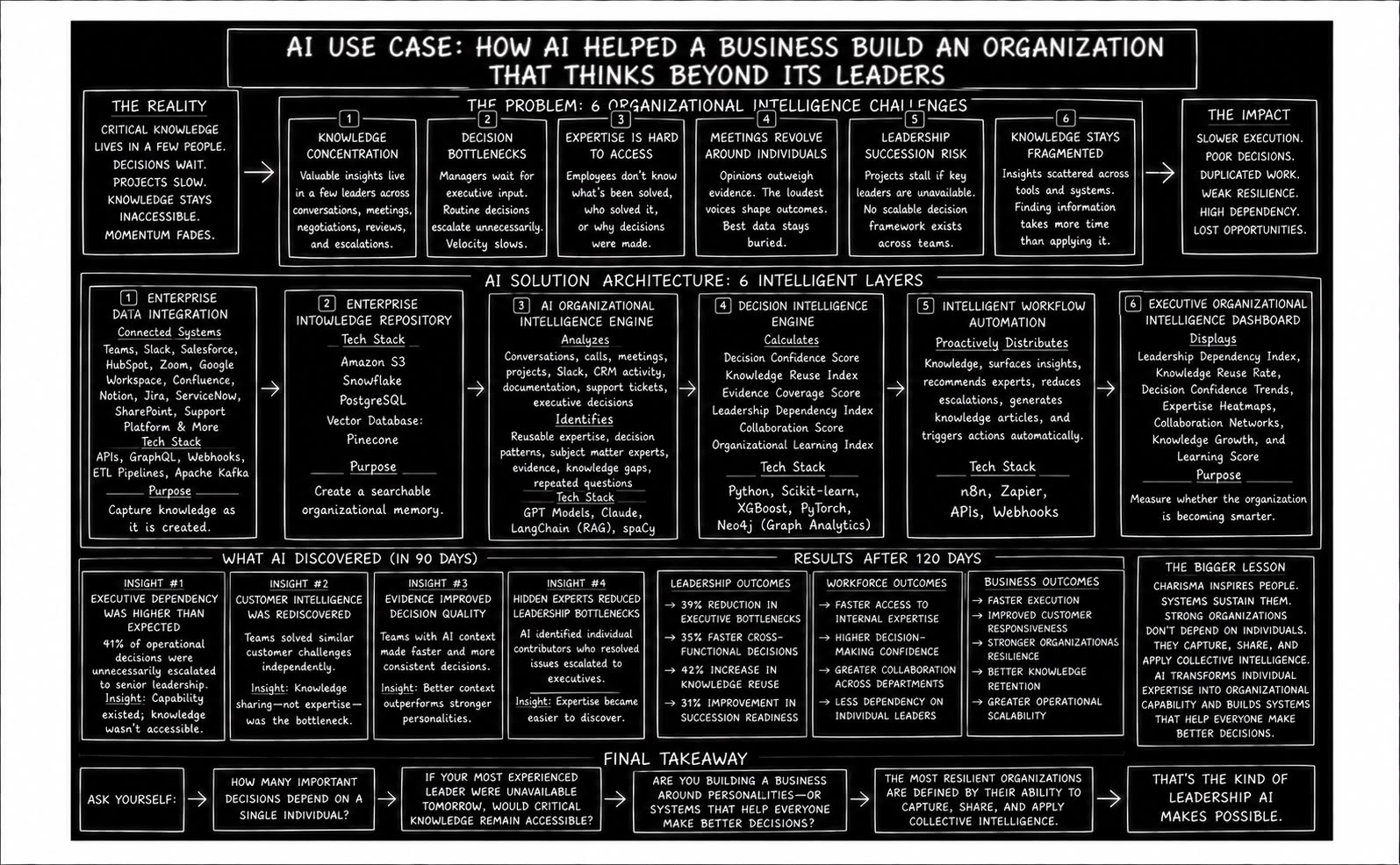
This case study explores how a rapidly growing technology company used AI to transform leadership from personality-driven influence into scalable organizational intelligence.
Company Background
A global B2B SaaS company with over 480 employees had expanded rapidly across North America, Europe, and Asia-Pacific.
Its workforce included:
* Sales
* Product
* Engineering
* Customer Success
* Marketing
* Operations
* Finance
* Human Resources
* Executive Leadership
The company had exceptional leaders.
Many customers specifically requested meetings with executives.
Internal teams frequently depended on senior leaders to resolve complex issues.
Initially, this appeared to be a strength.
Over time, leadership realized it had become a scalability problem.
The business wasn’t constrained by talent.
It was constrained by dependency.
The Problem
The organization faced six major organizational intelligence challenges.
1. Critical Knowledge Was Concentrated
The company’s most valuable insights lived inside a handful of experienced leaders.
Important business knowledge came from:
* Customer conversations
* Executive meetings
* Sales negotiations
* Product reviews
* Strategy sessions
* Support escalations
* Cross-functional workshops
Much of that knowledge never became organizational knowledge.
2. Decision-Making Bottlenecks
Managers frequently delayed decisions while waiting for executive input.
Routine operational questions escalated unnecessarily.
Decision velocity slowed as the company grew.
3. Expertise Was Difficult to Access
Employees often didn’t know:
* Whether similar situations had already occurred
* Which expert had solved them previously
* Why past decisions had been made
Institutional knowledge depended on personal relationships.
4. Meetings Revolved Around Individuals
Many meetings focused on obtaining opinions from senior leaders rather than evaluating evidence.
The loudest voices often shaped outcomes.
The best data remained buried.
5. Leadership Succession Risk Increased
If experienced leaders became unavailable, projects slowed dramatically.
The organization lacked a scalable decision-making framework.
6. Knowledge Stayed Fragmented
Business intelligence remained scattered across:
* Slack
* Microsoft Teams
* CRM notes
* Meeting recordings
* Emails
* Project documentation
* Customer feedback
Employees spent more time searching for information than applying it.
Why Traditional Knowledge Systems Failed
The organization already invested heavily in collaboration technology.
Its ecosystem included:
* Microsoft Teams
* Slack
* Confluence
* Salesforce
* Notion
* Zoom
These platforms stored information.
They couldn’t answer questions like:
* Why was this decision made?
* What evidence supported it?
* Which similar situations already exist?
* What did previous customer conversations teach us?
* Who else has solved this problem?
The company had documentation.
It lacked organizational intelligence.
The AI Strategy
The company implemented an AI-Powered Organizational Intelligence Platform.
Instead of relying on individual leaders to remember every decision and every lesson, AI continuously captured organizational knowledge as work happened.
The objective was clear:
Build an organization that could think collectively instead of depending on individual memory.
The platform continuously answered:
* What do we already know?
* What evidence supports this decision?
* Who has relevant expertise?
* Which previous experiences should guide us?
AI became the organization’s collective intelligence layer.
AI Solution Architecture
The solution consisted of six intelligent layers.
Layer 1: Enterprise Data Integration
AI continuously captured operational knowledge.
Connected Systems
* Microsoft Teams
* Slack
* Salesforce
* HubSpot
* Zoom
* Google Workspace
* Confluence
* Notion
* Jira
* ServiceNow
* SharePoint
* Customer Support Platform
Tech Stack
* REST APIs
* GraphQL APIs
* Webhooks
* ETL Pipelines
* Apache Kafka
Purpose
Capture organizational knowledge as it is created.
Layer 2: Enterprise Knowledge Repository
Structured and unstructured business knowledge was centralized.
Tech Stack
* Amazon S3
* Snowflake
* PostgreSQL
* Vector Database:
* Pinecone
Purpose
Create a searchable organizational memory.
Layer 3: AI Organizational Intelligence Engine
AI analyzed:
* Customer conversations
* Sales calls
* Team meetings
* Project reviews
* Slack discussions
* CRM activity
* Product documentation
* Support tickets
* Executive decisions
The platform automatically identified:
* Reusable expertise
* Decision patterns
* Subject matter experts
* Supporting evidence
* Knowledge gaps
* Frequently repeated questions
Example insight:
“This customer implementation issue has been successfully resolved five times by different teams, yet 80% of employees are unaware of those solutions.”
Tech Stack
* OpenAI GPT Models
* Claude
* Retrieval-Augmented Generation (RAG) using LangChain
* spaCy
Layer 4: Decision Intelligence Engine
Machine learning continuously analyzed organizational decision-making.
AI calculated:
* Decision Confidence Score
* Knowledge Reuse Index
* Evidence Coverage Score
* Leadership Dependency Index
* Collaboration Score
* Organizational Learning Index
Tech Stack
* Python
* Scikit-learn
* XGBoost
* PyTorch
* Graph analytics using Neo4j to understand expertise and collaboration networks
Layer 5: Intelligent Workflow Automation
AI proactively distributed knowledge.
Examples:
* New customer issue detected → Similar resolutions surfaced automatically
* Executive decision recorded → Supporting context indexed for future reuse
* New project begins → Relevant historical lessons recommended
* Employee asks a question → AI retrieves previous discussions and expert guidance
* Leadership dependency detected → Knowledge article generated automatically
Tech Stack
* n8n
* Zapier
* APIs
* Webhooks
Layer 6: Executive Organizational Intelligence Dashboard
Leadership received real-time visibility into organizational capability.
Dashboard displayed:
* Leadership Dependency Index
* Knowledge Reuse Rate
* Organizational Learning Score
* Decision Confidence Trends
* Expertise Heatmaps
* Collaboration Networks
* Knowledge Contribution Metrics
* Institutional Knowledge Growth
Leadership could finally measure whether the organization was becoming smarter—not just busier.
What AI Discovered
Within 90 days, AI uncovered several hidden opportunities.
Hidden Insight #1: Executive Dependency Was Higher Than Expected
Nearly 41% of operational decisions were unnecessarily escalated to senior leadership.
Insight
Decision-making capability already existed—it simply wasn’t supported with accessible knowledge.
Hidden Insight #2: Customer Intelligence Was Repeatedly Rediscovered
Sales and Customer Success teams solved similar customer challenges independently.
Insight
Knowledge sharing—not expertise—was the bottleneck.
Hidden Insight #3: Evidence Improved Decision Quality
Teams that accessed AI-recommended historical context made faster and more consistent decisions.
Insight
Better decisions came from better context, not stronger personalities.
Hidden Insight #4: Hidden Experts Reduced Leadership Bottlenecks
AI identified several individual contributors whose expertise resolved issues previously escalated to executives.
Insight
Leadership capacity increased by making expertise easier to discover.
Results After 120 Days
The AI implementation delivered measurable improvements.
Leadership Outcomes
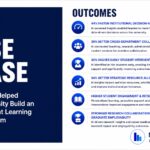
* 39% reduction in executive decision bottlenecks
* 35% faster cross-functional decision-making
* 42% increase in knowledge reuse
* 31% improvement in succession readiness
Workforce Outcomes
* Faster access to internal expertise
* Higher employee confidence in decision-making
* Greater collaboration across departments
* Reduced dependence on individual leaders
Business Outcomes
* Faster execution
* Improved customer responsiveness
* Stronger organizational resilience
* Better knowledge retention
* Increased operational scalability
The Bigger Lesson
Charisma can inspire people.
But scalable organizations are built on systems, not personalities.
The strongest leaders don’t become indispensable.
They build organizations that no longer depend on them for every important decision.
That’s where AI creates real leverage.
Not by replacing leadership.
By distributing intelligence.
AI transforms:
Individual expertise…
Into organizational capability.
Leadership influence…
Into scalable systems.
Personal knowledge…
Into enterprise intelligence.
Final Takeaway
Ask yourself:
* How many important decisions in your organization depend on a single individual?
* If your most experienced leader were unavailable tomorrow, would critical knowledge remain accessible?
* Are you building a business around personalities—or around systems that help everyone make better decisions?
The most resilient organizations aren’t defined by charismatic leaders.
They’re defined by their ability to capture, share, and apply collective intelligence.
That’s the kind of leadership AI makes possible.


⭐ ⭐⭐⭐⭐Top Rated AI Growth & Efficiency Strategist on Upwork
upwork.com/fl/navinmirania
If you’re exploring how AI can improve leadership visibility, knowledge management, workflow automation, or decision-making, let’s connect.
I help founders and organizations build practical AI-powered systems that transform fragmented business data into actionable insights, scalable knowledge, and measurable business growth.