AI Competitive Intelligence
Markets have never moved faster.
Customer expectations evolve overnight.
Competitors launch new products in weeks instead of years.
Technology that once created a competitive edge quickly becomes an industry standard.
For many organizations, the challenge is no longer building a competitive advantage.
It’s keeping one.
This case study explores how a fast-growing technology company used AI to detect emerging market shifts, identify new opportunities before competitors, and transform fragmented business signals into continuous strategic intelligence.
Company Background
A global B2B SaaS company with over 600 employees served customers across North America, Europe, and Asia-Pacific.
Its teams included:
* Sales
* Marketing
* Product
* Engineering
* Customer Success
* Operations
* Finance
* Executive Leadership
The company had enjoyed several years of rapid growth.
However, leadership noticed an emerging pattern.
Products that once differentiated the business were becoming commoditized.
Customer expectations shifted faster than product roadmaps.
Competitors were reacting to market changes more quickly.
Leadership realized they weren’t losing because of poor execution.
They were losing because they were reacting too late.
The Problem
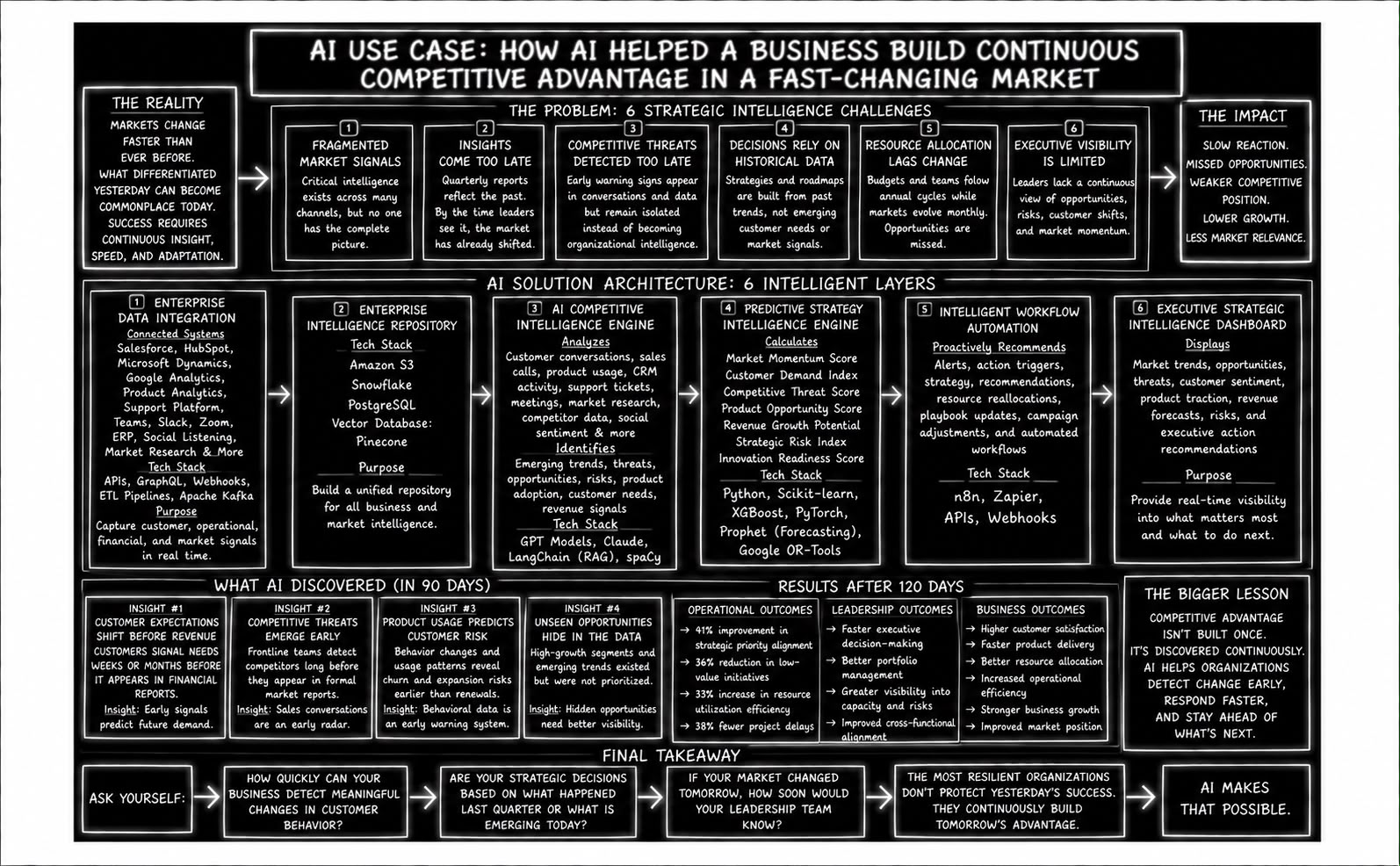
The organization faced six strategic intelligence challenges.
1. Market Signals Were Fragmented
Critical competitive intelligence existed across:
* Customer conversations
* Sales calls
* CRM opportunities
* Product usage analytics
* Customer support tickets
* Website analytics
* Market research
* Social listening
* Executive meetings
No single team could see the complete picture.
2. Customer Behavior Changed Faster Than Reporting
Quarterly reports highlighted historical trends.
By the time insights reached leadership, customer behavior had already evolved.
3. Competitive Threats Were Detected Too Late
Sales teams mentioned new competitors.
Customer Success reported changing expectations.
Marketing noticed declining engagement.
These signals remained isolated instead of becoming organizational intelligence.
4. Product Decisions Relied on Historical Data
Roadmaps were built using past demand rather than emerging customer needs.
Innovation gradually became reactive.
5. Resource Allocation Lagged Behind Market Change
Budget and staffing decisions followed annual planning cycles.
Markets changed monthly.
6. Executive Visibility Was Limited
Leadership lacked a continuous view of:
* Emerging opportunities
* Customer sentiment shifts
* Competitive positioning
* Revenue risks
* Market momentum
Strategic planning became backward-looking.
Why Traditional Business Intelligence Failed
The organization already invested heavily in analytics platforms.
Its technology ecosystem included:
* Salesforce
* HubSpot
* Google Analytics
* Power BI
* Tableau
* Microsoft Teams
These systems produced excellent reports.
They couldn’t answer questions like:
* What customer behaviors are changing right now?
* Which competitors are gaining momentum?
* Which products are becoming less relevant?
* Where should we invest next?
* Which emerging trends deserve immediate attention?
The company had business intelligence.
It lacked strategic intelligence.
The AI Strategy
The company implemented an AI-Powered Competitive Intelligence Platform.
Instead of producing static dashboards, AI continuously analyzed internal and external signals to detect change while it was still emerging.
The objective was simple:
Turn fragmented business data into continuous competitive advantage.
The platform continuously answered:
* What is changing?
* Why is it changing?
* How quickly is it changing?
* What should leadership do next?
AI became the organization’s early warning system.
AI Solution Architecture
The solution consisted of six intelligent layers.
Layer 1: Enterprise Data Integration
AI continuously collected business signals.
Connected Systems
* Salesforce
* HubSpot
* Microsoft Dynamics
* Google Analytics
* Product Analytics Platform
* Customer Support Platform
* Microsoft Teams
* Slack
* Zoom
* ERP System
* Social Listening Platform
* Market Research Platform
* Financial Systems
Tech Stack
* REST APIs
* GraphQL APIs
* Webhooks
* ETL Pipelines
* Apache Kafka
Purpose
Capture customer, operational, financial, and market signals in real time.
Layer 2: Enterprise Intelligence Repository
Business intelligence was centralized into a unified repository.
Tech Stack
* Amazon S3
* Snowflake
* PostgreSQL
* Vector Database:
* Pinecone
Purpose
Build a searchable enterprise intelligence layer.
Layer 3: AI Competitive Intelligence Engine
AI analyzed:
* Customer conversations
* Sales calls
* Product usage
* CRM opportunities
* Support tickets
* Product feedback
* Win-loss reports
* Internal meetings
* Market research
* Competitive intelligence feeds
The platform automatically identified:
* Emerging customer needs
* Competitive threats
* Market shifts
* Product adoption trends
* Revenue opportunities
* Strategic risks
Example insight:
“Enterprise customers in healthcare have increased requests for AI-powered workflow automation by 47% over the past eight weeks, while competitor mentions have doubled.”
Tech Stack
* OpenAI GPT Models
* Claude
* Retrieval-Augmented Generation (RAG) using LangChain
* spaCy
Layer 4: Predictive Strategy Intelligence Engine
Machine learning identified emerging patterns before they became obvious.
AI calculated:
* Market Momentum Score
* Customer Demand Index
* Competitive Threat Score
* Product Opportunity Score
* Revenue Growth Potential
* Strategic Risk Index
* Innovation Readiness Score
Tech Stack
* Python
* Scikit-learn
* XGBoost
* PyTorch
* Time-series forecasting using Prophet for trend prediction
Layer 5: Intelligent Workflow Automation
AI proactively recommended strategic action.
Examples:
* New customer trend detected → Product team notified
* Competitive threat identified → Sales battle card generated
* Revenue opportunity emerging → Executive strategy alert created
* Customer sentiment shifts → Customer Success playbook updated
* Product adoption changes → Marketing campaigns adjusted automatically
Tech Stack
* n8n
* Zapier
* APIs
* Webhooks
Layer 6: Executive Strategic Intelligence Dashboard
Leadership gained a live view of market evolution.
Dashboard displayed:
* Market Momentum Index
* Emerging Customer Trends
* Competitive Threat Heatmap
* Product Adoption Dashboard
* Revenue Opportunity Pipeline
* Strategic Risk Indicators
* Customer Sentiment Trends
* Innovation Opportunity Score
* Executive Action Recommendations
Instead of reviewing quarterly reports, leaders received continuous strategic intelligence.
What AI Discovered
Within 90 days, AI uncovered several hidden opportunities.
Hidden Insight #1: Customer Expectations Changed Before Revenue Did
AI detected rising demand for AI-enabled workflow automation months before it appeared in sales forecasts.
Insight
Customer conversations predicted future demand earlier than financial reports.
Hidden Insight #2: Competitive Threats Emerged Through Sales Conversations
Sales teams repeatedly mentioned a new competitor long before it appeared in formal market reports.
Insight
Frontline teams became the company’s earliest competitive intelligence source.
Hidden Insight #3: Product Usage Predicted Churn
Changes in customer usage patterns consistently appeared weeks before renewal risks.
Insight
Behavioral data became an early warning system.
Hidden Insight #4: Resource Allocation Lagged Behind Opportunity
AI identified rapidly growing customer segments receiving disproportionately low investment.
Insight
The biggest growth opportunities were already visible—but hidden inside operational data.
Results After 120 Days
The AI implementation delivered measurable improvements.
Strategic Outcomes
* 44% faster identification of emerging market trends
* 38% improvement in strategic planning accuracy
* 36% earlier detection of competitive threats
* 34% better prioritization of growth opportunities
Leadership Outcomes
* Faster executive decision-making
* Greater market visibility
* Improved resource allocation
* Stronger cross-functional alignment
Business Outcomes
* Increased product adoption
* Improved customer retention
* Faster response to market shifts
* Higher revenue growth
* Stronger competitive positioning
* Greater organizational agility
The Bigger Lesson
Competitive advantage is no longer something organizations build once.
It’s something they continuously discover.
The companies that outperform competitors aren’t always the ones with the best products.
They’re the ones that recognize change first—and respond fastest.
That’s where AI creates real leverage.
Not by predicting the future.
By helping organizations detect meaningful change before everyone else.
AI transforms:
Historical reporting…
Into continuous strategic intelligence.
Reactive planning…
Into proactive adaptation.
Static advantage…
Into continuous competitive advantage.
Final Takeaway
Ask yourself:
* How quickly can your organization detect meaningful changes in customer behavior?
* Are your strategic decisions based on what happened last quarter – or what is emerging today?
* If your market changed tomorrow, how soon would your leadership team know?
The most resilient organizations don’t protect yesterday’s success.
They continuously build tomorrow’s advantage.
AI makes that possible.


⭐ ⭐ ⭐ ⭐ ⭐ Top Rated AI Growth & Efficiency Strategist on Upwork
upwork.com/fl/navinmirania
If you’re exploring how AI can improve strategic planning, customer intelligence, workflow automation, competitive analysis, or executive decision-making, let’s connect.
I help founders and organizations build practical AI-powered systems that transform fragmented business data into actionable insights, faster adaptation, and measurable business growth.