AI Leadership Intelligence
Every organization has influential people.
Some hold senior titles.
Others don’t.
Yet when difficult problems arise, everyone knows who they turn to.
The product manager who consistently solves customer issues.
The engineer who prevents critical outages.
The customer success specialist who rescues key accounts.
The operations lead who quietly keeps projects moving.
Their influence wasn’t assigned.
It was earned.
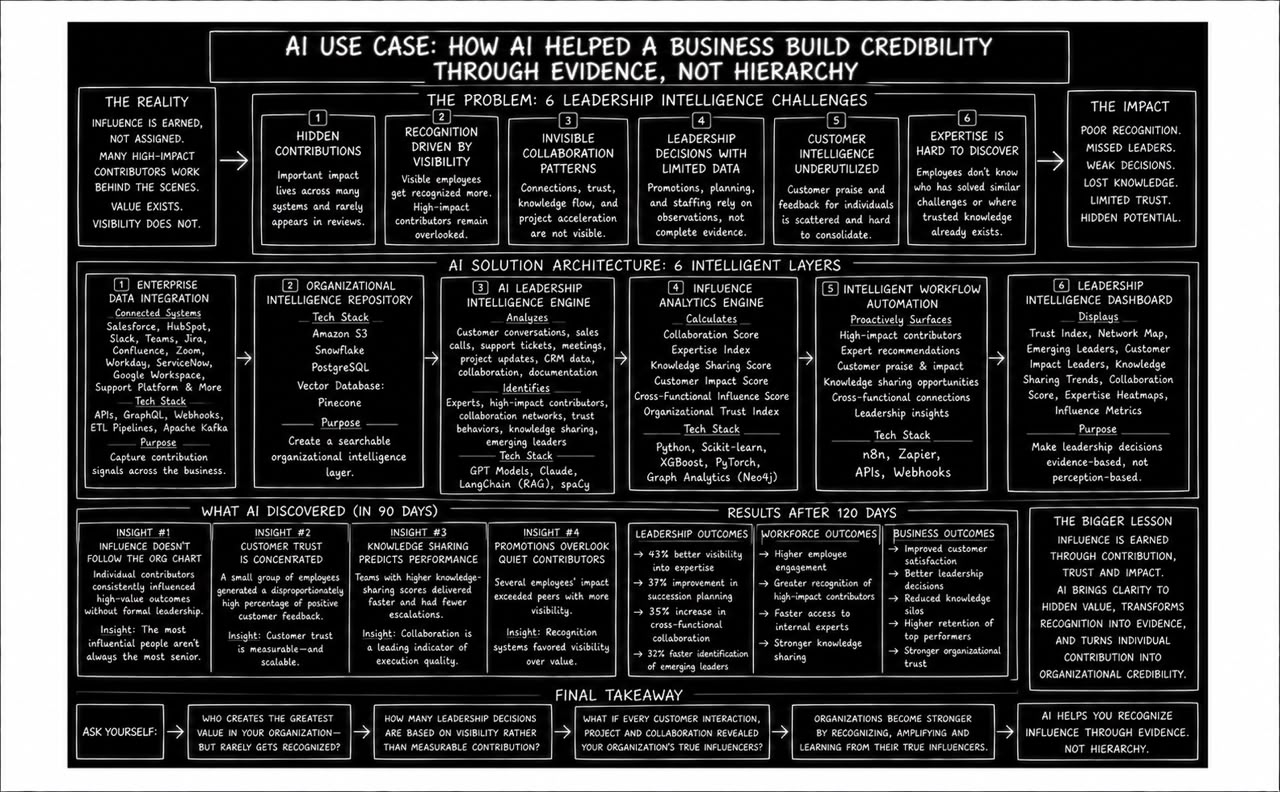
This case study explores how a growing technology company used AI to identify hidden expertise, recognize real business impact, and help leaders build credibility through evidence rather than hierarchy.
Company Background
A fast-growing B2B technology company with over 450 employees was expanding across multiple regions.
Its workforce included:
* Sales
* Product
* Engineering
* Marketing
* Customer Success
* Operations
* Human Resources
* Executive Leadership
The company had no shortage of talented people.
Yet leadership noticed an increasing challenge.
Recognition wasn’t always aligned with contribution.
Some employees were highly visible.
Others created tremendous value behind the scenes.
Leaders wanted to understand who was truly influencing business outcomes.
The Problem
The organization faced six leadership intelligence challenges.
1. Valuable Contributions Were Hidden
Important business impact occurred across:
* Customer conversations
* Sales calls
* CRM activities
* Project updates
* Slack discussions
* Internal documentation
* Support escalations
Much of it never appeared in performance reviews.
2. Recognition Was Driven by Visibility
Employees who presented frequently or managed larger teams often received greater recognition.
Meanwhile, many high-impact contributors remained largely invisible.
Leadership lacked objective visibility into value creation.
3. Collaboration Patterns Were Invisible
The company couldn’t identify:
* Which employees connected teams
* Who accelerated projects
* Where knowledge flowed
* Which relationships improved execution
Influence remained anecdotal.
4. Leadership Decisions Relied on Limited Information
Promotion, succession planning, and strategic staffing decisions were based on manager observations and periodic reviews.
Important evidence remained scattered across dozens of systems.
5. Customer Intelligence Was Underutilized
Customer feedback frequently praised individuals who rarely interacted with senior leadership.
Those signals were difficult to consolidate.
6. Organizational Expertise Was Difficult to Discover
Employees often didn’t know:
* Who had solved similar challenges
* Which teams possessed critical expertise
* Where trusted knowledge already existed
Expertise stayed hidden.
Why Traditional Performance Systems Failed
The organization already used modern business platforms.
Its technology ecosystem included:
* Salesforce
* Workday
* Slack
* Microsoft Teams
* Jira
* Confluence
These systems tracked activity.
They couldn’t answer questions like:
* Who creates the greatest organizational value?
* Which employees consistently influence successful outcomes?
* Where is trust naturally forming across teams?
* Who should mentor others?
* Which expertise is shaping customer success?
The organization measured performance.
It didn’t measure influence.
The AI Strategy
The company implemented an AI-Powered Leadership Intelligence Platform.
Rather than evaluating employees by hierarchy, AI continuously analyzed how people contributed to business outcomes.
The objective was clear:
Identify earned influence through evidence.
The platform continuously answered:
* Who consistently creates value?
* Where is expertise emerging?
* Which employees strengthen collaboration?
* What behaviors build trust across the organization?
AI became a leadership intelligence layer rather than a performance monitoring system.
AI Solution Architecture
The solution consisted of six intelligent layers.
Layer 1: Enterprise Data Integration
AI continuously collected operational and collaboration signals.
Connected Systems
* Salesforce
* HubSpot
* Slack
* Microsoft Teams
* Jira
* Confluence
* Zoom
* Workday
* ServiceNow
* Google Workspace
* Customer Support Platform
Tech Stack
* REST APIs
* GraphQL APIs
* Webhooks
* ETL Pipelines
* Apache Kafka
Purpose
Capture contribution signals across the business.
Layer 2: Organizational Intelligence Repository
Business activity was centralized into a unified data platform.
Tech Stack
* Amazon S3
* Snowflake
* PostgreSQL
* Vector Database:
* Pinecone
Purpose
Create a searchable organizational intelligence layer.
Layer 3: AI Leadership Intelligence Engine
AI analyzed:
* Customer conversations
* Sales calls
* Support tickets
* Team meetings
* Project updates
* Collaboration history
* CRM interactions
* Internal documentation
The platform automatically identified:
* Subject matter experts
* High-impact contributors
* Collaboration networks
* Trust-building behaviors
* Knowledge-sharing patterns
* Emerging leaders
Example insight:
“Although not a manager, this implementation consultant is referenced in more successful customer projects than any other employee.”
Tech Stack
* OpenAI GPT Models
* Claude
* Retrieval-Augmented Generation (RAG) using LangChain
* spaCy
Layer 4: Influence Analytics Engine
Machine learning analyzed organizational influence patterns.
AI calculated:
* Collaboration Score
* Expertise Index
* Knowledge Sharing Score
* Customer Impact Score
* Cross-Functional Influence Score
* Organizational Trust Index
Tech Stack
* Python
* Scikit-learn
* XGBoost
* PyTorch
* Graph analytics using Neo4j to understand collaboration networks
Layer 5: Intelligent Workflow Automation
AI proactively surfaced expertise and recognized impact.
Examples:
* High-impact contributor identified → Leadership notified
* Employee begins similar project → Relevant expert recommended
* Customer praise detected → Contribution highlighted
* Knowledge-sharing opportunity identified → Internal learning session suggested
* Cross-functional collaboration increases → Leadership insights updated
Tech Stack
* n8n
* Zapier
* APIs
* Webhooks
Layer 6: Leadership Intelligence Dashboard
Executives gained a real-time view of organizational influence.
Dashboard displayed:
* Organizational Trust Index
* Collaboration Network Map
* Emerging Leaders
* Customer Impact Leaders
* Knowledge Sharing Trends
* Cross-Functional Collaboration Score
* Expertise Heatmaps
* Leadership Influence Metrics
Leadership decisions became evidence-based rather than perception-based.
What AI Discovered
Within 90 days, AI uncovered several important insights.
Hidden Insight #1: Influence Didn’t Follow the Org Chart
Several individual contributors consistently influenced high-value customer outcomes despite having no formal leadership role.
Insight
The most influential people weren’t always the most senior.
Hidden Insight #2: Customer Trust Was Concentrated
A small group of employees generated a disproportionately high percentage of positive customer feedback.
Insight
Customer trust was measurable—and scalable.
Hidden Insight #3: Knowledge Sharing Predicted Team Performance
Teams with higher internal knowledge-sharing scores delivered projects faster and reported fewer escalations.
Insight
Collaboration was a leading indicator of execution quality.
Hidden Insight #4: Promotions Overlooked Quiet Contributors
AI identified several employees whose measurable business impact exceeded that of peers with greater visibility.
Insight
Recognition systems favored visibility over value.
Results After 120 Days
The AI implementation delivered measurable improvements.
Leadership Outcomes
* 43% better visibility into organizational expertise
* 37% improvement in succession planning decisions
* 35% increase in cross-functional collaboration
* 32% faster identification of emerging leaders
Workforce Outcomes
* Higher employee engagement
* Greater recognition of high-impact contributors
* Faster access to internal experts
* Stronger knowledge sharing
Business Outcomes
* Improved customer satisfaction
* Better leadership decisions
* Reduced knowledge silos
* Higher retention of top performers
* Stronger organizational trust
The Bigger Lesson
Influence cannot be assigned.
It is earned through consistent contribution, trust, and value creation.
The strongest organizations don’t simply promote authority.
They recognize impact.
That’s where AI creates real leverage.
Not by giving leaders more power.
By giving them greater clarity.
AI transforms:
Hierarchy…
Into transparency.
Recognition…
Into evidence.
Individual contribution…
Into organizational credibility.
Final Takeaway
Ask yourself:
* Who creates the greatest value inside your organization—but rarely gets recognized?
* How many leadership decisions are based on visibility rather than measurable contribution?
* What if every customer interaction, project, and collaboration helped reveal your organization’s true influencers?
Organizations don’t become stronger by concentrating power.
They become stronger by recognizing, amplifying, and learning from the people who create the greatest value every day.



⭐ ⭐⭐⭐⭐Top Rated AI Growth & Efficiency Strategist on Upwork
upwork.com/fl/navinmirania
If you’re exploring how AI can improve leadership visibility, knowledge management, workflow automation, or decision-making, let’s connect.
I help founders and organizations build practical AI-powered systems that transform fragmented business data into actionable insights, stronger leadership, and measurable business growth.