AI Team Intelligence
Organizations spend millions attracting top talent.
They invest in better hiring.
Better training.
Better managers.
Better collaboration tools.
Yet many teams still underperform.
Why?
Because great teams aren’t simply collections of talented individuals.
They’re systems where talented people can perform at their best.
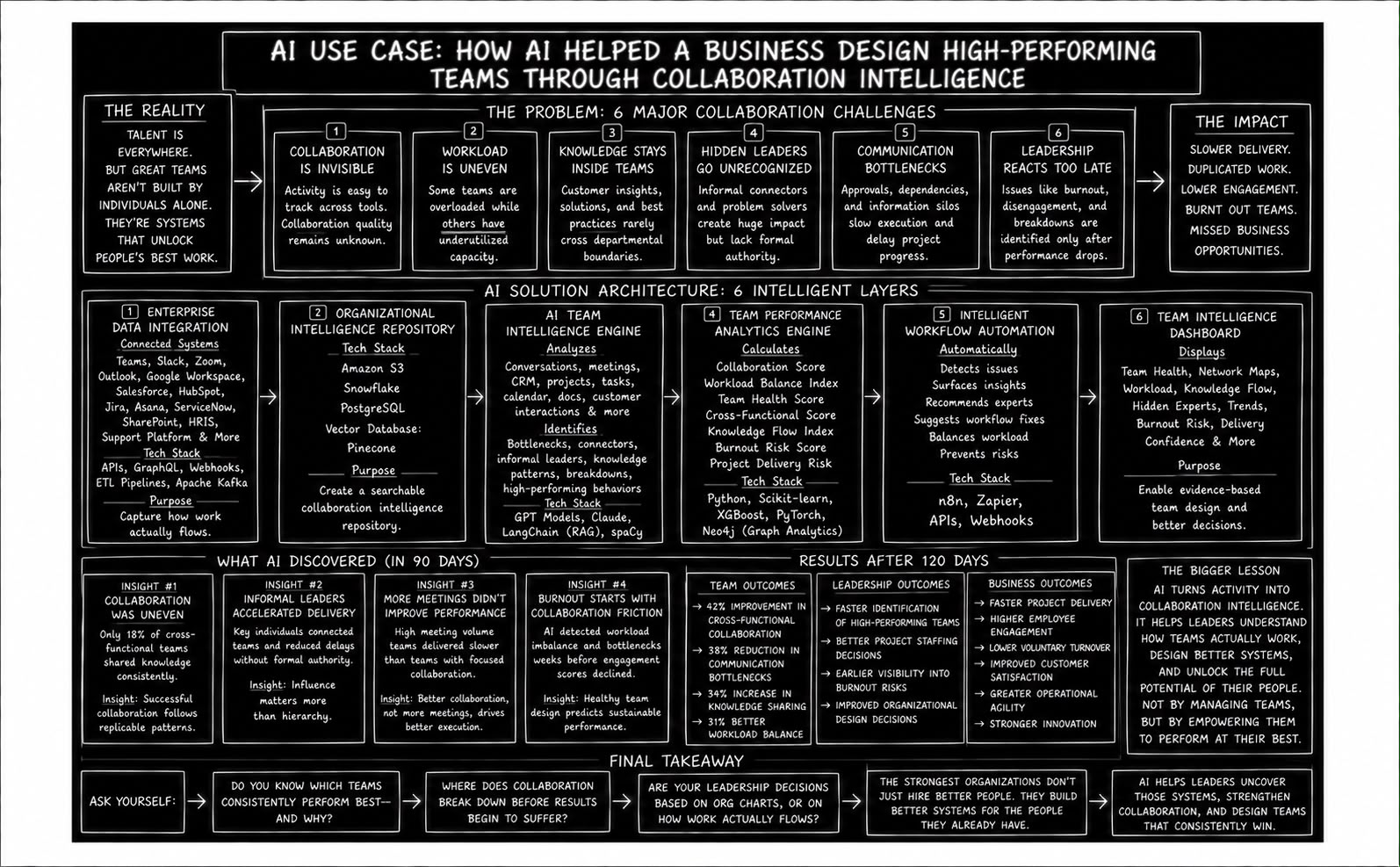
This case study explores how a rapidly growing technology company used AI to understand how teams actually collaborated, identify hidden bottlenecks, and redesign work around evidence instead of assumptions.
Company Background
A fast-growing B2B SaaS company with over 500 employees was scaling rapidly across North America, Europe, and Asia-Pacific.
Its workforce included:
* Sales
* Product
* Engineering
* Customer Success
* Marketing
* Operations
* Finance
* Human Resources
* Executive Leadership
As the company grew, collaboration became increasingly complex.
Projects involved multiple departments.
Hybrid work became the norm.
New communication tools were introduced.
Leadership believed more collaboration would improve execution.
Instead, they saw slower decision-making, duplicated work, and declining employee engagement.
The company didn’t have a talent problem.
It had a team design problem.
The Problem
The organization faced six major collaboration challenges.
1. Collaboration Was Invisible
Teams communicated through:
* Microsoft Teams
* Slack
* Zoom
* Jira
* Asana
* Salesforce
* Customer Support Platforms
Leadership could measure activity.
They couldn’t understand collaboration quality.
2. Workload Was Uneven
Some employees managed multiple high-priority initiatives simultaneously.
Others had significant unused capacity.
Managers discovered workload issues only after deadlines slipped.
3. Knowledge Stayed Inside Teams
Customer insights.
Technical solutions.
Operational improvements.
Best practices.
Often remained inside individual departments.
Cross-functional learning happened inconsistently.
4. Hidden Leaders Went Unrecognized
Certain employees naturally connected teams, solved conflicts, and accelerated projects.
Because they lacked formal leadership roles, their contribution often went unnoticed.
5. Communication Bottlenecks Delayed Execution
Projects frequently stalled because approvals, dependencies, and information flow weren’t visible.
Teams waited for updates instead of making progress.
6. Leadership Reacted Too Late
Employee disengagement, burnout, and collaboration breakdowns were typically identified only after performance declined.
Leadership lacked predictive visibility.
Why Traditional Collaboration Tools Failed
The company already invested heavily in workplace technology.
Its collaboration stack included:
* Microsoft Teams
* Slack
* Asana
* Jira
* Salesforce
* Google Workspace
These platforms helped teams communicate.
They couldn’t answer questions like:
* Which teams collaborate most effectively?
* Where does knowledge stop flowing?
* Who quietly connects multiple departments?
* Which projects are most at risk?
* Which teams are overloaded?
* What team structure consistently produces the best outcomes?
The company had communication.
It lacked collaboration intelligence.
The AI Strategy
The company implemented an AI-Powered Team Intelligence Platform.
Rather than monitoring employees, AI analyzed how work flowed across the organization.
The objective was simple:
Help leaders design better teams using real operational evidence.
The platform continuously answered:
* Which teams collaborate best?
* Where are bottlenecks forming?
* Who are the hidden connectors?
* Which employees are overloaded?
* What team structures consistently succeed?
AI became an organizational design engine rather than a productivity tracker.
AI Solution Architecture
The solution consisted of six intelligent layers.
Layer 1: Enterprise Data Integration
AI continuously collected collaboration and operational signals.
Connected Systems
* Microsoft Teams
* Slack
* Zoom
* Outlook
* Google Workspace
* Salesforce
* HubSpot
* Jira
* Asana
* ServiceNow
* SharePoint
* HRIS Platform
* Customer Support Platform
Tech Stack
* REST APIs
* GraphQL APIs
* Webhooks
* ETL Pipelines
* Apache Kafka
Purpose
Capture how work actually flows across the organization.
Layer 2: Organizational Intelligence Repository
All collaboration data was centralized into a unified enterprise knowledge platform.
Tech Stack
* Amazon S3
* Snowflake
* PostgreSQL
* Vector Database:
* Pinecone
Purpose
Create a searchable collaboration intelligence repository.
Layer 3: AI Team Intelligence Engine
AI analyzed:
* Slack conversations
* Microsoft Teams discussions
* Meeting transcripts
* CRM activity
* Customer interactions
* Project updates
* Calendar patterns
* Workload distribution
* Documentation
* Task completion history
The platform automatically identified:
* Collaboration bottlenecks
* Informal leaders
* Cross-functional connectors
* Communication breakdowns
* Knowledge-sharing patterns
* High-performing team behaviors
Example insight:
“Product and Customer Success teams collaborating weekly resolved enterprise customer issues 42% faster than teams working independently.”
Tech Stack
* OpenAI GPT Models
* Claude
* Retrieval-Augmented Generation (RAG) using LangChain
* spaCy
Layer 4: Team Performance Analytics Engine
Machine learning evaluated collaboration effectiveness and predicted future risks.
AI calculated:
* Collaboration Effectiveness Score
* Workload Balance Index
* Team Health Score
* Cross-Functional Collaboration Score
* Knowledge Flow Index
* Burnout Risk Score
* Project Delivery Risk
Tech Stack
* Python
* Scikit-learn
* XGBoost
* PyTorch
* Graph analytics using Neo4j to analyze collaboration networks
Layer 5: Intelligent Workflow Automation
AI automatically improved collaboration.
Examples:
* Workload imbalance detected → Manager notified
* Project risk increases → Cross-functional review scheduled
* Knowledge bottleneck identified → Relevant expert recommended
* Repeated communication issue detected → Workflow redesign suggested
* New project begins → AI recommends the optimal team based on historical performance
Tech Stack
* n8n
* Zapier
* APIs
* Webhooks
Layer 6: Executive Team Intelligence Dashboard
Leadership gained a real-time view of organizational collaboration.
Dashboard displayed:
* Team Health Scores
* Collaboration Network Maps
* Workload Distribution
* Knowledge Flow Heatmaps
* Hidden Expert Network
* Cross-Functional Collaboration Trends
* Burnout Risk Indicators
* Project Delivery Confidence
* Organizational Collaboration Index
Leadership could now improve team design using evidence instead of assumptions.
What AI Discovered
Within 90 days, AI uncovered several important insights.
Hidden Insight #1: Collaboration Was Uneven
Only 18% of cross-functional teams consistently shared knowledge effectively.
Insight
Successful collaboration followed identifiable patterns that could be replicated.
Hidden Insight #2: Informal Leaders Accelerated Delivery
Several employees with no formal management responsibility consistently reduced project delays by connecting teams and removing blockers.
Insight
Influence mattered more than hierarchy.
Hidden Insight #3: Meeting Volume Didn’t Improve Performance
Teams with the highest number of meetings delivered projects more slowly than teams with structured, purpose-driven collaboration.
Insight
Better collaboration—not more meetings—improved execution.
Hidden Insight #4: Burnout Started with Collaboration Friction
AI detected workload imbalance and communication bottlenecks weeks before employee engagement scores declined.
Insight
Healthy team design was a leading indicator of sustainable performance.
Results After 120 Days
The AI implementation delivered measurable improvements.
Team Outcomes
* 42% improvement in cross-functional collaboration
* 38% reduction in communication bottlenecks
* 34% increase in knowledge sharing
* 31% better workload balance
Leadership Outcomes
* Faster identification of high-performing teams
* Better project staffing decisions
* Earlier visibility into burnout risks
* Improved organizational design decisions
Business Outcomes
* Faster project delivery
* Higher employee engagement
* Lower voluntary turnover
* Improved customer satisfaction
* Greater operational agility
* Stronger innovation across departments
The Bigger Lesson
High-performing teams aren’t built by adding more managers, meetings, or tools.
They’re built by designing environments where talented people can collaborate effectively.
That’s where AI creates real leverage.
Not by managing teams.
By helping leaders understand how teams actually work.
AI transforms:
Activity…
Into collaboration intelligence.
Managers…
Into team architects.
Assumptions…
Into evidence-backed organizational design.
Final Takeaway
Ask yourself:
* Do you know which teams consistently perform best—and why?
* Where does collaboration break down before results begin to suffer?
* Are your leadership decisions based on organizational charts, or on how work actually flows?
The strongest organizations don’t simply hire better people.
They build better systems for the people they already have.
AI helps leaders uncover those systems, strengthen collaboration, and design teams that consistently perform at their best.


⭐ ⭐ ⭐ ⭐ ⭐ Top Rated AI Growth & Efficiency Strategist on Upwork
upwork.com/fl/navinmirania
If you’re exploring how AI can improve team effectiveness, operational visibility, workflow automation, and decision-making, let’s connect.
I help founders and organizations build practical AI-powered systems that transform fragmented business data into actionable insights, stronger collaboration, and measurable business growth.