Responsible AI Governance
Artificial intelligence is transforming how organizations operate.
Customer support teams use AI to resolve issues faster.
Sales teams personalize outreach with AI.
Marketing creates campaigns in minutes.
HR streamlines recruitment and employee support.
Finance automates reporting.
Operations optimize workflows.
Across every department, AI is accelerating productivity.
But as organizations adopt more third-party AI platforms, a critical misconception is emerging.
Many believe outsourcing AI also outsources the responsibility.
It doesn’t.
If an AI system exposes confidential information, makes biased recommendations, violates compliance policies, or damages customer trust, the responsibility remains with the business – not the AI provider.
This case study explores how a multinational financial services organization implemented an Enterprise AI Governance Platform that enabled rapid AI adoption while maintaining governance, security, compliance, and executive oversight.
Company Background
A global financial services company with over 3,500 employees operated across North America, Europe, and Asia-Pacific.
Its business depended on AI across multiple functions:
* Customer Service
* Sales
* Marketing
* Finance
* Risk Management
* Human Resources
* Legal & Compliance
* Operations
* Executive Leadership
Within eighteen months, the company had deployed AI across more than thirty business processes using multiple third-party platforms.
These included:
* Customer support assistants
* Sales copilots
* Marketing content generators
* HR assistants
* Financial analysis tools
* Executive reporting copilots
* Workflow automation agents
Productivity improved rapidly.
However, executives soon recognized that governance had not kept pace with innovation.
The Problem
The organization faced six major governance challenges.
1. AI Adoption Outpaced Governance
Individual departments selected AI platforms independently.
Each solution introduced its own:
* Security settings
* Access permissions
* Prompt libraries
* Knowledge sources
* Compliance controls
Innovation became decentralized.
Governance did not.
2. Sensitive Business Information Was Increasingly Exposed
Employees frequently entered confidential information into AI tools, including:
* Customer financial records
* Internal strategies
* Contract details
* Product roadmaps
* Pricing models
Leadership had little visibility into how sensitive information was being used.
3. AI Decisions Were Difficult to Explain
Executives struggled to answer:
* Why did AI recommend this action?
* Which knowledge sources were used?
* Which employee approved the response?
* Was company policy followed?
Without explainability, accountability became difficult.
4. Compliance Monitoring Was Fragmented
The company needed to comply with multiple regulatory frameworks while using AI across different regions.
However, compliance checks varied between departments, increasing operational risk.
5. Human Oversight Was Inconsistent
Some business-critical AI decisions required human approval.
Others were fully automated without standardized governance.
The level of oversight depended more on the implementation team than organizational policy.
6. Leadership Had Limited Enterprise Visibility
Executives couldn’t easily determine:
* Which AI systems presented the highest risk
* Which departments handled sensitive data most frequently
* Where policy violations occurred
* Which AI models required retraining
* Whether governance standards were consistently applied
AI adoption expanded faster than executive visibility.
Why Traditional Security Controls Failed
The organization already used enterprise-grade security and compliance tools, including:
* Microsoft Purview
* Microsoft Entra ID
* Okta
* Salesforce Shield
* ServiceNow
These platforms secured applications and user access.
They couldn’t answer:
* Is AI using approved business knowledge?
* Did AI expose confidential information?
* Which AI decisions require human review?
* Are AI systems following company policies?
* Can every AI-generated decision be audited?
The company had cybersecurity.
It lacked AI governance.
The AI Strategy
The organization implemented an Enterprise AI Governance & Trust Platform.
Instead of governing each AI application independently, leadership created a centralized governance layer that managed every AI interaction across the enterprise.
Every AI request passed through governance before reaching employees or customers.
The platform continuously evaluated:
* Knowledge accuracy
* Policy compliance
* Data sensitivity
* User authorization
* Regulatory obligations
* Business risk
* Human approval requirements
The objective was simple:
Allow innovation to scale without compromising governance.
AI Solution Architecture
The solution consisted of six intelligent layers.
Layer 1: Enterprise Data Integration
AI continuously synchronized enterprise data from trusted business systems.
Connected Systems
* Salesforce
* SAP ERP
* Microsoft Dynamics 365
* ServiceNow
* Microsoft Teams
* Slack
* SharePoint
* Confluence
* Workday
* Google Workspace
* Customer Data Platform
* Identity Management Systems
* Compliance Platforms
* Legal Document Repository
Tech Stack
* REST APIs
* GraphQL APIs
* Webhooks
* ETL Pipelines
* Apache Kafka
Purpose
Create secure, governed data pipelines across enterprise systems.
Layer 2: Enterprise Knowledge & Governance Repository
All approved business knowledge, governance policies, regulatory documentation, and audit records were centralized.
Tech Stack
* Amazon S3
* Snowflake
* PostgreSQL
* Vector Database:
* Pinecone
Purpose
Establish a governed enterprise source of truth for every AI interaction.
Layer 3: AI Governance & Policy Engine
Every AI interaction was validated before execution.
The platform analyzed:
* User identity
* Access permissions
* Prompt content
* Knowledge sources
* Business policies
* Regulatory requirements
* Data classification
* AI confidence levels
The system automatically:
* Blocked unauthorized requests
* Masked confidential information
* Validated responses against approved knowledge
* Applied governance policies
* Triggered human review when required
* Logged every AI decision
Example insight:
“The requested response contains confidential pricing information. User authorization is insufficient. Recommendation: redact sensitive fields and escalate to an authorized manager.”
Tech Stack
* OpenAI GPT Models
* Claude
* Retrieval-Augmented Generation (RAG) using LangChain
* spaCy
* Guardrails AI
* Microsoft Presidio for sensitive data detection and anonymization
Layer 4: AI Risk & Compliance Intelligence
Machine learning continuously evaluated governance performance.
AI generated:
* AI Risk Score
* Policy Compliance Score
* Sensitive Data Exposure Index
* Human Oversight Score
* Audit Readiness Index
* Regulatory Compliance Score
* AI Trust Index
Tech Stack
* Python
* Scikit-learn
* XGBoost
* PyTorch
* Neo4j to map relationships between users, AI agents, data assets, and governance policies
Layer 5: Intelligent Governance Automation
AI enforced governance automatically.
Examples:
* Sensitive customer data detected → Automatically masked
* High-risk AI response → Human approval required
* New governance policy published → Applied across every AI agent
* Regulatory update received → Compliance rules synchronized
* Repeated policy violations detected → Security team notified
* Complete audit trail generated for every AI interaction
Tech Stack
* n8n
* Zapier
* APIs
* Webhooks
Layer 6: Executive AI Governance Dashboard
Leadership gained complete visibility into enterprise AI usage.
Dashboard displayed:
* Enterprise AI Trust Score
* Policy Compliance Rate
* AI Risk Heatmap
* Sensitive Data Access Trends
* Human Review Queue
* Regulatory Compliance Status
* AI Adoption by Department
* Audit Readiness
* AI Governance Performance Score
Executives could manage AI governance with the same rigor as financial and operational performance.
What AI Discovered
Within 120 days, the governance platform uncovered several hidden risks.
Hidden Insight #1: Most Governance Risks Originated from Employee Prompts
Employees unintentionally shared sensitive business information with external AI tools.
Insight
The greatest governance risk wasn’t the AI model—it was uncontrolled data usage.
Hidden Insight #2: High-Risk Decisions Represented a Small Percentage of AI Activity
Less than 8% of AI interactions required human review.
Insight
Targeted governance enabled innovation without slowing productivity.
Hidden Insight #3: Policy Inconsistencies Created Compliance Gaps
Different departments applied governance standards differently.
Insight
Centralized AI governance improved consistency across the enterprise.
Hidden Insight #4: Executive Visibility Increased Organizational Confidence
Real-time governance dashboards enabled leadership to monitor AI adoption, compliance, and operational risk from a single platform.
Insight
Visibility transformed AI governance from reactive compliance into proactive risk management.
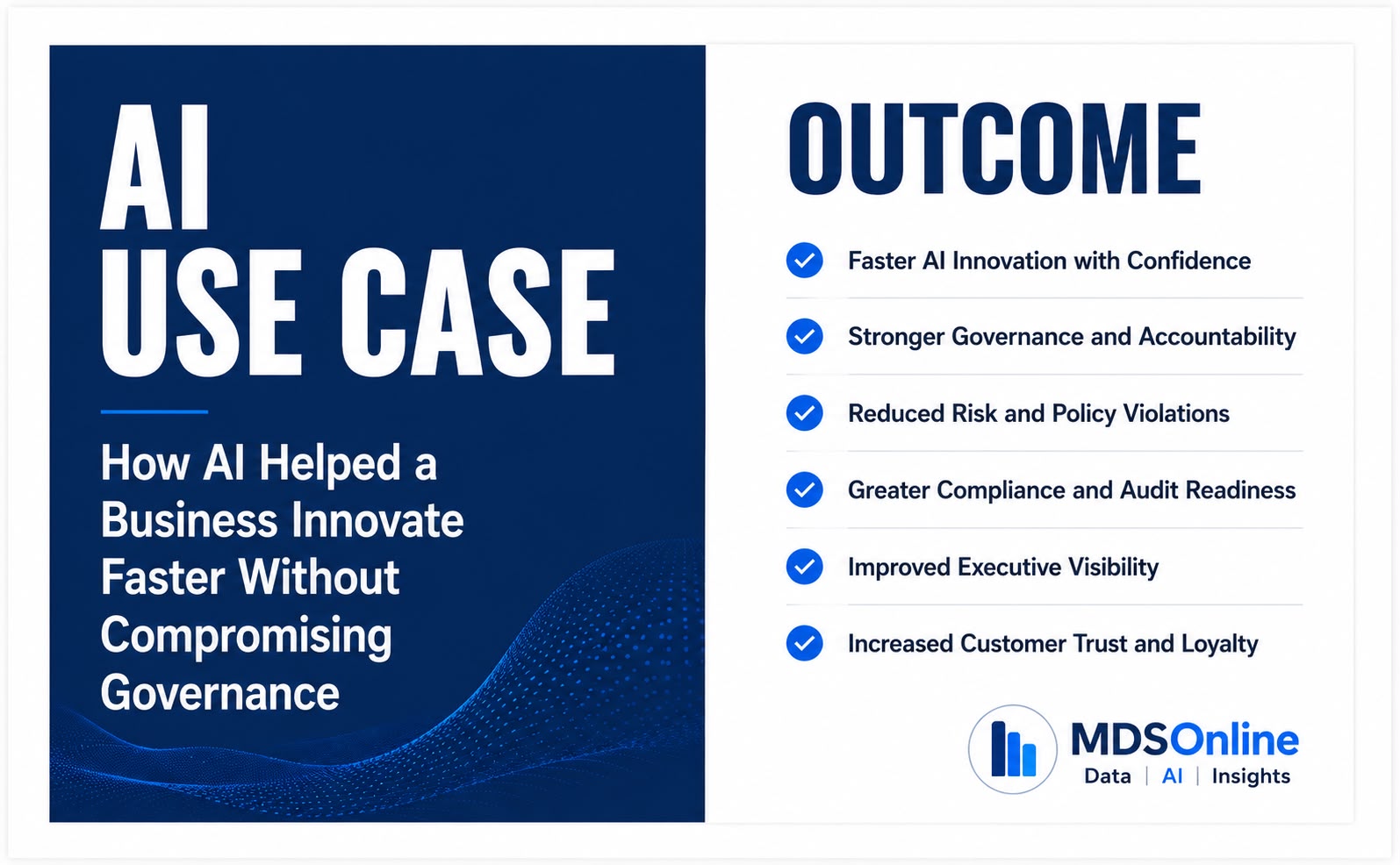
Results After 120 Days
Governance Outcomes
* 52% reduction in AI-related policy violations
* 47% improvement in AI compliance across business units
* 43% faster governance reviews
* 38% reduction in sensitive data exposure incidents
Leadership Outcomes
* Complete visibility into enterprise AI usage
* Stronger regulatory readiness
* Faster governance decision-making
* Increased confidence in enterprise AI adoption
Business Outcomes
* Greater customer trust
* More consistent AI implementation
* Lower operational and compliance risk
* Faster enterprise AI adoption
* Improved audit readiness
* Stronger organizational resilience
The Bigger Lesson
AI responsibility cannot be outsourced.
While organizations may rely on external AI models, accountability for customer trust, regulatory compliance, and business decisions always remains internal.
The companies that lead in the AI era won’t simply deploy AI faster.
They’ll build AI ecosystems that are governed, transparent, secure, and accountable.
That’s where AI becomes more than a technology investment.
It becomes a strategic capability.
Final Takeaway
Ask yourself:
* If one of your AI systems made a business-critical mistake today, could you explain exactly how the decision was made?
* Are your AI systems governed by consistent policies, or is each department creating its own rules?
* Are you outsourcing AI—or are you outsourcing accountability?
The organizations that build lasting competitive advantage with AI won’t be those that innovate the fastest.
They’ll be the ones that innovate with trust, governance, and accountability from day one.


If you’re exploring how to implement AI while maintaining governance, compliance, and operational control, let’s connect. I’d be happy to discuss practical AI architectures that help organizations innovate with confidence.
mdsonline.co.in