AI Strategic Prioritization
Every growing organization faces the same challenge.
Opportunities never stop arriving.
A customer requests a custom feature.
Sales asks for another proposal.
Marketing launches another campaign.
Leadership introduces another initiative.
Operations needs another report.
Each request seems reasonable.
Individually, saying “yes” feels like progress.
Collectively, those decisions quietly erode focus.
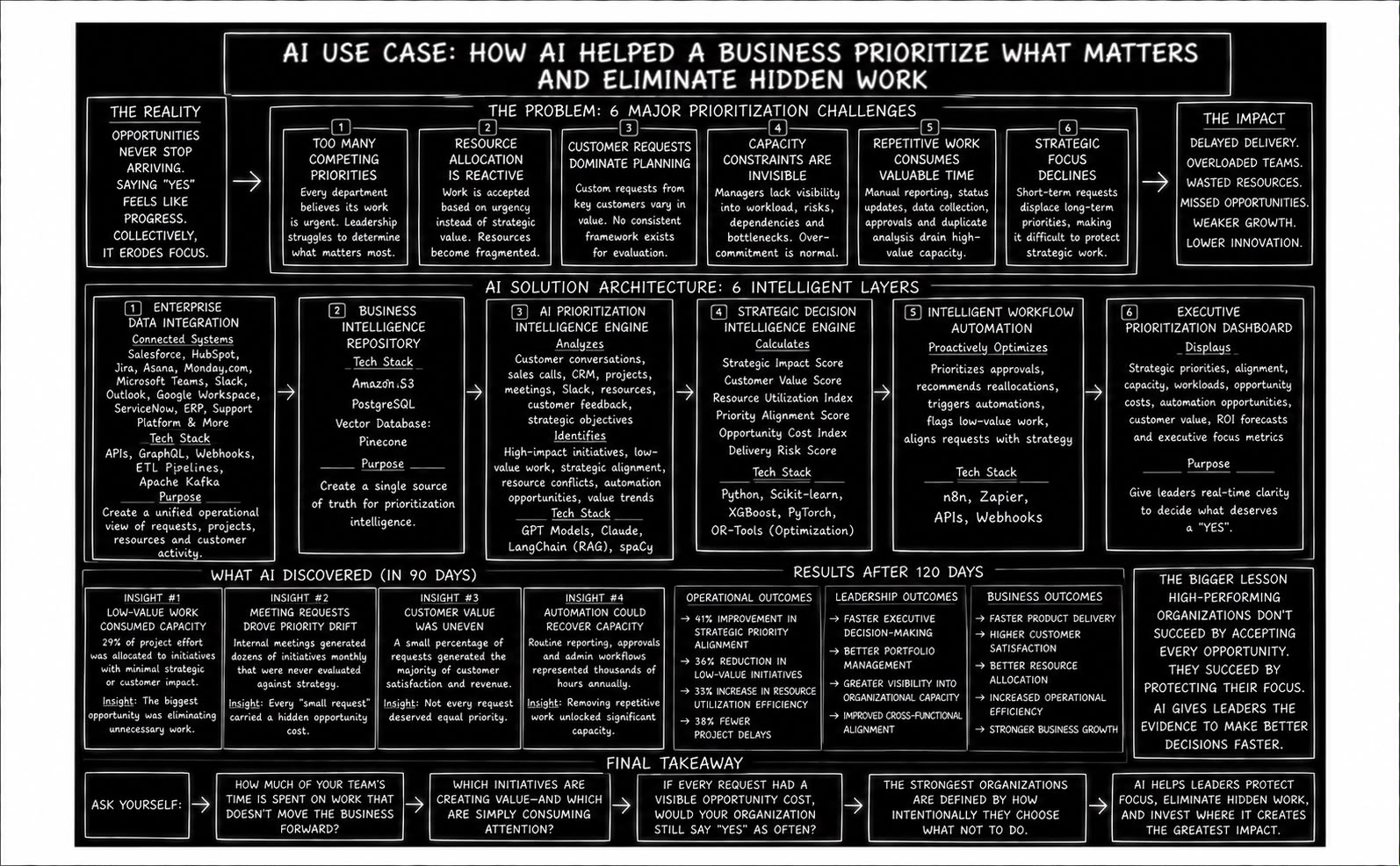
This case study explores how a fast-growing technology company used AI to distinguish high-impact work from low-value activity, helping leaders protect strategic priorities without slowing innovation.
Company Background
A rapidly growing B2B SaaS company with over 420 employees was expanding into new international markets.
Its workforce included:
* Sales
* Marketing
* Product
* Engineering
* Customer Success
* Operations
* Finance
* Executive Leadership
The business generated hundreds of requests every week.
Customer enhancements.
Internal projects.
Operational improvements.
Executive initiatives.
At first, leadership viewed this as healthy growth.
Over time, they realized something was changing.
Teams were working harder than ever.
Yet strategic initiatives consistently missed deadlines.
The company wasn’t suffering from a lack of effort.
It was suffering from fragmented priorities.
The Problem
The organization faced six major prioritization challenges.
1. Too Many Competing Priorities
Every department believed its work was urgent.
Product wanted new features.
Sales wanted customer-specific requests.
Marketing wanted faster campaign execution.
Operations wanted process improvements.
Leadership struggled to determine what truly mattered most.
2. Resource Allocation Was Reactive
Teams accepted work based on urgency rather than strategic value.
High-value initiatives competed with low-impact requests.
Resources became fragmented.
3. Customer Requests Dominated Planning
Sales teams frequently escalated custom requests from large customers.
Some delivered significant business value.
Others created unnecessary technical debt.
There was no consistent framework for evaluation.
4. Capacity Constraints Were Invisible
Managers lacked visibility into:
* Team workload
* Project dependencies
* Delivery risks
* Resource bottlenecks
Overcommitment became normal.
5. Repetitive Work Consumed Valuable Time
Employees repeatedly completed:
* Manual reporting
* Status updates
* Data collection
* Administrative approvals
* Duplicate analysis
Little attention was given to eliminating recurring work.
6. Strategic Focus Declined
Because every initiative appeared important, leadership found it increasingly difficult to protect long-term priorities.
Short-term requests repeatedly displaced strategic work.
Why Traditional Planning Tools Failed
The company already relied on modern planning platforms.
Its technology stack included:
* Jira
* Asana
* Salesforce
* HubSpot
* Microsoft Teams
These platforms organized work.
They couldn’t answer questions like:
* Which initiatives create the greatest business impact?
* Which requests should be declined?
* Where is capacity already constrained?
* Which recurring activities should be automated?
* Which work aligns most closely with company strategy?
The organization managed tasks.
It didn’t optimize priorities.
The AI Strategy
The company implemented an AI-Powered Strategic Prioritization Platform.
Instead of relying on intuition, AI continuously evaluated every request against business objectives, customer value, resource availability, and strategic priorities.
The objective was simple:
Help leaders confidently decide what deserved a “yes.”
The platform continuously answered:
* Which work creates the greatest business value?
* Which initiatives should be delayed?
* Where are resources overloaded?
* What work can be automated or eliminated?
* Which priorities best support company strategy?
AI became a prioritization intelligence layer rather than another project management tool.
AI Solution Architecture
The solution consisted of six intelligent layers.
Layer 1: Enterprise Data Integration
AI continuously collected operational and business signals.
Connected Systems
* Salesforce
* HubSpot
* Jira
* Asana
* Microsoft Teams
* Slack
* Outlook
* Google Workspace
* ServiceNow
* Finance ERP
* Customer Support Platform
Tech Stack
* REST APIs
* GraphQL APIs
* Webhooks
* ETL Pipelines
* Apache Kafka
Purpose
Create a unified operational view of requests, projects, resources, and customer activity.
Layer 2: Business Intelligence Repository
All structured and unstructured operational data flowed into a centralized platform.
Tech Stack
* Amazon S3
* Snowflake
* PostgreSQL
* Vector Database:
* Pinecone
Purpose
Create a single source of truth for prioritization intelligence.
Layer 3: AI Prioritization Intelligence Engine
AI analyzed:
* Customer conversations
* Sales calls
* CRM opportunities
* Project portfolios
* Meeting transcripts
* Slack discussions
* Resource allocation
* Customer feedback
* Strategic objectives
The platform automatically identified:
* High-impact initiatives
* Low-value work
* Strategic alignment
* Resource conflicts
* Automation opportunities
* Customer value trends
Example insight:
“Twenty-three percent of engineering effort is being spent on customer-specific feature requests that contribute less than 4% of annual recurring revenue.”
Tech Stack
* OpenAI GPT Models
* Claude
* Retrieval-Augmented Generation (RAG) using LangChain
* spaCy
Layer 4: Strategic Decision Intelligence Engine
Machine learning continuously evaluated business priorities.
AI calculated:
* Strategic Impact Score
* Customer Value Score
* Resource Utilization Index
* Priority Alignment Score
* Opportunity Cost Index
* Delivery Risk Score
Tech Stack
* Python
* Scikit-learn
* XGBoost
* PyTorch
* Optimization models using Google OR-Tools for resource and capacity planning
Layer 5: Intelligent Workflow Automation
AI proactively optimized execution.
Examples:
* High-impact initiative detected → Executive approval prioritized
* Capacity limit exceeded → Resource reallocation recommended
* Repetitive request identified → Automation workflow triggered
* Low-value initiative submitted → Strategic review required
* Customer request aligned with roadmap → Product team notified automatically
Tech Stack
* n8n
* Zapier
* APIs
* Webhooks
Layer 6: Executive Prioritization Dashboard
Leadership gained real-time visibility into organizational priorities.
Dashboard displayed:
* Strategic Priority Score
* Portfolio Alignment
* Resource Capacity
* Team Workload Distribution
* Opportunity Cost Analysis
* Automation Opportunities
* Customer Value Heatmap
* Initiative ROI Forecast
* Executive Focus Index
Leaders no longer asked, “Can we do this?”
They asked, “Should we do this?”
What AI Discovered
Within 90 days, AI uncovered several hidden opportunities.
Hidden Insight #1: Low-Value Work Consumed Significant Capacity
Nearly 29% of project effort was allocated to initiatives with minimal strategic or customer impact.
Insight
The biggest opportunity wasn’t doing more work.
It was eliminating unnecessary work.
Hidden Insight #2: Meeting Requests Were Driving Priority Drift
Internal meetings generated dozens of new initiatives each month that were never evaluated against company strategy.
Insight
Every “small request” carried a hidden opportunity cost.
Hidden Insight #3: Customer Value Was Uneven
A relatively small percentage of requests generated the majority of customer satisfaction and revenue growth.
Insight
Not every customer request deserved equal priority.
Hidden Insight #4: Automation Could Recover Significant Capacity
Routine reporting, approvals, and administrative workflows represented thousands of hours annually.
Insight
The fastest way to increase capacity wasn’t hiring.
It was removing repetitive work.
Results After 120 Days
The AI implementation delivered measurable improvements.
Operational Outcomes
* 41% improvement in strategic priority alignment
* 36% reduction in low-value initiatives
* 33% increase in resource utilization efficiency
* 38% fewer project delays
Leadership Outcomes
* Faster executive decision-making
* Better portfolio management
* Greater visibility into organizational capacity
* Improved cross-functional alignment
Business Outcomes
* Higher customer satisfaction
* Faster product delivery
* Better resource allocation
* Increased operational efficiency
* Stronger business growth
The Bigger Lesson
High-performing organizations don’t succeed because they accept every opportunity.
They succeed because they protect their focus.
That’s where AI creates real leverage.
Not by making decisions for leaders.
By giving them the evidence to make better decisions faster.
AI transforms:
Endless requests…
Into strategic priorities.
Busyness…
Into business impact.
Reaction…
Into intentional execution.
Final Takeaway
Ask yourself:
* How much of your team’s time is spent on work that doesn’t move the business forward?
* Which initiatives are creating measurable value—and which are simply consuming attention?
* If every request had a visible opportunity cost, would your organization still say “yes” as often?
The strongest organizations aren’t defined by how much they do.
They’re defined by how intentionally they choose what not to do.
That’s the kind of strategic focus AI can help build.



⭐ ⭐ ⭐ ⭐ ⭐ Top Rated AI Growth & Efficiency Strategist on Upwork
upwork.com/fl/navinmirania
If you’re exploring how AI can improve prioritization, resource planning, workflow automation, customer intelligence, or executive decision-making, let’s connect.
I help founders and organizations build practical AI-powered systems that transform fragmented business data into actionable insights, sharper priorities, and measurable business growth.