AI Governance
Artificial intelligence is transforming how businesses engage with customers.
Sales teams use AI to personalize outreach.
Marketing uses AI to generate campaigns.
Support teams deploy AI agents for faster responses.
Operations automate repetitive workflows.
HR uses AI for employee support.
Individually, each AI system delivers value.
Collectively, they can create a hidden business risk.
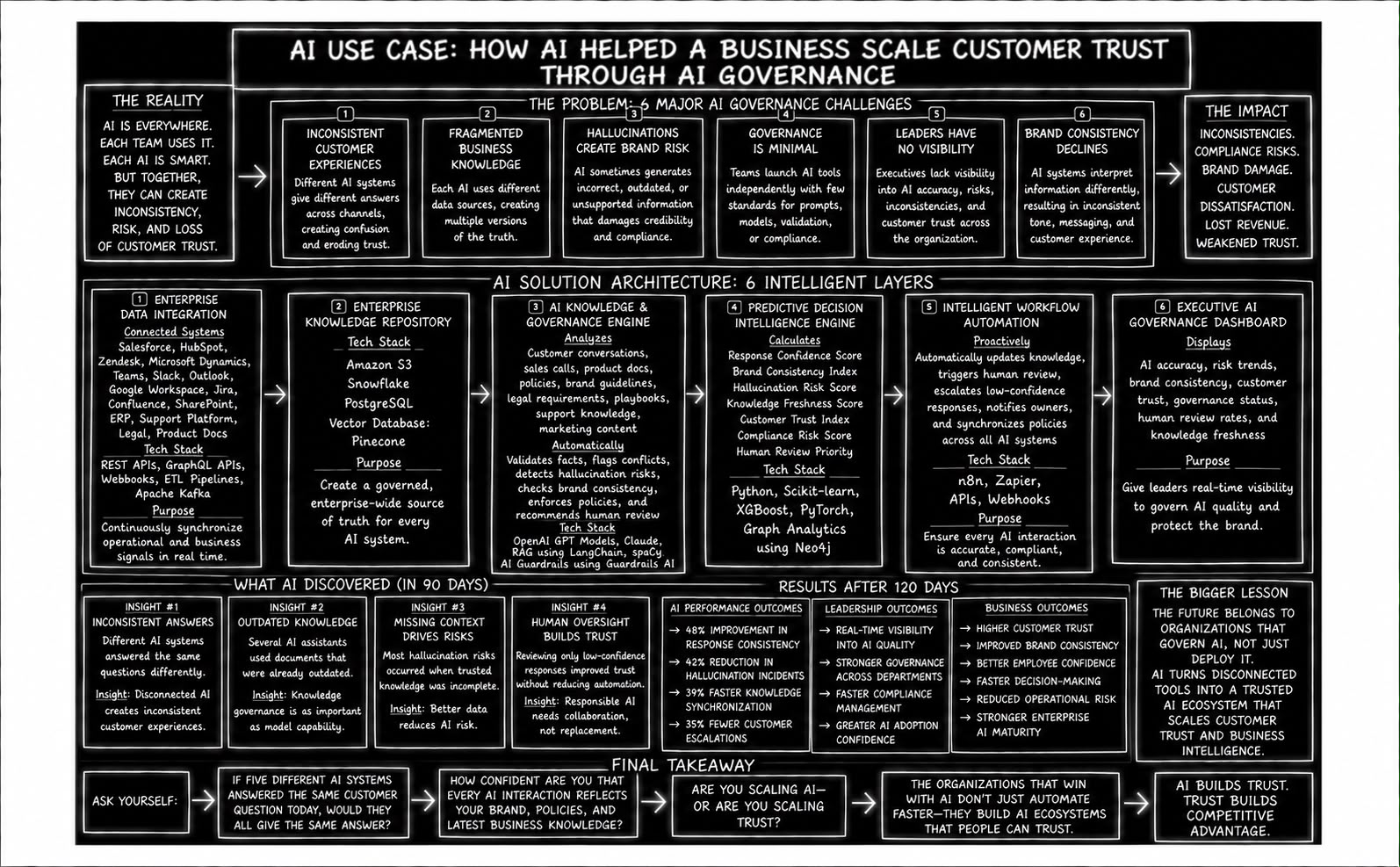
This case study explores how a global technology company implemented an AI Governance Platform that unified every AI interaction under a single source of truth—ensuring consistency, protecting its brand, and building customer trust at scale.
Company Background
A global B2B SaaS company with over 700 employees operated across North America, Europe, and Asia-Pacific.
Its business relied heavily on AI across multiple departments:
* Sales
* Marketing
* Customer Success
* Product
* Support
* Human Resources
* Finance
* Operations
Within two years, the company had deployed more than 25 AI-powered applications, including:
* Customer support chatbots
* AI sales assistants
* Marketing content generators
* Internal knowledge assistants
* Executive reporting copilots
* Workflow automation agents
Initially, productivity increased dramatically.
However, leadership soon identified a growing challenge.
Every AI system was becoming smarter individually.
But the business was becoming less consistent collectively.
The Problem
The organization faced six major AI governance challenges.
1. AI Produced Inconsistent Customer Experiences
Customers interacting through different channels received different answers.
Sales AI emphasized product flexibility.
Support AI referenced outdated policies.
Marketing AI highlighted features that Product had already deprecated.
The customer experience varied depending on which AI answered first.
2. Business Knowledge Became Fragmented
Every AI assistant relied on different data sources:
* CRM
* Product documentation
* Help Center
* Internal Wikis
* Marketing assets
* Sales playbooks
* Legal documents
Each system developed its own version of the truth.
3. Hallucinations Created Brand Risk
Large language models occasionally generated:
* Incorrect pricing
* Unsupported product claims
* Obsolete documentation
* Policy inaccuracies
Although infrequent, every mistake reduced customer trust.
4. Governance Was Minimal
Teams could launch AI assistants independently.
There were few standards governing:
* Prompt design
* Model selection
* Knowledge validation
* Human approvals
* Compliance reviews
Innovation outpaced governance.
5. Leaders Had No Visibility
Executives couldn’t answer:
* Which AI systems customers trusted most?
* Which prompts generated inaccurate responses?
* Which departments introduced the highest AI risk?
* Where human review was most needed?
AI performance remained largely invisible.
6. Brand Consistency Declined
Although employees followed brand guidelines, AI systems interpreted information differently.
The business no longer communicated with one consistent voice.
Why Traditional AI Deployments Failed
The company already used leading AI platforms.
Its ecosystem included:
* OpenAI
* Anthropic Claude
* Microsoft Copilot
* Salesforce Agentforce
* HubSpot AI
* Zendesk AI
These platforms were highly capable.
But they couldn’t answer questions like:
* Is every AI using approved business knowledge?
* Are responses aligned with company policies?
* Which AI interactions require human review?
* How consistent is our customer experience across channels?
* Which AI-generated answers create the greatest business risk?
The company had AI.
It lacked AI governance.
The AI Strategy
The company implemented an Enterprise AI Governance & Knowledge Platform.
Rather than allowing every AI assistant to operate independently, leadership created a centralized intelligence layer that connected every AI model, workflow, and department to the same trusted business knowledge.
The objective was simple:
Ensure every AI interaction strengthened the brand instead of weakening it.
The platform continuously answered:
* Is this response accurate?
* Does it comply with company policy?
* Is it consistent with our brand?
* Should a human review this interaction?
AI became a trusted business capability rather than a collection of disconnected tools.
AI Solution Architecture
The solution consisted of six intelligent layers.
Layer 1: Enterprise Data Integration
AI continuously synchronized trusted business knowledge.
Connected Systems
* Salesforce
* HubSpot
* Zendesk
* Microsoft Dynamics
* Microsoft Teams
* Slack
* SharePoint
* Confluence
* Notion
* Google Workspace
* ERP System
* Product Documentation
* Legal Knowledge Base
Tech Stack
* REST APIs
* GraphQL APIs
* Webhooks
* ETL Pipelines
* Apache Kafka
Purpose
Continuously synchronize approved enterprise knowledge.
Layer 2: Enterprise Knowledge Repository
Every approved document, policy, workflow, and customer interaction was centralized.
Tech Stack
* Amazon S3
* Snowflake
* PostgreSQL
* Vector Database:
* Pinecone
Purpose
Create a governed, enterprise-wide source of truth for every AI system.
Layer 3: AI Knowledge & Governance Engine
Every AI interaction passed through a governance layer before reaching employees or customers.
AI analyzed:
* Customer conversations
* Product documentation
* Company policies
* Brand guidelines
* Legal requirements
* Sales playbooks
* Support knowledge
* Marketing content
The platform automatically:
* Validated facts against approved knowledge
* Flagged conflicting information
* Detected hallucination risks
* Checked brand consistency
* Enforced policy compliance
* Recommended human review when confidence was low
Example insight:
“Three AI assistants are providing different responses to the same pricing question. Recommended action: synchronize approved pricing policy before further customer interactions.”
Tech Stack
* OpenAI GPT Models
* Claude
* Retrieval-Augmented Generation (RAG) using LangChain
* spaCy
* AI Guardrails using Guardrails AI
Layer 4: AI Governance Intelligence Engine
Machine learning continuously evaluated AI quality and business risk.
AI calculated:
* Response Confidence Score
* Brand Consistency Index
* Hallucination Risk Score
* Knowledge Freshness Score
* Customer Trust Index
* Compliance Risk Score
* Human Review Priority
Tech Stack
* Python
* Scikit-learn
* XGBoost
* PyTorch
Layer 5: Intelligent Workflow Automation
AI automatically protected business consistency.
Examples:
* Product policy updated → Every AI assistant refreshed automatically
* Hallucination risk detected → Human review triggered
* Brand inconsistency identified → Content owner notified
* Customer question exceeds confidence threshold → Escalated to specialist
* New legal policy published → Enterprise knowledge base synchronized
Tech Stack
* n8n
* Zapier
* APIs
* Webhooks
Layer 6: Executive AI Governance Dashboard
Leadership gained real-time visibility into enterprise AI performance.
Dashboard displayed:
* Brand Consistency Score
* AI Accuracy Rate
* Hallucination Risk Trends
* Customer Trust Index
* Human Escalation Rate
* Knowledge Freshness
* Compliance Status
* AI Usage Across Departments
* Enterprise AI Health Score
Executives could monitor AI quality as closely as financial performance.
What AI Discovered
Within 90 days, AI uncovered several hidden risks.
Hidden Insight #1: Different AI Systems Answered the Same Question Differently
Pricing, onboarding, and product capability questions produced inconsistent responses across departments.
Insight
Disconnected AI created inconsistent customer experiences.
Hidden Insight #2: Outdated Knowledge Increased Business Risk
Several AI assistants referenced documents that had been superseded months earlier.
Insight
Knowledge governance mattered as much as model quality.
Hidden Insight #3: Most Hallucination Risks Came From Missing Context
AI was least accurate when trusted enterprise knowledge wasn’t available.
Insight
Better data reduced AI risk more effectively than changing models.
Hidden Insight #4: Human Oversight Improved AI Performance
Reviewing only low-confidence responses significantly increased customer trust while keeping automation levels high.
Insight
Responsible AI required collaboration – not replacement.
Results After 120 Days
The AI implementation delivered measurable improvements.
AI Performance Outcomes
* 48% improvement in response consistency
* 42% reduction in hallucination-related incidents
* 39% faster enterprise knowledge synchronization
* 35% fewer customer escalations caused by inconsistent information
Leadership Outcomes
* Real-time visibility into enterprise AI quality
* Stronger governance across departments
* Faster compliance management
* Better AI adoption confidence
Business Outcomes
* Higher customer trust
* Improved brand consistency
* Better employee confidence in AI
* Faster decision-making
* Reduced operational risk
* Stronger enterprise AI maturity
⸻
The Bigger Lesson
The future belongs to organizations that govern AI—not just deploy it.
The most successful businesses won’t be those with the largest number of AI tools.
They’ll be the ones where every AI system works from the same trusted knowledge, follows the same business rules, and reinforces the same customer promise.
That’s where AI creates real leverage.
Not by replacing human judgment.
By making every AI interaction more trustworthy.
AI transforms:
Disconnected tools…
Into an intelligent AI ecosystem.
Scattered knowledge…
Into a governed source of truth.
Automation…
Into trusted customer experiences.
Final Takeaway
Ask yourself:
* If five different AI systems answered the same customer question today, would they all give the same answer?
* How confident are you that every AI interaction reflects your brand, policies, and latest business knowledge?
* Are you scaling AI – or are you scaling trust?
The organizations that win with AI won’t simply automate faster.
They’ll build AI ecosystems that customers, employees, and leaders can trust.




⭐ ⭐ ⭐ ⭐ ⭐ Top Rated AI Growth & Efficiency Strategist on Upwork
upwork.com/fl/navinmirania
If you’re exploring how to implement AI without compromising your customer experience or brand reputation, let’s connect. I’d be happy to discuss practical architectures and real-world AI solutions that scale responsibly.