AI Knowledge Management
Every organization has experts.
The people everyone turns to when a difficult problem needs solving.
The sales leader who understands enterprise negotiations.
The engineer who knows every system dependency.
The customer success manager who can calm an unhappy client.
The operations manager who has solved the same issue dozens of times.
These individuals become invaluable.
But they also become bottlenecks.
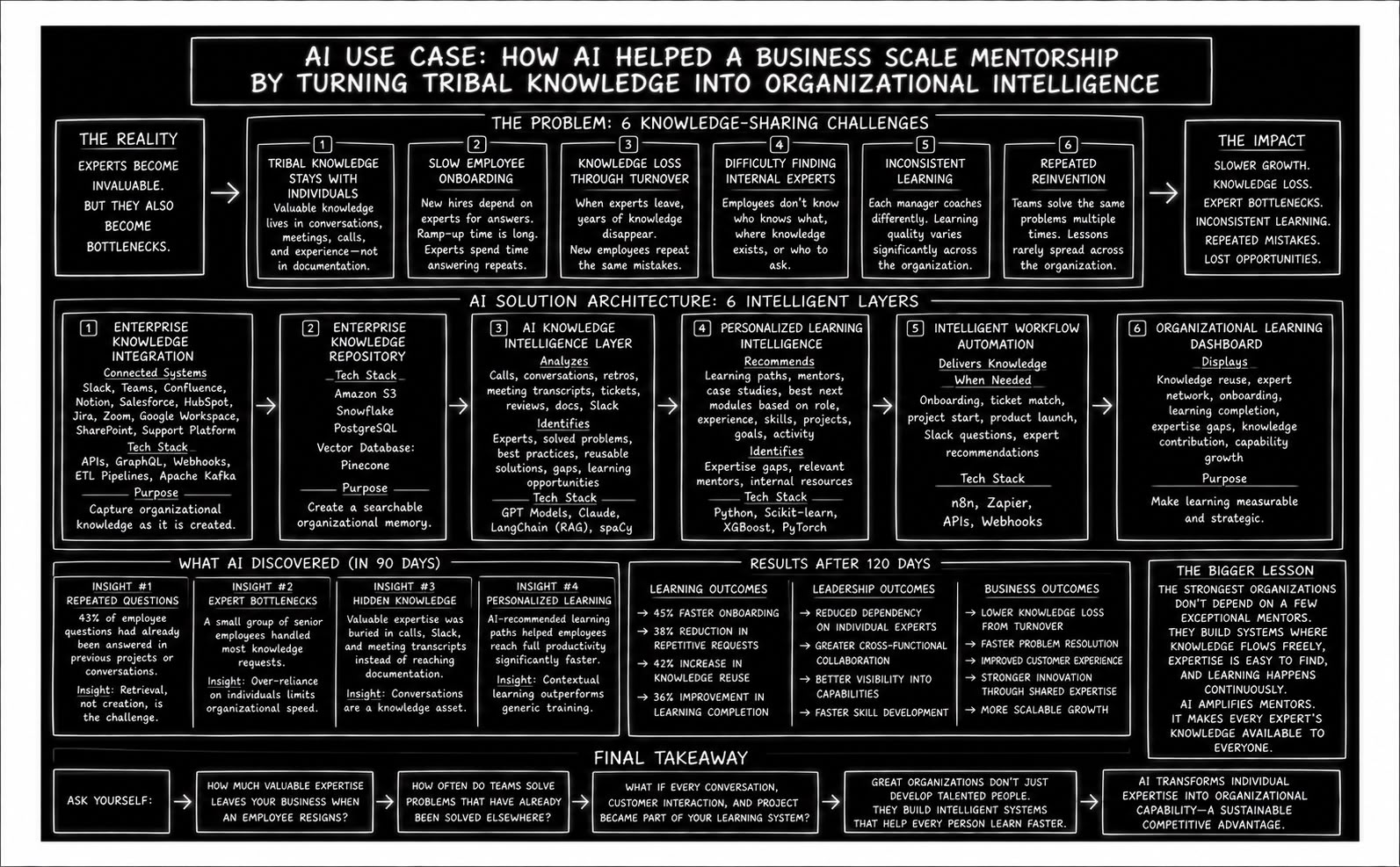
This case study explores how a growing technology company used AI to capture institutional knowledge, make expertise instantly accessible, and create a culture of continuous learning—without relying solely on one-to-one mentoring.
Company Background
A rapidly growing B2B SaaS company with over 380 employees was expanding into new markets.
The company operated across:
* Sales
* Product
* Engineering
* Customer Success
* Marketing
* Operations
* Human Resources
The business hired more than 100 new employees annually.
Leadership invested heavily in mentoring.
Despite this, onboarding remained slow.
Employees repeatedly asked the same questions.
Senior experts became overwhelmed.
Knowledge was abundant—but difficult to access.
The Problem
The organization faced six major knowledge-sharing challenges.
1. Tribal Knowledge Stayed with Individuals
The company’s most valuable expertise lived inside experienced employees.
Critical knowledge existed in:
* Customer conversations
* Sales calls
* Team meetings
* Slack discussions
* Project retrospectives
* Product reviews
* Support escalations
Very little of it was documented.
2. Slow Employee Onboarding
New hires depended heavily on senior employees for answers.
Ramp-up time averaged nearly four months.
Experienced staff spent increasing amounts of time answering repetitive questions.
3. Knowledge Loss Through Employee Turnover
When experienced employees left, years of practical knowledge disappeared.
Replacement employees often repeated the same mistakes.
4. Difficulty Finding Internal Experts
Employees rarely knew:
* Who had solved similar problems
* Which department owned specific expertise
* Where useful documentation existed
Finding answers often depended on personal networks.
5. Inconsistent Learning
Each manager coached differently.
Knowledge transfer depended on individual mentoring styles.
Learning quality varied significantly.
6. Repeated Reinvention
Different teams unknowingly solved the same problems multiple times.
Lessons learned rarely spread across the organization.
Why Traditional Knowledge Management Failed
The company already invested in modern collaboration platforms.
Its technology stack included:
* Confluence
* Notion
* Slack
* Microsoft Teams
* SharePoint
The issue wasn’t documentation.
The issue was discoverability.
Employees struggled to answer questions such as:
* Has someone solved this before?
* Who is the best person to ask?
* What does our experience suggest?
* Where is the relevant knowledge stored?
Information existed.
Accessible expertise did not.
The AI Strategy
The company implemented an AI-Powered Organizational Learning Platform.
Rather than replacing mentors, AI amplified them.
The objective was simple:
Capture expertise once.
Make it available to everyone.
Whenever they needed it.
AI continuously answered:
* Who knows the most about this topic?
* What similar situations have occurred?
* Which documents, conversations, and decisions are relevant?
* What should employees learn next?
AI Solution Architecture
The solution consisted of six intelligent layers.
Layer 1: Enterprise Knowledge Integration
AI continuously collected knowledge from every major business system.
Connected Systems
* Slack
* Microsoft Teams
* Confluence
* Notion
* Salesforce
* HubSpot
* Jira
* Zoom
* Google Workspace
* SharePoint
* Customer Support Platform
Tech Stack
* REST APIs
* GraphQL APIs
* Webhooks
* ETL Pipelines
* Apache Kafka
Purpose:
Capture organizational knowledge as it is created.
Layer 2: Enterprise Knowledge Repository
Structured and unstructured knowledge flowed into a centralized platform.
Tech Stack
* Amazon S3
* Snowflake
* PostgreSQL
* Vector Database:
* Pinecone
Purpose:
Create a searchable organizational memory.
Layer 3: AI Knowledge Intelligence Layer
AI analyzed:
* Sales calls
* Customer conversations
* Project retrospectives
* Meeting transcripts
* Support tickets
* Product reviews
* Documentation
* Slack discussions
The platform automatically identified:
* Subject matter experts
* Frequently solved problems
* Best practices
* Reusable solutions
* Knowledge gaps
* Learning opportunities
Example insight:
The Customer Success team has solved this onboarding issue 18 times across different regions.
Tech Stack
* OpenAI GPT Models
* Claude
* Retrieval-Augmented Generation (RAG) using LangChain
* spaCy
Layer 4: Personalized Learning Intelligence
Machine learning recommended learning paths based on:
* Role
* Experience
* Skills
* Current projects
* Career goals
* Previous learning activity
AI also identified:
* Expertise gaps
* Recommended mentors
* Relevant internal case studies
* Best next learning modules
Tech Stack
* Python
* Scikit-learn
* XGBoost
* PyTorch
Layer 5: Intelligent Workflow Automation
AI proactively delivered knowledge when it was needed.
Examples:
* New employee joins Sales → Personalized onboarding created
* Support ticket resembles previous issue → Existing solution recommended
* Project begins → Relevant lessons from previous projects surfaced
* New product launch → Expert documentation automatically shared
* Employee asks a question in Slack → AI suggests answers and subject matter experts
Tech Stack
* n8n
* Zapier
* APIs
* Webhooks
Layer 6: Organizational Learning Dashboard
Leadership gained visibility into organizational learning.
Dashboard displayed:
* Knowledge reuse rate
* Subject matter expert network
* Onboarding progress
* Learning completion
* Expertise gaps
* Knowledge contribution trends
* Employee capability growth
Learning became measurable.
What AI Discovered
Within 90 days, AI surfaced several hidden insights.
Hidden Insight #1: The Same Questions Were Asked Repeatedly
Nearly 43% of employee questions had already been answered in previous projects or conversations.
Insight
The challenge wasn’t knowledge creation.
It was knowledge retrieval.
Hidden Insight #2: Experts Were Becoming Bottlenecks
A small group of senior employees handled most knowledge requests.
Insight
The organization relied too heavily on individuals instead of systems.
Hidden Insight #3: Valuable Knowledge Was Buried in Conversations
Customer calls, Slack discussions, and meeting transcripts contained practical expertise that never reached documentation.
Insight
Conversations were an untapped knowledge asset.
Hidden Insight #4: Personalized Learning Accelerated Onboarding
Employees receiving AI-recommended learning paths reached full productivity significantly faster than those following standard training.
Insight
Contextual learning outperformed generic onboarding.
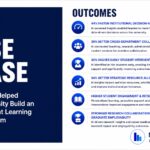
Results After 120 Days
The AI implementation delivered measurable improvements.
Learning Outcomes
* 45% faster employee onboarding
* 38% reduction in repetitive knowledge requests
* 42% increase in knowledge reuse
* 36% improvement in learning completion rates
Leadership Outcomes
* Reduced dependency on individual experts
* Greater cross-functional collaboration
* Better visibility into organizational capabilities
* Faster skill development
Business Outcomes
* Lower knowledge loss during employee turnover
* Faster problem resolution
* Improved customer experience
* Stronger innovation through shared expertise
* More scalable organizational growth
The Bigger Lesson
The strongest organizations don’t depend on a handful of exceptional mentors.
They build environments where knowledge flows freely.
Where expertise is easy to find.
Where learning happens continuously.
That’s where AI creates real leverage.
Not by replacing mentors.
By making every expert’s knowledge available to the entire organization.
Final Takeaway
Ask yourself:
* How much valuable expertise leaves your business when an experienced employee resigns?
* How often do teams solve problems that have already been solved elsewhere?
* What if every conversation, customer interaction, and project became part of your organization’s learning system?
Great organizations don’t just develop talented people.
They build intelligent systems that help every person learn faster.
AI transforms individual expertise into organizational capability.
And organizational capability is one of the most sustainable competitive advantages a business can build.


You can read the article here as well
https://www.linkedin.com/pulse/ai-use-case-how-helped-business-scale-mentorship-turning-mirania-ccnbc/