AI Operational Intelligence
Every executive dashboard tells a story.
Revenue is growing.
Projects are on schedule.
Customer satisfaction remains high.
Operational KPIs are being achieved.
On paper, everything appears to be working.
Yet beneath those reports lies another reality.
Employees create manual workarounds.
Teams solve the same problems independently.
Knowledge remains trapped across departments.
Critical processes evolve informally without ever being documented.
The further these two versions of the business drift apart, the more difficult it becomes for leaders to make informed decisions.
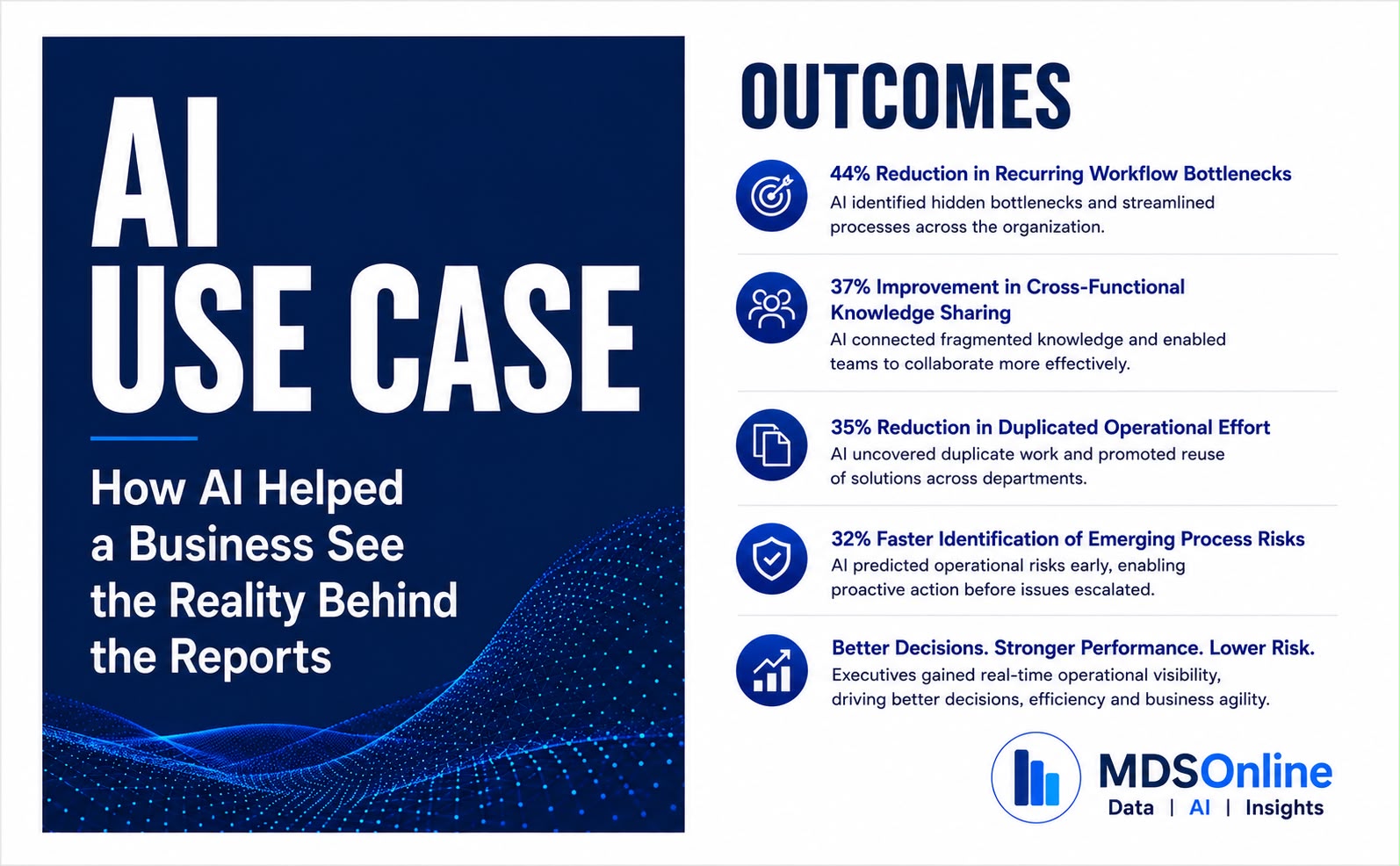
This case study explores how a multinational manufacturing and services company implemented an AI-Powered Operational Intelligence Platform to uncover hidden operational realities, connect fragmented knowledge, and provide executives with a real-time understanding of how work actually happened across the organization.
Company Background
A global industrial services company with over 2,800 employees operated across North America, Europe, the Middle East, and Asia-Pacific.
Its business included:
* Sales
* Customer Service
* Operations
* Engineering
* Manufacturing
* Supply Chain
* Finance
* Human Resources
* Information Technology
* Executive Leadership
The company had invested heavily in digital transformation.
Executives received hundreds of dashboards each month covering:
* Revenue
* Customer satisfaction
* Operational KPIs
* Manufacturing performance
* Project delivery
* Employee productivity
Despite extensive reporting, operational issues continued to emerge unexpectedly.
Projects missed deadlines.
Customers experienced inconsistent service.
Employees complained about inefficient processes.
Leadership realized that traditional reporting described what should be happening—not necessarily what was actually happening.
The Problem
The organization faced six operational visibility challenges.
1. Executive Dashboards Missed Operational Reality
Business reports focused on outcomes.
They rarely explained:
* Why delays occurred
* How employees completed work
* Which informal processes existed
* Where productivity was being lost
Leaders saw performance.
They couldn’t see operational behavior.
2. Knowledge Was Fragmented
Critical business knowledge existed across:
* Emails
* Microsoft Teams
* Slack
* CRM
* ERP
* Project documentation
* SharePoint
* Customer support platforms
* Engineering documentation
* Personal spreadsheets
Finding answers often depended on knowing who to ask.
3. Teams Created Independent Workarounds
Departments regularly bypassed official workflows to complete work faster.
Many of these workarounds solved immediate problems but introduced:
* Duplicate effort
* Process inconsistency
* Compliance risk
* Knowledge loss
Leadership remained unaware because these practices never appeared in reports.
4. Operational Bottlenecks Were Hidden
Recurring delays developed gradually across departments.
Because each team optimized its own work independently, no one recognized the enterprise-wide impact until customer experience suffered.
5. Strategic Decisions Relied on Incomplete Context
Executives based decisions on structured reporting.
However, much of the organization’s operational knowledge existed within conversations, documents, meeting notes, and employee experience.
Critical context never reached leadership.
6. Risks Were Identified Too Late
Operational issues frequently became visible only after affecting:
* Customers
* Revenue
* Delivery schedules
* Employee satisfaction
The organization reacted instead of anticipating.
Why Traditional Business Intelligence Failed
The company already used enterprise reporting platforms including:
* Microsoft Power BI
* Tableau
* SAP Analytics Cloud
* Salesforce
* ServiceNow
These platforms measured business performance.
They couldn’t answer:
* How is work actually getting done?
* Where are employees creating unofficial workflows?
* Which operational issues occur repeatedly but remain undocumented?
* Where is knowledge trapped?
* Which hidden bottlenecks will become tomorrow’s business problems?
The company had reporting.
It lacked operational intelligence.
The AI Strategy
The organization implemented an AI-Powered Operational Reality Platform.
Rather than replacing existing dashboards, AI continuously connected structured business data with unstructured operational knowledge.
The platform became a real-time intelligence layer that understood:
* How work actually flowed
* Where teams deviated from official processes
* Which operational issues repeated most often
* Where knowledge became inaccessible
* Which risks were emerging across the organization
The objective was simple:
Provide leadership with a live view of how the business truly operated—not just how reports described it.
AI Solution Architecture
The solution consisted of six intelligent layers.
Layer 1: Enterprise Data Integration
AI continuously collected operational signals across the organization.
Connected Systems
* Salesforce
* SAP ERP
* Microsoft Teams
* Slack
* Outlook
* SharePoint
* Jira
* Confluence
* ServiceNow
* Google Workspace
* Customer Support Platform
* HRIS
* Manufacturing Execution Systems (MES)
* IoT Production Sensors
Tech Stack
* REST APIs
* GraphQL APIs
* Webhooks
* ETL Pipelines
* Apache Kafka
Purpose
Capture structured and unstructured operational activity across the enterprise in real time.
Layer 2: Enterprise Operational Knowledge Repository
Every approved document, workflow, conversation, process, and operational event was centralized.
Tech Stack
* Amazon S3
* Snowflake
* PostgreSQL
* Vector Database:
* Pinecone
Purpose
Create a searchable enterprise operational memory.
Layer 3: AI Operational Intelligence Engine
AI continuously analyzed:
* Emails
* Meeting transcripts
* Customer interactions
* CRM activity
* Support tickets
* Project updates
* Internal documentation
* Workflow events
* Operational logs
* Employee collaboration
The platform automatically:
* Identified hidden workflow bottlenecks
* Detected recurring operational problems
* Mapped unofficial workarounds
* Connected fragmented knowledge
* Recommended process improvements
* Surfaced emerging operational risks
Example insight:
“Three regional teams independently created manual approval spreadsheets because the ERP approval workflow adds an average delay of 2.8 days. Standardizing a simplified approval process could reduce cycle time by 24%.”
Tech Stack
* OpenAI GPT Models
* Claude
* Retrieval-Augmented Generation (RAG) using LangChain
* spaCy
* Process mining with PM4Py to reconstruct actual workflows from system event logs
Layer 4: Predictive Operational Intelligence
Machine learning continuously evaluated enterprise operations.
AI generated:
* Operational Reality Score
* Workflow Efficiency Index
* Process Deviation Score
* Knowledge Accessibility Index
* Collaboration Effectiveness Score
* Customer Impact Risk
* Operational Bottleneck Forecast
Tech Stack
* Python
* Scikit-learn
* XGBoost
* PyTorch
* Graph analytics using Neo4j to visualize knowledge flows and collaboration networks
Layer 5: Intelligent Workflow Automation
AI improved operations automatically.
Examples:
* Hidden workflow bottleneck detected → Process owner notified
* Duplicate work identified across departments → Shared solution recommended
* Repeated manual workaround detected → Automation opportunity created
* Emerging customer impact predicted → Leadership alerted
* New best practice discovered → Enterprise knowledge repository updated
Tech Stack
* n8n
* Zapier
* APIs
* Webhooks
Layer 6: Executive Operational Reality Dashboard
Leadership gained visibility into both reported performance and operational reality.
Dashboard displayed:
* Operational Reality Score
* Workflow Bottleneck Heatmap
* Process Deviation Trends
* Knowledge Flow Map
* Hidden Workaround Index
* Cross-Department Collaboration Score
* Customer Risk Forecast
* Enterprise Process Health
* AI-Recommended Improvement Opportunities
Executives could now compare reported performance with actual operational behavior in real time.
What AI Discovered
Within 120 days, AI uncovered several hidden operational insights.
Hidden Insight #1: High-Performing Teams Were Frequently Bypassing Official Processes
Many of the organization’s best-performing teams had developed informal workflows that were faster than documented procedures.
Insight
Operational innovation was happening—but it wasn’t being shared.
Hidden Insight #2: Duplicate Problem Solving Was Widespread
Multiple departments independently solved the same operational issues.
Insight
Better knowledge sharing could eliminate significant duplicated effort.
Hidden Insight #3: Most Customer Delays Originated Long Before Customer Service Became Involved
AI identified recurring operational bottlenecks weeks before customers noticed service delays.
Insight
Operational visibility enabled proactive intervention.
Hidden Insight #4: Leadership Reports Reflected Results, Not Reality
Traditional dashboards accurately measured outcomes but overlooked the operational behaviors producing those outcomes.
Insight
Understanding how work happened proved as valuable as measuring what was delivered.
Results After 120 Days
Operational Outcomes
* 44% reduction in recurring workflow bottlenecks
* 37% improvement in cross-functional knowledge sharing
* 35% reduction in duplicated operational effort
* 32% faster identification of emerging process risks
Leadership Outcomes
* Greater visibility into enterprise operations
* Faster identification of process improvement opportunities
* Better strategic decision-making
* Increased confidence in operational reporting
Business Outcomes
* Improved customer experience
* Higher operational efficiency
* Better organizational alignment
* Faster execution of strategic initiatives
* Reduced operational risk
* Stronger business agility
The Bigger Lesson
Executive dashboards explain what happened.
AI reveals why it happened.
Organizations that create the greatest competitive advantage won’t simply automate work.
They’ll build AI systems that connect operational reality with executive decision-making, ensuring strategy is grounded in how the business truly operates.
That’s where AI becomes more than an efficiency tool.
It becomes an organizational intelligence capability.
Final Takeaway
Ask yourself:
* If your frontline employees and executive team described how work gets done today, would their stories match?
* How many operational risks are hidden because they never appear in reports?
* Are your leaders managing the business they see – or the business that’s actually operating?
The best business decisions aren’t made from more reports.
They’re made from a deeper understanding of reality.


If you’re exploring how to implement AI while maintaining governance, compliance, and operational control, let’s connect. I’d be happy to discuss practical AI architectures that help organizations innovate with confidence.
mdsonline.co.in