AI Organizational Intelligence
Every organization has untapped potential.
Not because employees lack talent.
But because much of what they already know never becomes accessible to the rest of the business.
Every customer interaction…
Every successful project…
Every difficult negotiation…
Every product launch…
Creates valuable knowledge.
Yet most organizations never capture it.
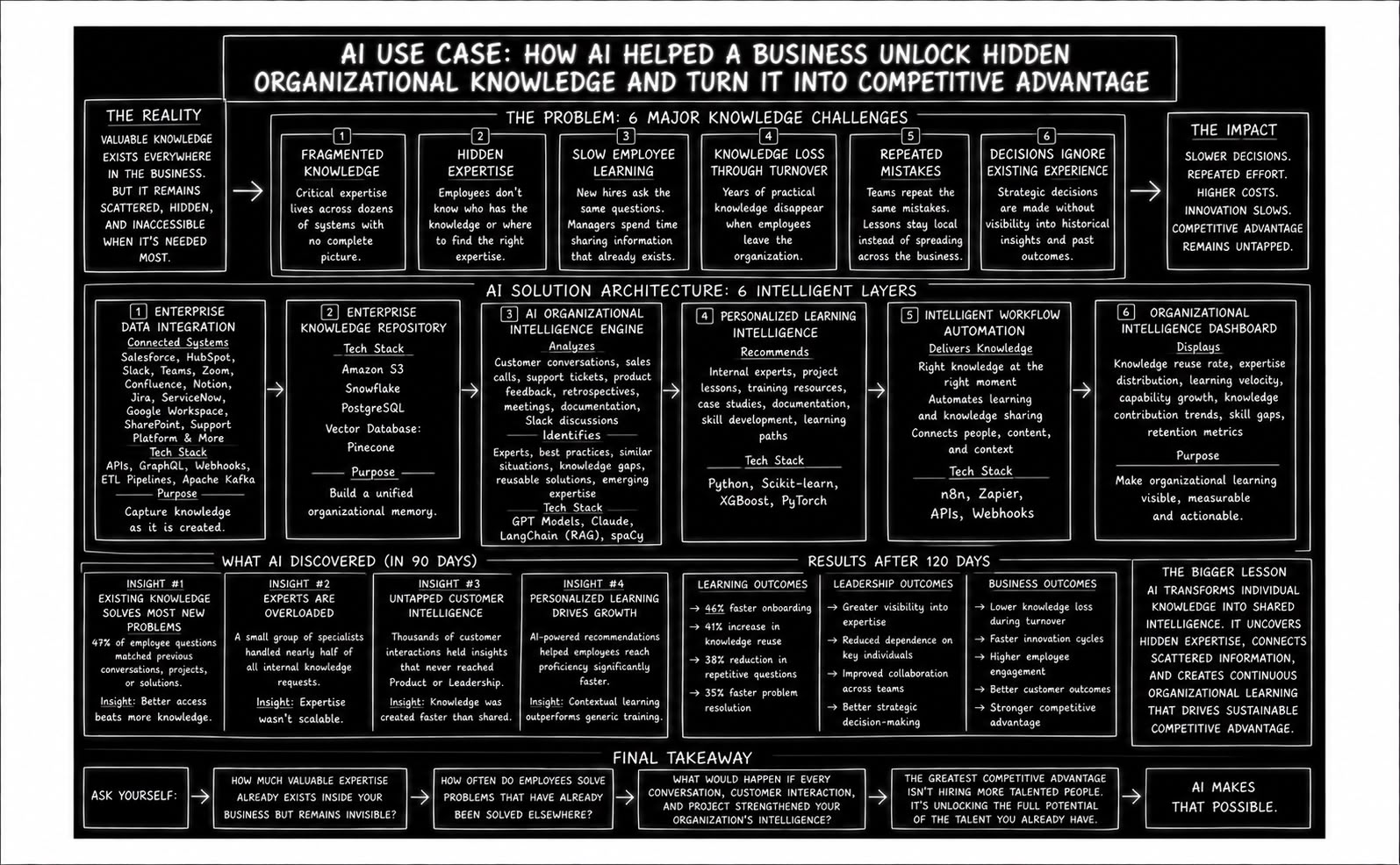
This case study explores how a fast-growing technology company used AI to transform fragmented business knowledge into an intelligent organizational learning system that accelerated onboarding, improved decision-making, and unlocked hidden potential across the company.
Company Background
A global B2B SaaS company with over 520 employees had experienced rapid growth over five years.
Its teams operated across:
* Sales
* Marketing
* Product
* Engineering
* Customer Success
* Operations
* Human Resources
The company hired nearly 150 new employees every year.
Although it attracted exceptional talent, leadership noticed a recurring problem.
Employees spent too much time searching for answers that already existed somewhere inside the business.
Knowledge was everywhere.
Access to knowledge was not.
The Problem
The organization faced six major knowledge challenges.
1. Organizational Knowledge Was Fragmented
Critical expertise lived across dozens of systems:
* CRM records
* Customer support tickets
* Slack channels
* Sales calls
* Meeting recordings
* Product documentation
* Project retrospectives
* Internal documents
No one had a complete picture.
2. Expertise Was Hidden
Employees often didn’t know:
* Who had solved similar problems
* Which department owned specific knowledge
* Which customer situations resembled current challenges
Finding expertise relied on personal relationships.
3. Slow Employee Learning
New hires repeatedly asked questions that had already been answered.
Managers spent considerable time providing information that already existed somewhere else.
4. Knowledge Was Lost During Employee Turnover
When experienced employees left, years of practical knowledge disappeared.
Their replacements often repeated the same mistakes.
5. Teams Repeated Previous Mistakes
Project lessons rarely travelled beyond the original team.
Different departments unknowingly solved identical problems.
Learning remained local.
6. Decision-Making Ignored Existing Experience
Executives frequently made strategic decisions without visibility into historical customer insights or previous project outcomes.
Past experience remained disconnected from present decisions.
Why Traditional Knowledge Systems Failed
The organization already used modern collaboration platforms.
Its technology stack included:
* Confluence
* Notion
* Slack
* Microsoft Teams
* Salesforce
* Google Workspace
The company didn’t lack documentation.
It lacked intelligence.
Employees could search documents.
They couldn’t easily ask:
* Have we solved this before?
* Which expert should I speak with?
* What have customers told us about this problem?
* What lessons should guide today’s decision?
Information was stored.
Knowledge wasn’t connected.
The AI Strategy
The company implemented an AI-Powered Organizational Intelligence Platform.
Rather than creating another knowledge repository, AI continuously captured, organized, and connected knowledge as employees worked.
The objective was simple:
Turn everyday business activity into reusable organizational intelligence.
The AI continuously answered:
* What does the organization already know?
* Who has relevant expertise?
* Which lessons apply to this situation?
* What should employees learn next?
AI Solution Architecture
The solution consisted of six intelligent layers.
Layer 1: Enterprise Data Integration
AI continuously collected knowledge from enterprise systems.
Connected Systems
* Salesforce
* HubSpot
* Slack
* Microsoft Teams
* Zoom
* Confluence
* Notion
* Jira
* ServiceNow
* Google Workspace
* SharePoint
* Customer Support Platform
Tech Stack
* REST APIs
* GraphQL APIs
* Webhooks
* ETL Pipelines
* Apache Kafka
Purpose
Capture organizational knowledge as it is created.
Layer 2: Enterprise Knowledge Repository
Structured and unstructured knowledge was centralized.
Tech Stack
* Amazon S3
* Snowflake
* PostgreSQL
* Vector Database:
* Pinecone
Purpose
Build a unified organizational memory.
Layer 3: AI Organizational Intelligence Engine
AI analyzed:
* Customer conversations
* Sales calls
* Support tickets
* Product feedback
* Project retrospectives
* Team meetings
* Documentation
* Slack discussions
The platform automatically identified:
* Subject matter experts
* Best practices
* Similar historical situations
* Knowledge gaps
* Reusable solutions
* Emerging organizational expertise
Example insight:
“This implementation challenge has been solved successfully by the APAC Customer Success team three times in the past year.”
Tech Stack
* OpenAI GPT Models
* Claude
* Retrieval-Augmented Generation (RAG) using LangChain
* spaCy
Layer 4: Personalized Learning Intelligence
Machine learning personalized learning for every employee.
AI recommended:
* Internal experts
* Previous project lessons
* Training resources
* Customer case studies
* Relevant documentation
* Skill development opportunities
Tech Stack
* Python
* Scikit-learn
* XGBoost
* PyTorch
Layer 5: Intelligent Workflow Automation
AI proactively surfaced organizational knowledge.
Examples:
* Employee starts a new project → Similar projects automatically recommended
* Customer issue detected → Previous successful resolutions surfaced
* New hire joins → Personalized learning journey created
* Product release planned → Relevant customer feedback highlighted
* Slack question posted → AI recommends existing answers and internal experts
Tech Stack
* n8n
* Zapier
* APIs
* Webhooks
Layer 6: Organizational Intelligence Dashboard
Leadership gained visibility into organizational capability.
Dashboard displayed:
* Knowledge reuse rate
* Expertise distribution
* Organizational learning velocity
* Employee capability growth
* Knowledge contribution trends
* Skill gap analysis
* Knowledge retention metrics
Leadership could finally measure organizational learning.
What AI Discovered
Within 90 days, AI revealed several hidden opportunities.
Hidden Insight #1: Existing Knowledge Solved Most New Problems
Nearly 47% of employee questions matched previous conversations, projects, or documented solutions.
Insight
The business didn’t need more knowledge.
It needed better access to knowledge.
Hidden Insight #2: Experts Were Spending Too Much Time Answering Repetitive Questions
A small group of specialists handled nearly half of all internal knowledge requests.
Insight
Expertise wasn’t scalable.
Hidden Insight #3: Customer Conversations Contained Untapped Business Intelligence
Thousands of customer interactions contained insights that never reached Product or Leadership.
Insight
Customer knowledge was being created faster than it could be shared.
Hidden Insight #4: Personalized Learning Accelerated Capability Growth
Employees who received AI-powered recommendations reached role proficiency significantly faster than those using traditional training.
Insight
Learning became more effective when it was contextual and continuous.
Results After 120 Days
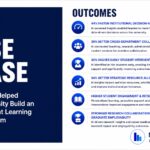
The AI implementation delivered measurable improvements.
Learning Outcomes
* 46% faster employee onboarding
* 41% increase in knowledge reuse
* 38% reduction in repetitive internal questions
* 35% faster problem resolution
Leadership Outcomes
* Greater visibility into organizational expertise
* Reduced dependence on key individuals
* Improved cross-functional collaboration
* Better strategic decision-making
Business Outcomes
* Lower knowledge loss during employee turnover
* Faster innovation cycles
* Improved employee engagement
* Better customer outcomes
* Stronger competitive advantage
The Bigger Lesson
Organizations don’t become smarter simply by hiring talented people.
They become smarter by ensuring every employee can benefit from what the organization already knows.
That’s where AI creates real leverage.
Not by replacing human potential.
By uncovering it.
It transforms:
Individual knowledge…
Into shared intelligence.
Hidden expertise…
Into business capability.
Scattered information…
Into continuous organizational learning.
Final Takeaway
Ask yourself:
* How much valuable expertise already exists inside your business but remains invisible?
* How often do employees solve problems that have already been solved elsewhere?
* What would happen if every conversation, customer interaction, and project automatically strengthened your organization’s intelligence?
The greatest competitive advantage isn’t hiring more talented people.
It’s unlocking the full potential of the talented people you already have.
AI makes that possible.


⭐ ⭐ ⭐ ⭐ ⭐ Top Rated AI Growth & Efficiency Strategist on Upwork
upwork.com/fl/navinmirania
If you’re exploring how AI can improve knowledge management, employee enablement, workflow automation, or decision-making, let’s connect.
I help founders and organizations build practical AI-powered systems that transform fragmented business knowledge into actionable insights, faster learning, and measurable business growth.