AI Strategic Decision Making
As businesses grow, confidence often grows with them.
That sounds like a good thing.
And often, it is.
Confidence helps leaders move faster.
It improves execution speed.
It enables quicker decisions.
But confidence has a hidden risk.
Over time, yesterday’s successful assumptions can quietly become today’s blind spots.
What once worked continues to get repeated.
Messaging stays unchanged.
Processes become fixed.
Strategies go unquestioned.
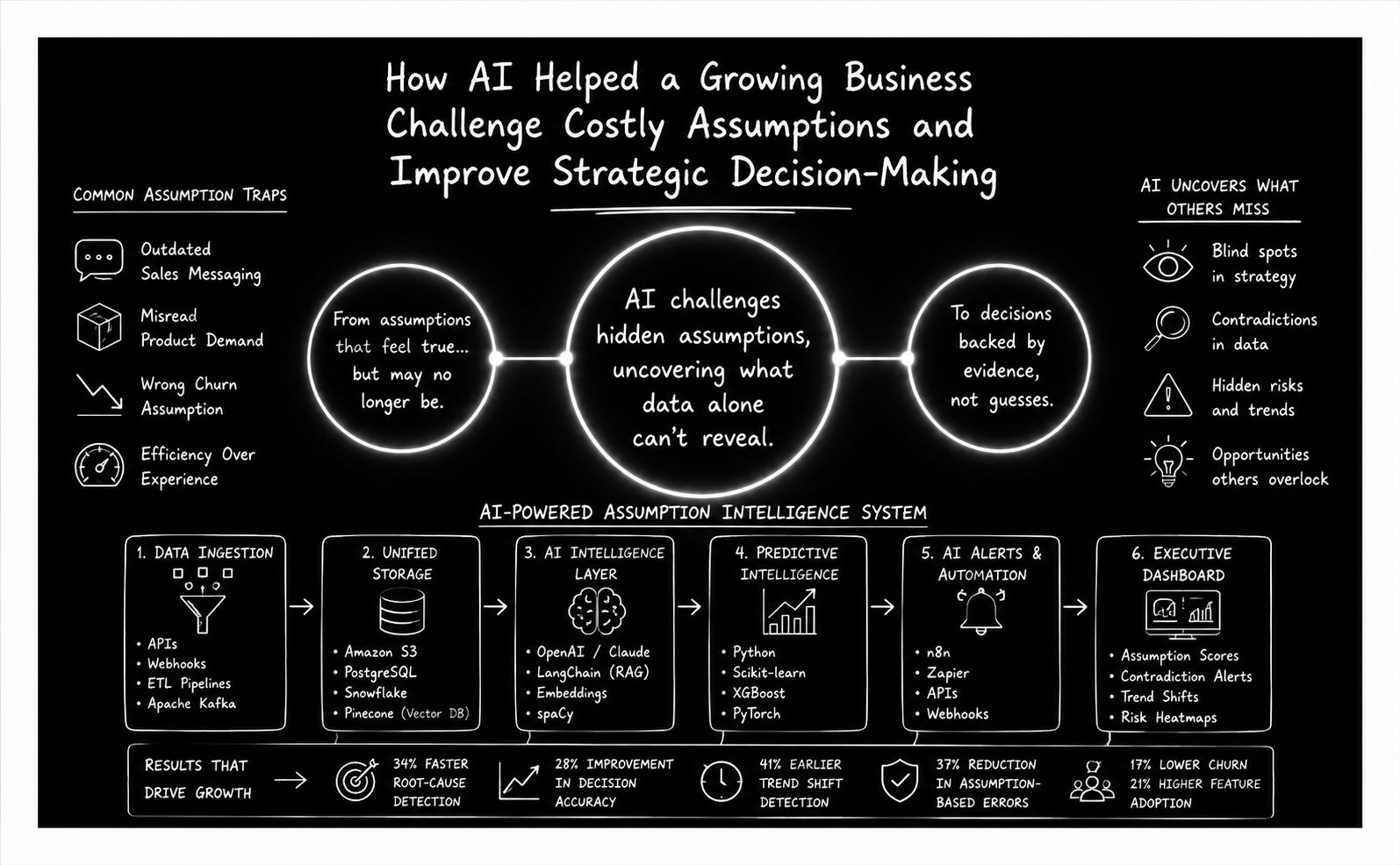
This case study shows how a growing company used AI to identify outdated assumptions, challenge hidden biases, and improve strategic decision-making.
Company Background
A mid-sized B2B SaaS company with 300+ employees had scaled rapidly over five years.
The company had mature teams across:
– Sales
– Product
– Customer Success
– Operations
– Leadership
Revenue was growing steadily.
The company had strong historical performance.
But growth had started slowing.
Leadership noticed troubling signals:
– Lower sales conversion
– Rising churn
– Slower product adoption
– Increasing support complaints
Yet traditional dashboards showed no obvious root cause.
That created a critical question:
What are we missing?
The Problem
The company faced four major assumption traps.
1. Outdated Sales Messaging
Sales teams were using messaging that had worked for years.
Leadership believed it still resonated.
Conversion rates suggested otherwise.
2. Misread Product Demand
Product teams prioritized features based on customer requests.
They assumed demand equaled value.
Adoption data told a different story.
3. Wrong Churn Assumption
Leadership believed churn was mainly caused by pricing.
Retention data suggested another cause.
4. Efficiency Over Experience
Operations optimized heavily for speed and efficiency.
Customer satisfaction quietly declined.
Internal KPIs improved.
External experience worsened.
Why Traditional Analytics Failed
The company already used modern business intelligence systems.
They relied on:
– Salesforce
– Tableau
– HubSpot
– Snowflake
Dashboards provided strong reporting.
But reporting had limitations.
Traditional analytics showed:
– What changed
– By how much
– When it changed
It struggled to explain:
– Why beliefs were wrong
– Which assumptions caused poor decisions
– Which correlations were misleading
That’s where AI came in.
The AI Strategy
The objective was to build an AI-powered Assumption Intelligence System.
The system needed to continuously answer:
– Which beliefs no longer match reality?
– Which metrics contradict existing assumptions?
– Which patterns are changing?
– Where are leaders relying on outdated thinking?
AI became a strategic intelligence layer across the organization.
AI Solution Architecture
The solution was built across six layers.
Layer 1: Data Ingestion Layer
AI collected data from all core systems.
Sources included:
– CRM
– Sales calls
– Support tickets
– Product usage analytics
– Customer surveys
– Email interactions
– Operational systems
Tech Stack
– APIs
– Webhooks
– ETL pipelines
– Event streaming via Apache Kafka
Purpose:
Centralize fragmented business signals.
Layer 2: Unified Data Storage
All structured and unstructured data was centralized.
Tech Stack
– Amazon S3
– PostgreSQL
– Snowflake
– Vector DB: Pinecone
Purpose:
Enable analytical and semantic querying.
Layer 3: AI Intelligence Layer
This became the reasoning engine.
AI analyzed:
– Customer conversations
– Behavioral trends
– Metric contradictions
– Sentiment changes
– KPI relationships
It searched for evidence that challenged existing assumptions.
Example:
> “Pricing complaints decreased, but onboarding complaints increased by 63%.”
This contradicted leadership’s churn assumption.
Tech Stack
– OpenAI GPT Models
– Claude
– LangChain
– spaCy
Layer 4: Predictive Intelligence Layer
Machine learning identified hidden patterns and false correlations.
AI models predicted:
– Churn risk
– Conversion probability
– Feature adoption likelihood
– Satisfaction decline
– Customer behavior shifts
Tech Stack
– Python
– Scikit-learn
– XGBoost
– PyTorch
Layer 5: AI Alerts & Automation
AI proactively flagged contradictions.
Examples:
– Assumption invalidated → leadership alert
– Metric anomaly → escalation
– Customer trend changes → strategy review trigger
– Churn driver changes → retention workflow update
Tech Stack
– n8n
– Zapier
– APIs
– Webhooks
Layer 6: Executive Intelligence Dashboard
Leadership received real-time strategic insights.
Dashboard included:
– Assumption confidence scores
– Contradiction alerts
– Customer behavior changes
– Emerging churn drivers
– Trend shifts
– Risk heatmaps
Leaders now saw what their assumptions missed.
What AI Discovered
Within 60 days, AI surfaced critical blind spots.
Blind Spot #1: Sales Messaging Fatigue
The company’s core messaging had become stale.
Buyer engagement dropped significantly.
Competitor messaging had evolved.
Insight
What worked 2 years ago no longer resonated.
Blind Spot #2: Feature Request Illusion
Highly requested features had low usage.
Frequently ignored features drove retention.
Insight
Demand signals were misleading.
Blind Spot #3: Wrong Churn Diagnosis
Leadership believed churn came from pricing.
AI found the biggest churn driver was onboarding friction.
New customers struggled during setup.
Insight
They were solving the wrong problem.
Blind Spot #4: Efficiency Trap
Operational efficiency improved by 22%.
Customer satisfaction fell by 14%.
Insight
Internal optimization was hurting external experience.
Results After 120 Days
The AI implementation delivered measurable impact.
Strategic Outcomes
– 34% faster root-cause detection
– 41% earlier trend shift detection
– 28% improvement in decision accuracy
– 37% reduction in assumption-based errors
Business Outcomes
– 17% lower churn
– 21% higher feature adoption
– 19% improved sales conversion
– Higher customer satisfaction
The Bigger Lesson
The smartest organizations aren’t the ones with all the answers.
They’re the ones that keep questioning their answers.
That’s the real value of AI.
Not replacing strategy.
Improving strategy.
AI helps leaders challenge certainty with evidence.
It moves organizations from:
Certainty → Curiosity
Assumptions → Evidence
Opinions → Intelligence
That’s where competitive advantage begins.
Final Takeaway
Ask yourself:
– Which business assumptions haven’t been challenged recently?
– Which strategies are running on outdated beliefs?
– What if your biggest blind spot feels completely normal today?
Growth rarely stalls from obvious mistakes alone.
It often stalls when businesses keep scaling beliefs that are no longer true.
AI changes that.
It helps organizations think again.
And thinking again often changes everything.