Enterprise AI Intelligence
Technology has never been the true competitive advantage.
Every decade introduces a new wave of innovation.
Cloud computing.
Mobile applications.
IoT.
Automation.
Now it’s artificial intelligence.
Yet history shows that technology alone doesn’t create market leaders.
The organizations that consistently outperform competitors are those that transform technology into better decisions, faster execution, and superior customer experiences.
This case study explores how a global manufacturing and distribution company implemented an Enterprise AI Intelligence Platform that connected fragmented knowledge, embedded AI into every business function, and transformed AI from a collection of isolated tools into the organization’s central intelligence capability.
Company Background
A multinational manufacturing and distribution company with over 5,200 employees operated across North America, Europe, Asia-Pacific, and the Middle East.
The organization managed:
* Sales
* Marketing
* Manufacturing
* Supply Chain
* Procurement
* Finance
* Human Resources
* Customer Service
* Product Development
* Executive Leadership
Over several years, the company invested heavily in digital transformation.
Its technology landscape included:
* ERP
* CRM
* Business Intelligence
* IoT-enabled manufacturing
* Customer support platforms
* Workflow automation
* Predictive analytics
* AI copilots
Despite significant investment, executives recognized an important challenge.
The business had more technology than ever before.
But decision-making remained fragmented.
Departments optimized independently.
Knowledge remained disconnected.
Leadership still relied on manual analysis to connect information across the enterprise.
The Problem
The organization faced six enterprise intelligence challenges.
1. Business Knowledge Was Fragmented
Critical information existed across dozens of enterprise systems:
* CRM
* ERP
* Customer support
* Manufacturing systems
* Finance
* HR
* Project management
* Emails
* Teams
* SharePoint
* Market research
Employees spent significant time searching for information instead of using it.
2. AI Was Deployed in Silos
Different departments independently adopted AI.
Sales used AI forecasting.
Marketing generated content.
Operations automated workflows.
Customer support deployed AI assistants.
Each implementation delivered value.
Collectively, they created another layer of disconnected intelligence.
3. Decision-Making Remained Reactive
Leaders often learned about:
* Supply chain disruptions
* Customer dissatisfaction
* Revenue risks
* Capacity constraints
* Market changes
Only after operational performance had already been affected.
4. Operational Data Didn’t Become Business Intelligence
The company generated millions of operational events every day.
Most remained isolated within transactional systems.
Very little became enterprise-wide strategic insight.
5. Employees Couldn’t Access Organizational Knowledge
Finding previous decisions, best practices, technical expertise, or customer history often depended on knowing who possessed the information.
Knowledge existed.
Accessibility did not.
6. Leadership Lacked a Unified Business View
Executives received multiple dashboards.
Each represented one business function.
None explained how decisions in one department affected the rest of the enterprise.
Why Traditional Digital Transformation Failed
The organization already operated modern enterprise platforms, including:
* SAP S/4HANA
* Salesforce
* Microsoft Power BI
* Microsoft Teams
* ServiceNow
These systems managed business operations efficiently.
They couldn’t answer:
* What is happening across the entire enterprise right now?
* Which decisions require executive attention?
* Where are risks emerging?
* Which customer trends are changing?
* What actions should leadership take next?
The company had technology.
It lacked enterprise intelligence.
The AI Strategy
The organization implemented an Enterprise AI Intelligence Platform.
Rather than deploying AI separately within each department, leadership created a centralized intelligence layer connecting every business function.
The platform continuously learned from:
* Operational activity
* Customer interactions
* Financial performance
* Employee collaboration
* Market signals
* Executive decisions
Its objective was simple:
Turn enterprise data into enterprise intelligence.
AI became the organization’s intelligence engine rather than another software application.
AI Solution Architecture
The solution consisted of six intelligent layers.
Layer 1: Enterprise Data Integration
AI continuously synchronized enterprise-wide information.
Connected Systems
* SAP ERP
* Salesforce
* Microsoft Dynamics 365
* Microsoft Teams
* Slack
* SharePoint
* Jira
* ServiceNow
* Manufacturing Execution Systems (MES)
* IoT Sensors
* Customer Support Platforms
* HRIS
* Financial Systems
* Data Warehouse
Tech Stack
* REST APIs
* GraphQL APIs
* Webhooks
* ETL Pipelines
* Apache Kafka
Purpose
Create a real-time enterprise data pipeline.
Layer 2: Enterprise Knowledge Repository
Business knowledge from every department was centralized into a searchable enterprise memory.
Tech Stack
* Amazon S3
* Snowflake
* PostgreSQL
* Vector Database:
* Pinecone
Purpose
Provide a trusted enterprise-wide source of knowledge.
Layer 3: AI Enterprise Intelligence Engine
AI continuously analyzed:
* Customer conversations
* Sales opportunities
* Manufacturing performance
* Supply chain activity
* Financial trends
* HR data
* Project execution
* Market intelligence
* Operational KPIs
* Executive decisions
The platform automatically:
* Connected enterprise knowledge
* Generated strategic recommendations
* Identified operational risks
* Detected emerging customer trends
* Recommended process improvements
* Summarized enterprise performance
Example insight:
“Customer demand for sustainable products has increased by 21% across three regions while manufacturing capacity remains concentrated on legacy products. Recommended action: adjust production planning and inventory allocation before demand exceeds capacity.”
Tech Stack
* OpenAI GPT Models
* Claude
* Retrieval-Augmented Generation (RAG) using LangChain
* spaCy
Layer 4: Predictive Enterprise Intelligence
Machine learning continuously predicted business performance.
AI generated:
* Enterprise Intelligence Score
* Business Opportunity Index
* Strategic Risk Score
* Customer Experience Index
* Knowledge Utilization Score
* Decision Confidence Score
* Operational Health Index
Tech Stack
* Python
* Scikit-learn
* XGBoost
* PyTorch
* Prophet for forecasting demand and business trends
* Neo4j for enterprise knowledge graph and relationship analysis
Layer 5: Intelligent Workflow Automation
AI transformed insights into action.
Examples:
* Supply chain disruption predicted → Procurement alerted automatically
* Customer sentiment declines → Customer Success notified
* Strategic opportunity detected → Executive recommendation generated
* Knowledge gap identified → Enterprise knowledge repository updated
* High-impact operational risk detected → Leadership escalation triggered
Tech Stack
* n8n
* Zapier
* APIs
* Webhooks
Layer 6: Executive Enterprise Intelligence Dashboard
Leadership gained a unified view of the business.
Dashboard displayed:
* Enterprise Intelligence Score
* Strategic Opportunity Pipeline
* Cross-Department Alignment
* Operational Health
* Customer Experience Trends
* Knowledge Utilization
* AI Recommendation Queue
* Business Risk Heatmap
* Executive Decision Insights
Instead of reviewing isolated departmental dashboards, executives monitored the organization as a connected enterprise.
What AI Discovered
Within 120 days, AI uncovered several hidden opportunities.
Hidden Insight #1: Valuable Knowledge Already Existed
Most business problems had been solved previously somewhere else in the organization.
Insight
The challenge wasn’t creating knowledge – it was connecting it.
Hidden Insight #2: AI Created More Value When Connected
Individual AI tools improved local productivity.
A connected AI ecosystem improved enterprise performance.
Insight
Enterprise intelligence emerged from integration, not automation alone.
Hidden Insight #3: Risks Were Predictable
Operational patterns consistently identified supply chain, customer, and financial risks before traditional reporting detected them.
Insight
Predictive intelligence enabled proactive leadership.
Hidden Insight #4: Leaders Needed Intelligence, Not More Data
Executives already had access to reports.
AI created value by transforming information into actionable recommendations.
Insight
Competitive advantage came from decision quality, not data volume.
Results After 120 Days
Leadership Outcomes
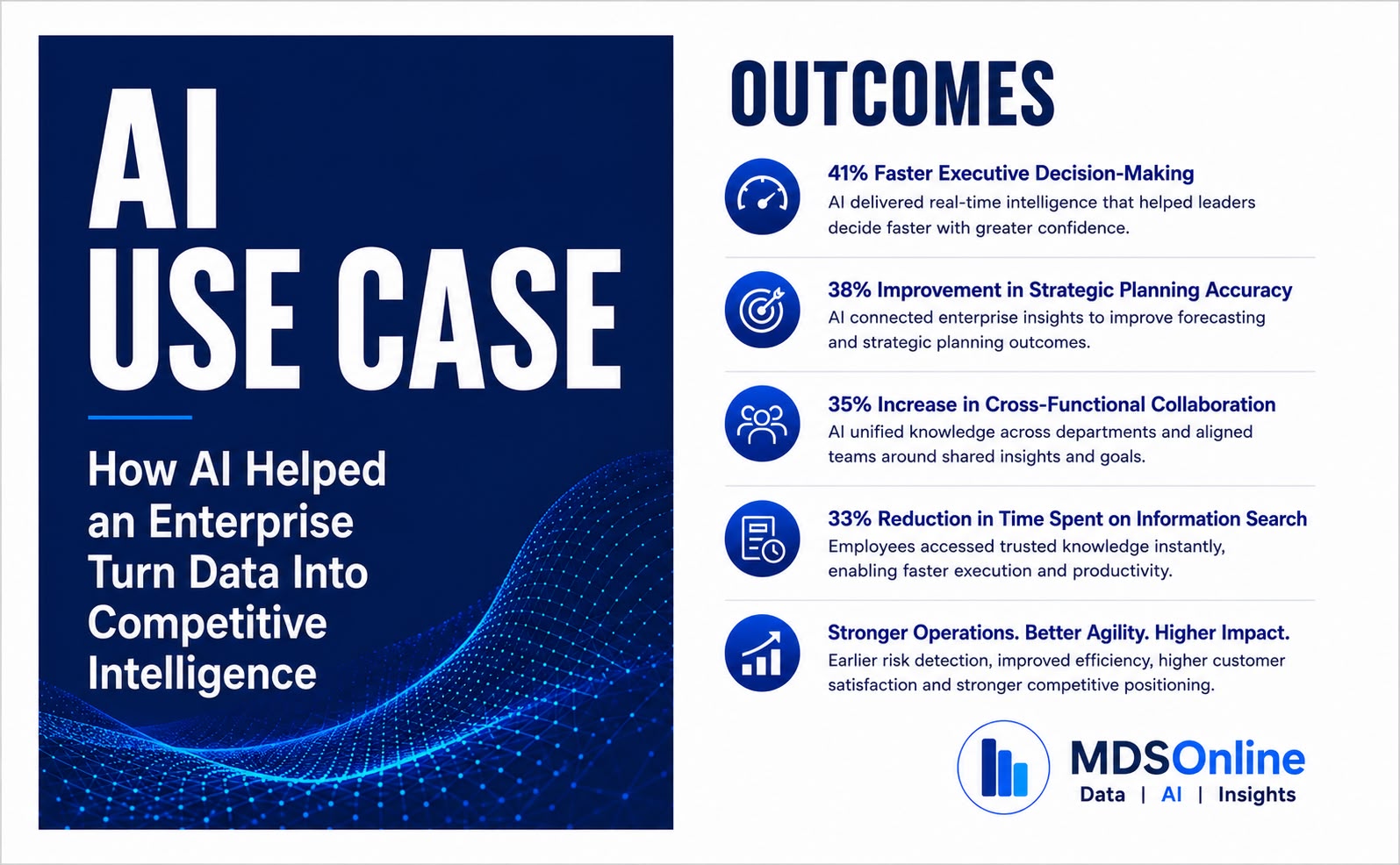
* 41% faster executive decision-making
* 38% improvement in strategic planning accuracy
* 35% increase in cross-functional collaboration
* 33% reduction in time spent gathering business information
Operational Outcomes
* Improved knowledge accessibility
* Faster issue resolution
* Better workflow automation
* Earlier identification of enterprise risks
* Stronger alignment across departments
Business Outcomes
* Higher customer satisfaction
* Better business agility
* Increased operational efficiency
* Improved strategic execution
* Stronger competitive positioning
* Greater enterprise resilience
The Bigger Lesson
Technology alone has never created lasting competitive advantage.
Intelligence does.
The organizations leading the next generation of business won’t simply invest in more AI.
They’ll embed intelligence into every decision, every workflow, and every customer interaction.
That’s when AI becomes more than a technology initiative.
It becomes the operating system for the modern enterprise.
Final Takeaway
Ask yourself:
* If AI became part of every business decision tomorrow, would your organization make better decisions – or simply automate existing processes?
* Is your business connecting knowledge across the enterprise, or creating new AI silos?
* Are you investing in technology – or building organizational intelligence?
The future of business won’t belong to the organizations with the most AI.
It will belong to those that use AI to think, decide, and act more intelligently every day.



If you’re exploring how to build an Enterprise AI ecosystem that connects your data, empowers your teams, and transforms business intelligence into measurable results, let’s connect. I’d be happy to discuss practical AI strategies that create long-term competitive advantage.
Visit MDSOnline.co.in