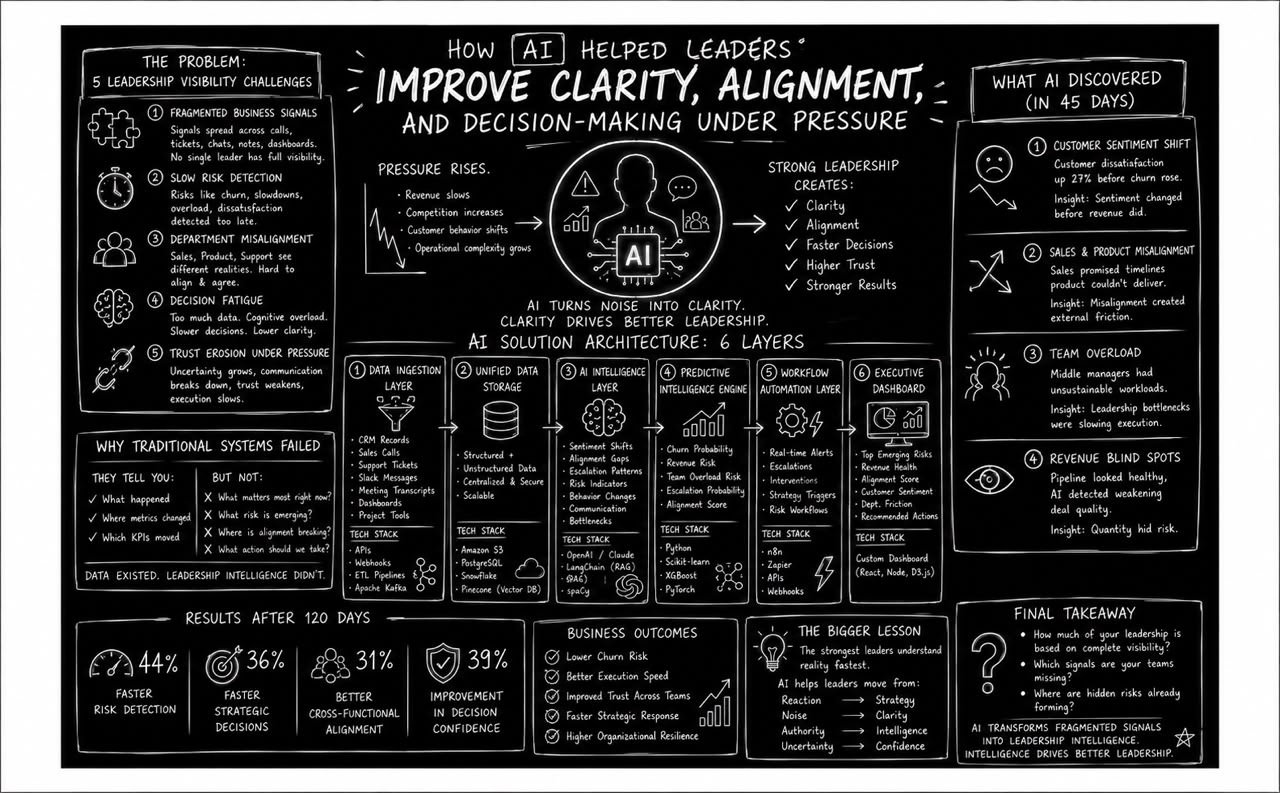
AI leadership Intelligence
Leadership is tested most during uncertainty.
When markets are stable, leadership flaws often stay hidden.
But when pressure rises, everything becomes clearer.
Revenue slows.
Competition increases.
Customer behavior shifts.
Operational complexity grows.
That’s when leadership truly matters.
Some leaders create clarity.
Others unintentionally create confusion.
This case study shows how a growing company used AI to improve leadership visibility, reduce decision blind spots, and strengthen organizational alignment during high-pressure periods.
Company Background
A fast-growing B2B SaaS company with 350+ employees was entering a challenging market cycle.
The company operated across:
– Sales
– Product
– Engineering
– Customer Success
– Operations
– Executive Leadership
For three years, growth had been strong.
Then market conditions changed.
The company began facing:
– Longer sales cycles
– Increased churn risk
– Rising competition
– Greater pricing pressure
– Slower expansion
Leadership meetings became more frequent.
Yet decision quality declined.
Leaders felt overwhelmed by conflicting signals.
The Problem
The company faced five major leadership visibility challenges.
1. Fragmented Business Signals
Critical business intelligence was spread across multiple systems.
Important signals lived inside:
– Customer conversations
– Sales calls
– Support tickets
– Slack threads
– Meeting notes
– Operational dashboards
No single leader had full visibility.
2. Slow Risk Detection
By the time major risks became obvious, damage had already started.
Examples included:
– Churn spikes
– Sales slowdowns
– Team overload
– Customer dissatisfaction
Risk detection was reactive.
3. Department Misalignment
Each department saw the business differently.
Sales saw pipeline pressure.
Product saw roadmap complexity.
Support saw customer frustration.
Leadership struggled to reconcile conflicting perspectives.
4. Decision Fatigue
Executives reviewed massive amounts of data daily.
This created:
– Cognitive overload
– Slower decisions
– Lower clarity
– Reduced confidence
5. Trust Erosion Under Pressure
When clarity dropped, teams felt uncertainty.
Communication became inconsistent.
Trust weakened.
Execution slowed.
Why Traditional Systems Failed
The company already used modern systems.
They relied on:
– Salesforce
– Slack
– Tableau
– Jira
– Zoom
The issue wasn’t lack of data.
It was this:
Data existed.
Leadership intelligence didn’t.
Dashboards answered:
– What happened
– Where metrics changed
– Which KPIs moved
But they struggled to answer:
– What matters most right now?
– What risk is emerging?
– Where is alignment breaking?
– What action should leadership take?
That’s where AI came in.
The AI Strategy
The objective was clear:
Build an AI-powered Leadership Intelligence System.
The system needed to continuously answer:
– What is changing?
– What matters most?
– What risk is emerging?
– What requires leadership attention now?
AI became a strategic intelligence layer for leadership.
AI Solution Architecture
The solution was built across six layers.
Layer 1: Data Ingestion Layer
AI collected signals from every business system.
Data sources included:
– CRM records
– Sales calls
– Support tickets
– Slack messages
– Meeting transcripts
– Operational dashboards
– Project management tools
Tech Stack
– APIs
– Webhooks
– ETL pipelines
– Event streaming via Apache Kafka
Purpose:
Centralize fragmented leadership signals.
Layer 2: Unified Data Storage
All structured and unstructured data was centralized.
Tech Stack
– Amazon S3
– PostgreSQL
– Snowflake
– Vector DB: Pinecone
Purpose:
Enable large-scale analytics and semantic search.
Layer 3: AI Intelligence Layer
AI analyzed structured and unstructured signals.
It detected:
– Sentiment shifts
– Escalation patterns
– Alignment gaps
– Risk indicators
– Customer behavior changes
– Communication bottlenecks
Example insight:
> “Customer frustration increased 27% over the last 14 days.”
Tech Stack
– OpenAI GPT Models
– Claude
– RAG via LangChain
– spaCy
Layer 4: Predictive Intelligence Engine
Machine learning predicted emerging risks.
AI scored:
– Churn probability
– Revenue risk
– Team overload risk
– Escalation probability
– Alignment health score
Tech Stack
– Python
– Scikit-learn
– XGBoost
– PyTorch
Layer 5: Workflow Automation Layer
AI triggered real-time alerts and workflows.
Examples:
– Churn risk spike → executive alert
– Alignment breakdown → escalation
– Team overload → manager intervention
– Revenue risk increase → strategy review
Tech Stack
– n8n
– Zapier
– APIs
– Webhooks
Layer 6: Executive Intelligence Dashboard
Leadership received AI-powered visibility.
Dashboard displayed:
– Top emerging risks
– Revenue health
– Team alignment score
– Customer sentiment
– Department friction
– Recommended actions
This gave leaders clarity under pressure.
What AI Discovered
Within 45 days, AI surfaced critical insights.
Hidden Risk #1: Customer Sentiment Shift
Customer dissatisfaction was rising before churn appeared.
Leadership had missed early warning signs.
Insight
Sentiment changed before revenue did.
Hidden Risk #2: Sales and Product Misalignment
Sales promised aggressive timelines.
Product couldn’t support commitments.
Customer trust suffered.
Insight
Misalignment was creating external friction.
Hidden Risk #3: Team Overload
Middle managers had unsustainable workload levels.
Decision delays increased.
Insight
Leadership bottlenecks were slowing execution.
Hidden Risk #4: Revenue Blind Spots
Pipeline health appeared stable.
AI detected weakening deal quality.
Insight
Pipeline size hid conversion risk.
Results After 120 Days
The AI implementation delivered measurable impact.
Leadership Outcomes
– 44% faster risk detection
– 36% faster strategic decisions
– 31% better cross-functional alignment
– 39% improvement in decision confidence
Business Outcomes
– Lower churn risk
– Better execution speed
– Improved trust across teams
– Faster strategic response
– Higher organizational resilience
The Bigger Lesson
The strongest leaders are not the ones who control everything.
They are the ones who understand reality fastest.
That’s the real power of AI.
Not replacing leadership.
Strengthening leadership intelligence.
AI helps leaders move from:
Reaction → Strategy
Noise → Clarity
Authority → Intelligence
Uncertainty → Confidence
That’s where real leverage exists.
Final Takeaway
Ask yourself:
– How much of your leadership is based on complete visibility?
– Which signals are your teams missing?
– Where are hidden risks already forming?
Business rarely breaks from pressure alone.
It breaks when leaders lose visibility, clarity, and trust.
AI changes that.
It transforms fragmented signals into leadership intelligence.
And intelligence drives better leadership.