AI Operational Intelligence
For many founders and executives, taking a vacation doesn’t mean switching off.
It means changing locations.
The laptop still opens.
Slack notifications still arrive.
Emails still get checked.
Important decisions still find their way to the same people.
The problem isn’t dedication.
It’s dependency.
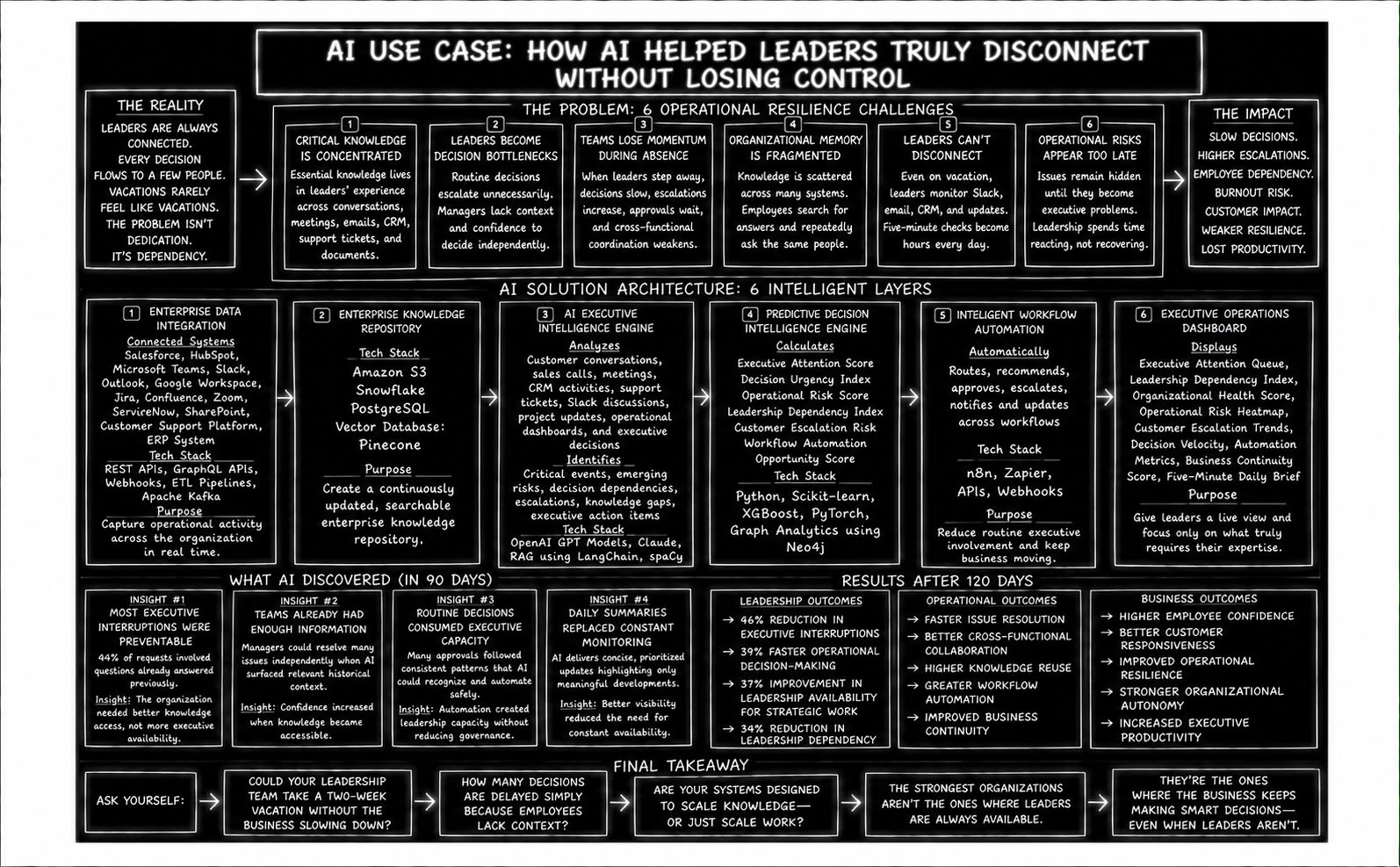
This case study explores how a rapidly growing technology company used AI to reduce founder dependency, preserve organizational knowledge, and enable leaders to step away with confidence while the business continued to operate effectively.
Company Background
A fast-growing B2B SaaS company with over 520 employees operated across North America, Europe, and Asia-Pacific.
Its teams included:
* Sales
* Marketing
* Product
* Engineering
* Customer Success
* Operations
* Finance
* Human Resources
* Executive Leadership
Although the company had experienced strong growth, leadership faced an ongoing operational challenge.
Every major decision eventually reached a small group of executives.
Employees frequently waited for approvals.
Customers requested executive involvement.
Managers delayed decisions until leaders became available.
Vacations rarely felt like vacations.
Leadership wasn’t the problem.
Organizational dependency was.
The Problem
The organization faced six major operational resilience challenges.
1. Critical Knowledge Was Concentrated
Essential business knowledge existed across:
* Customer conversations
* Sales calls
* Executive meetings
* CRM records
* Slack discussions
* Emails
* Support tickets
* Project documentation
Much of that knowledge remained inside individual leaders’ experience.
2. Leaders Became Decision Bottlenecks
Routine operational decisions frequently escalated to executives.
Managers lacked confidence because they couldn’t easily access previous decisions or business context.
3. Teams Lost Momentum During Executive Absence
Whenever senior leaders traveled or took leave:
* Decisions slowed
* Customer escalations increased
* Project approvals waited
* Cross-functional coordination weakened
Execution became dependent on executive availability.
4. Organizational Memory Was Fragmented
Employees searched across multiple systems trying to find:
* Previous customer decisions
* Product commitments
* Contract exceptions
* Operational procedures
* Historical context
Finding answers often required asking the same people repeatedly.
5. Leaders Couldn’t Disconnect
Even during vacations, executives monitored:
* Slack
* CRM alerts
* Customer escalations
* Project updates
Five-minute check-ins became several hours every day.
6. Operational Risks Appeared Too Late
Without centralized intelligence, emerging issues often remained hidden until they became executive problems.
Leadership spent time reacting rather than recovering.
Why Traditional Collaboration Tools Failed
The organization already invested heavily in digital collaboration.
Its technology ecosystem included:
* Microsoft Teams
* Slack
* Salesforce
* Jira
* Confluence
* Google Workspace
These platforms stored information.
They couldn’t answer questions like:
* What changed while I was away?
* Which issues actually require executive attention?
* Has something similar happened before?
* What decision would we normally make?
* Which risks are emerging right now?
The organization had collaboration tools.
It lacked operational intelligence.
The AI Strategy
The company implemented an AI-Powered Executive Operations Intelligence Platform.
Rather than replacing leaders, AI continuously captured business knowledge, monitored operational activity, and surfaced only the information requiring executive judgment.
The objective was simple:
Allow leaders to disconnect without the business losing direction.
The platform continuously answered:
* What happened today?
* What actually matters?
* Which issues can teams resolve independently?
* Which decisions truly require executive involvement?
AI became an executive intelligence layer instead of another reporting tool.
AI Solution Architecture
The solution consisted of six intelligent layers.
Layer 1: Enterprise Data Integration
AI continuously collected operational signals.
Connected Systems
* Salesforce
* HubSpot
* Microsoft Teams
* Slack
* Outlook
* Google Workspace
* Jira
* Confluence
* Zoom
* ServiceNow
* SharePoint
* Customer Support Platform
* ERP System
Tech Stack
* REST APIs
* GraphQL APIs
* Webhooks
* ETL Pipelines
* Apache Kafka
Purpose
Capture operational activity across the organization in real time.
Layer 2: Enterprise Knowledge Repository
Business knowledge was centralized into a searchable organizational memory.
Tech Stack
* Amazon S3
* Snowflake
* PostgreSQL
* Vector Database:
* Pinecone
Purpose
Create a continuously updated enterprise knowledge repository.
Layer 3: AI Executive Intelligence Engine
AI analyzed:
* Customer conversations
* Sales calls
* Meeting transcripts
* CRM activities
* Support tickets
* Slack discussions
* Project updates
* Operational dashboards
* Executive decisions
The platform automatically identified:
* Critical business events
* Emerging risks
* Decision dependencies
* Customer escalations
* Knowledge gaps
* Executive action items
Example insight:
“Thirty-two customer issues were resolved this week without executive involvement using previous decision patterns. Two strategic contract approvals require your review.”
Tech Stack
* OpenAI GPT Models
* Claude
* Retrieval-Augmented Generation (RAG) using LangChain
* spaCy
Layer 4: Predictive Decision Intelligence Engine
Machine learning evaluated operational patterns continuously.
AI calculated:
* Executive Attention Score
* Decision Urgency Index
* Operational Risk Score
* Leadership Dependency Index
* Customer Escalation Risk
* Workflow Automation Opportunity Score
Tech Stack
* Python
* Scikit-learn
* XGBoost
* PyTorch
* Graph analytics using Neo4j to understand decision dependencies across teams
Layer 5: Intelligent Workflow Automation
AI reduced routine executive involvement.
Examples:
* Routine contract approval → Auto-approved based on predefined policies
* Customer escalation detected → Similar historical resolution recommended
* Team asks operational question → AI retrieves previous executive guidance
* Executive returns from vacation → AI generates a five-minute strategic briefing
* Emerging operational risk detected → Relevant manager notified automatically
Tech Stack
* n8n
* Zapier
* APIs
* Webhooks
Layer 6: Executive Operations Dashboard
Leadership gained a real-time operational overview.
Dashboard displayed:
* Executive Attention Queue
* Leadership Dependency Index
* Organizational Health Score
* Operational Risk Heatmap
* Customer Escalation Trends
* Decision Velocity
* Workflow Automation Metrics
* Business Continuity Score
* Five-Minute Executive Daily Brief
Instead of monitoring everything, leaders focused only on what truly required their expertise.
What AI Discovered
Within 90 days, AI uncovered several hidden opportunities.
Hidden Insight #1: Most Executive Interruptions Were Preventable
Nearly 44% of executive requests involved questions that had already been answered previously.
Insight
The organization needed better knowledge access—not more executive availability.
Hidden Insight #2: Teams Already Had Enough Information
Managers could independently resolve many issues when AI surfaced relevant historical context.
Insight
Confidence increased when knowledge became accessible.
Hidden Insight #3: Routine Decisions Consumed Executive Capacity
Many approvals followed consistent patterns that AI could recognize and automate safely.
Insight
Automation created leadership capacity without reducing governance.
Hidden Insight #4: Daily Summaries Replaced Constant Monitoring
Executives no longer needed to check multiple platforms throughout the day.
AI delivered concise, prioritized updates highlighting only meaningful developments.
Insight
Better visibility reduced the need for constant availability.
Results After 120 Days
The AI implementation delivered measurable improvements.
Leadership Outcomes
* 46% reduction in executive interruptions
* 39% faster operational decision-making
* 37% improvement in leadership availability for strategic work
* 34% reduction in leadership dependency
Operational Outcomes
* Faster issue resolution
* Better cross-functional collaboration
* Higher knowledge reuse
* Greater workflow automation
* Improved business continuity
Business Outcomes
* Higher employee confidence
* Better customer responsiveness
* Improved operational resilience
* Stronger organizational autonomy
* Increased executive productivity
The Bigger Lesson
Great leaders don’t build organizations that depend on them every hour of every day.
They build systems that allow people to make smart decisions without constant supervision.
That’s where AI creates real leverage.
Not by replacing leaders.
By making leadership scalable.
AI transforms:
Constant oversight…
Into intelligent visibility.
Founder dependency…
Into organizational resilience.
Scattered information…
Into shared operational intelligence.
Final Takeaway
Ask yourself:
* Could your leadership team take a two-week vacation without the business slowing down?
* How many decisions are delayed simply because employees lack context?
* Are your systems designed to scale knowledge – or just scale work?
The strongest organizations aren’t the ones where leaders are always available.
They’re the ones where the business keeps making smart decisions – even when leaders aren’t.


⭐ ⭐ ⭐ ⭐ ⭐ Top Rated AI Growth & Efficiency Strategist on Upwork
upwork.com/fl/navinmirania
If you’re exploring how AI can improve operational visibility, knowledge management, workflow automation, or executive decision-making, let’s connect.
I help founders and organizations build practical AI-powered systems that transform fragmented business data into actionable insights, autonomous operations, and measurable business growth.