AI Strategic Execution
Business leaders don’t struggle because they lack ideas.
They struggle because they lack time.
Every day is consumed by customer issues, operational meetings, project updates, approvals, emails, and unexpected challenges. While these activities keep the business running, they often prevent leaders from focusing on the initiatives that will drive future growth.
The challenge isn’t working harder.
It’s creating enough capacity to think strategically.
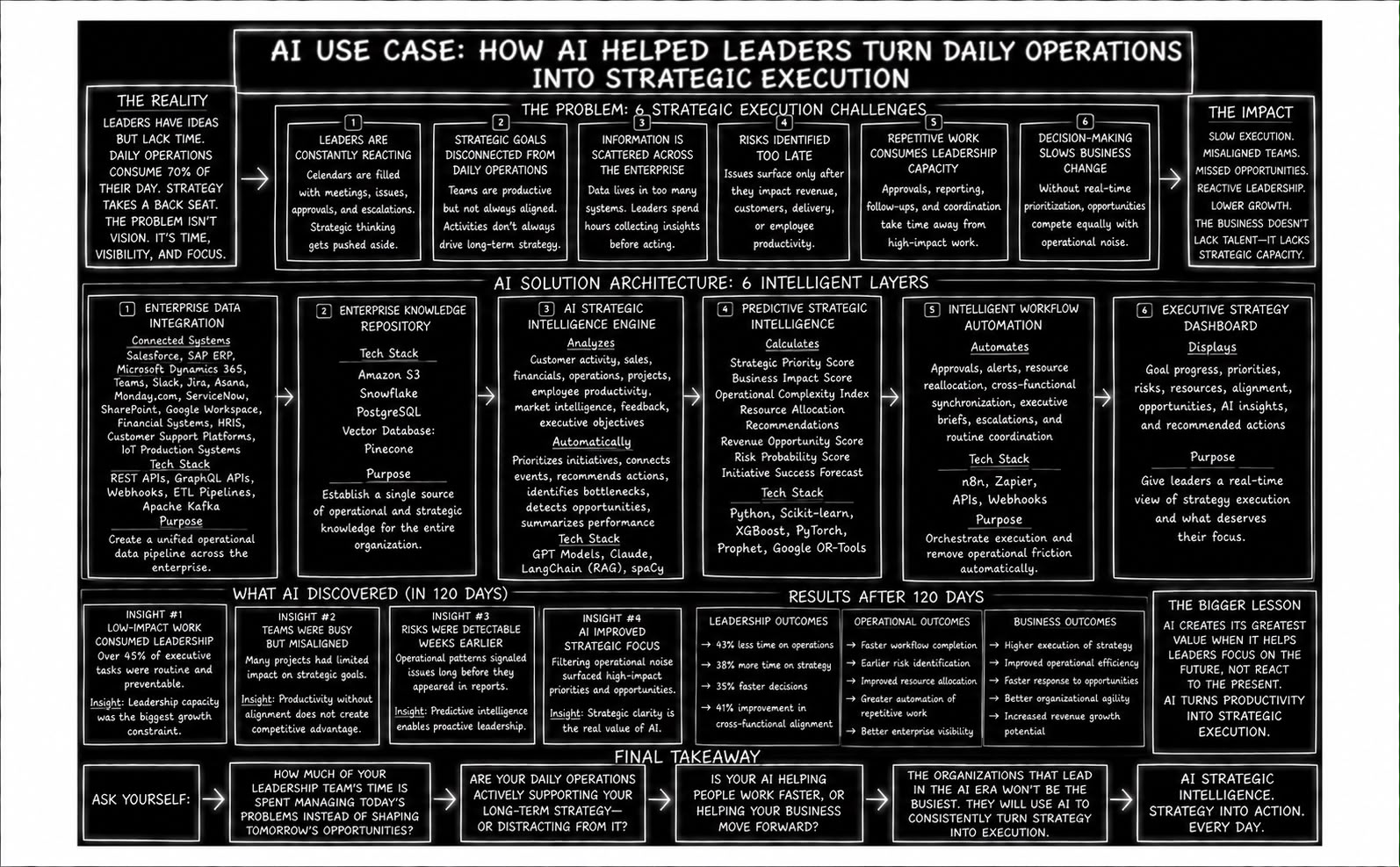
This case study explores how a global manufacturing and technology company implemented an AI-powered Strategic Execution Platform that automated operational complexity, aligned daily work with business goals, and enabled leaders to spend more time shaping the future instead of reacting to the present.
Company Background
A multinational industrial technology company with over 1,200 employees operated across North America, Europe, and Asia-Pacific.
The organization consisted of:
* Executive Leadership
* Sales
* Marketing
* Operations
* Product Development
* Engineering
* Supply Chain
* Finance
* Customer Success
* Human Resources
Despite strong growth, executives found themselves spending nearly 70% of their time on operational management rather than strategic planning.
Business priorities frequently shifted as urgent issues displaced long-term initiatives.
Although the company had invested heavily in digital transformation, strategy execution remained inconsistent.
Leadership wasn’t short of vision.
It was short of visibility, alignment, and time.
The Problem
The organization faced six major strategic execution challenges.
1. Leaders Were Constantly Reacting
Executive calendars filled with:
* Customer escalations
* Operational meetings
* Approval requests
* Status reviews
* Cross-functional coordination
* Issue resolution
Strategic planning became an activity reserved for quarterly off-sites rather than daily decision-making.
2. Strategic Goals Were Disconnected from Daily Operations
Departments worked efficiently within their own functions.
However, many activities contributed little to the organization’s long-term strategic objectives.
Teams remained productive.
The business wasn’t always progressing strategically.
3. Information Was Scattered Across the Enterprise
Critical insights existed across:
* CRM
* ERP
* Project management platforms
* Financial systems
* Customer support
* Emails
* Teams
* Slack
* Operational dashboards
Executives spent significant time gathering information before making decisions.
4. Risks Were Identified Too Late
Operational issues often became visible only after they affected:
* Revenue
* Customer satisfaction
* Delivery timelines
* Employee productivity
Leadership reacted instead of anticipating.
5. Repetitive Operational Work Consumed Leadership Capacity
Routine approvals, reporting, follow-ups, and coordination absorbed hours that could have been spent on innovation and growth.
6. Decision-Making Was Slower Than Business Change
Although data was abundant, executives lacked real-time prioritization.
Important opportunities often competed equally with routine operational noise.
Why Traditional Business Intelligence Failed
The organization already used enterprise platforms including:
* Microsoft Power BI
* Microsoft Teams
* Salesforce
* SAP
* Jira
* Asana
These systems reported what had already happened.
They couldn’t answer:
* Which initiatives best support our strategic goals?
* Which operational issues deserve executive attention?
* What can be automated?
* Which risks are emerging?
* Where should leadership invest its time today?
The company had dashboards.
It lacked strategic intelligence.
The AI Strategy
The organization implemented an AI-Powered Strategic Execution Platform.
Rather than creating another reporting system, AI continuously connected operational activities with strategic business objectives.
The platform became an intelligent execution layer that:
* Prioritized initiatives based on business goals
* Automated routine operational work
* Identified emerging opportunities
* Detected business risks early
* Connected enterprise knowledge
* Recommended executive actions
The objective was simple:
Help leaders spend less time managing operations and more time leading the business.
AI Solution Architecture
The solution consisted of six intelligent layers.
Layer 1: Enterprise Data Integration
AI continuously collected enterprise-wide operational data.
Connected Systems
* Salesforce
* SAP ERP
* Microsoft Dynamics 365
* Microsoft Teams
* Slack
* Jira
* Asana
* ServiceNow
* SharePoint
* Google Workspace
* Financial Systems
* HRIS
* Customer Support Platforms
* IoT Production Systems
Tech Stack
* REST APIs
* GraphQL APIs
* Webhooks
* ETL Pipelines
* Apache Kafka
Purpose
Create a unified operational data pipeline across the enterprise.
Layer 2: Enterprise Knowledge Repository
Operational knowledge from every department was centralized into a searchable intelligence platform.
Tech Stack
* Amazon S3
* Snowflake
* PostgreSQL
* Vector Database:
* Pinecone
Purpose
Establish a single source of operational and strategic knowledge.
Layer 3: AI Strategic Intelligence Engine
AI continuously analyzed:
* Customer activity
* Sales performance
* Operational KPIs
* Financial trends
* Project progress
* Employee productivity
* Market intelligence
* Customer feedback
* Executive objectives
The platform automatically:
* Prioritized strategic initiatives
* Connected related business events
* Recommended executive actions
* Identified operational bottlenecks
* Detected emerging growth opportunities
* Summarized organizational performance
Example insight:
“Customer demand for Product A has increased 18% over the past six weeks. Reallocating engineering resources from two lower-priority projects could accelerate revenue growth by an estimated 9%.”
Tech Stack
* OpenAI GPT Models
* Claude
* Retrieval-Augmented Generation (RAG) using LangChain
* spaCy
Layer 4: Predictive Strategic Intelligence
Machine learning continuously predicted business performance.
AI generated:
* Strategic Priority Score
* Business Impact Score
* Operational Complexity Index
* Resource Allocation Recommendations
* Revenue Opportunity Score
* Risk Probability Score
* Initiative Success Forecast
Tech Stack
* Python
* Scikit-learn
* XGBoost
* PyTorch
* Time-series forecasting using Prophet
* Optimization modeling with Google OR-Tools
Layer 5: Intelligent Workflow Automation
AI orchestrated strategic execution automatically.
Examples:
* Routine approvals → Automated based on governance policies
* Strategic KPI deviation → Executive alert generated
* High-impact initiative delayed → Resources reallocated automatically for review
* Cross-functional dependency detected → Teams synchronized automatically
* Weekly leadership brief → AI-generated executive summary with priorities, risks, and recommended actions
Tech Stack
* n8n
* Zapier
* APIs
* Webhooks
Layer 6: Executive Strategy Dashboard
Executives gained a live view of strategic execution.
Dashboard displayed:
* Strategic Goal Progress
* Executive Attention Score
* Initiative Priority Matrix
* Business Opportunity Pipeline
* Operational Risk Heatmap
* Resource Utilization
* Cross-Department Alignment Index
* AI-Recommended Next Actions
* Strategy Execution Score
Leadership no longer managed isolated tasks.
They managed enterprise-wide strategic outcomes.
What AI Discovered
Within 120 days, AI identified several hidden opportunities.
Hidden Insight #1: Most Leadership Time Was Consumed by Low-Impact Activities
Over 45% of executive tasks involved routine operational work that could be automated or delegated.
Insight
Leadership capacity—not talent—was the organization’s biggest growth constraint.
Hidden Insight #2: Teams Were Busy but Misaligned
Many completed projects had limited impact on strategic objectives.
Insight
Productivity without alignment does not create competitive advantage.
Hidden Insight #3: Risks Were Detectable Weeks Earlier
Operational patterns consistently signaled potential disruptions before they became visible through traditional reporting.
Insight
Predictive intelligence enabled proactive leadership.
Hidden Insight #4: AI Improved Strategic Focus
By filtering operational noise and surfacing high-impact priorities, AI enabled executives to make faster, more confident decisions.
Insight
The greatest value of AI wasn’t automation—it was strategic clarity.
Results After 120 Days
Leadership Outcomes
* 43% reduction in executive time spent on operational management
* 38% increase in time dedicated to strategic initiatives
* 35% faster executive decision-making
* 41% improvement in cross-functional alignment
Operational Outcomes
* Faster workflow completion
* Earlier risk identification
* Improved resource allocation
* Greater automation of repetitive processes
* Better enterprise visibility
Business Outcomes
* Higher execution of strategic initiatives
* Improved operational efficiency
* Faster response to market opportunities
* Better organizational agility
* Increased revenue growth potential
The Bigger Lesson
AI creates its greatest business value when it helps leaders focus on the future rather than constantly reacting to the present.
The organizations gaining the strongest competitive advantage aren’t simply automating workflows.
They’re aligning AI with strategy, operations, and decision-making so every action contributes to long-term business goals.
That’s when AI evolves from a productivity tool into a strategic execution partner.
Final Takeaway
Ask yourself:
* How much of your leadership team’s time is spent managing today’s problems instead of shaping tomorrow’s opportunities?
* Are your daily operations actively supporting your long-term strategy—or distracting from it?
* Is your AI helping people work faster, or helping your business move forward?
The organizations that lead in the AI era won’t be the busiest.
They’ll be the ones that use AI to consistently turn strategy into execution.


Visit our website mdsonline.co.in
If you’re exploring how to use AI to reduce operational complexity while accelerating strategic execution, let’s connect. I’d be happy to discuss practical AI architectures that deliver measurable business outcomes.