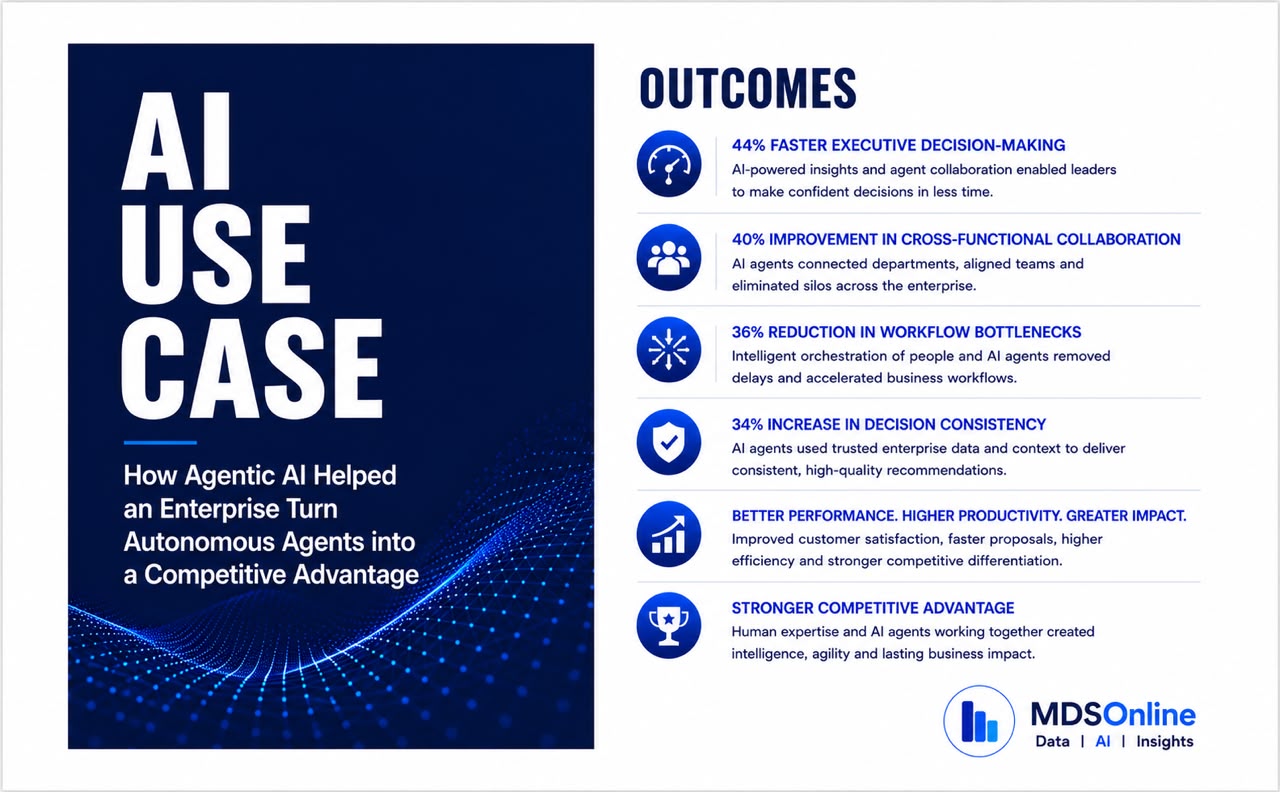
Generative AI Business Value
Generative AI has moved beyond experimentation.
Today, the biggest question facing business leaders isn’t:
“Can we use AI?”
It’s:
“Is AI creating measurable business value?”
Many organizations proudly report:
* Thousands of AI prompts
* Hundreds of active users
* Dozens of AI applications
* Enterprise-wide AI licenses
Yet executive teams still struggle to answer one simple question:
“What business outcomes have actually improved?”
This case study explores how a multinational financial services organization transformed its Generative AI strategy by shifting its focus from AI activity to measurable business value.
Company Background
A global financial services company with over 8,500 employees operated across North America, Europe, Asia-Pacific, and the Middle East.
Its business functions included:
* Retail Banking
* Commercial Banking
* Wealth Management
* Customer Service
* Risk & Compliance
* Finance
* Human Resources
* IT
* Operations
* Executive Leadership
The organization invested heavily in Generative AI.
Employees had access to:
* AI writing assistants
* Enterprise copilots
* Customer support assistants
* Knowledge search tools
* Document summarization
* Meeting assistants
* Workflow automation
Within months, adoption exceeded expectations.
Business value did not.
The Problem
Leadership identified six major challenges.
1. AI Success Was Measured by Usage
Executive dashboards celebrated:
* Active AI users
* AI licenses deployed
* Prompts generated
* AI sessions completed
None explained whether AI improved business performance.
2. High-Value Opportunities Were Overlooked
Employees used AI for:
* Email drafting
* Meeting summaries
* Presentation creation
* Content generation
Meanwhile, high-impact business problems remained largely unchanged:
* Slow customer onboarding
* Lengthy loan approvals
* Manual compliance reviews
* Fragmented customer insights
* Delayed executive decisions
3. AI Operated Outside Daily Workflows
Employees opened separate AI applications.
Generated responses.
Copied results.
Returned to business systems.
AI became an extra step instead of becoming part of the workflow.
4. Business Outcomes Were Difficult to Measure
Leadership couldn’t confidently answer:
* Which AI initiatives increased revenue?
* Which reduced costs?
* Which improved customer experience?
* Which accelerated decision-making?
Every department reported success.
Few could prove business impact.
5. Automation Improved Tasks—but Not Business Performance
Many repetitive activities disappeared.
Entire business processes remained unchanged.
Departments became more efficient.
The enterprise did not become more effective.
6. AI Investments Lacked Strategic Prioritization
Projects were selected because AI could automate them.
Not because they created measurable strategic value.
Why Traditional AI Adoption Failed
The organization already deployed enterprise AI technologies including:
* Microsoft Copilot
* OpenAI GPT Models
* Claude
* Salesforce Agentforce
* Enterprise Knowledge Assistants
* Workflow Automation Platforms
These technologies increased productivity.
They didn’t automatically improve business outcomes.
The company measured AI activity.
It wasn’t measuring business value.
The AI Strategy
Leadership introduced an Enterprise Generative AI Value Intelligence Platform.
Instead of tracking AI adoption, the platform continuously measured how AI influenced business performance.
Every AI initiative was linked to one or more strategic objectives:
* Revenue Growth
* Operational Efficiency
* Customer Experience
* Decision Speed
* Risk Reduction
* Employee Productivity
AI projects that couldn’t demonstrate measurable business value were redesigned or discontinued.
The objective was simple:
Transform AI from a productivity tool into a business transformation capability.
AI Solution Architecture
The platform consisted of six intelligent layers.
Layer 1: Enterprise Data Integration
AI continuously connected operational and business performance data.
Connected Systems
* Salesforce CRM
* SAP ERP
* Microsoft Teams
* SharePoint
* ServiceNow
* Workday
* Customer Support Platform
* Financial Systems
* Compliance Platform
* Knowledge Base
* Document Management Systems
Tech Stack
* REST APIs
* GraphQL APIs
* Webhooks
* ETL Pipelines
* Apache Kafka
Purpose
Connect AI activity directly with operational and financial outcomes.
Layer 2: Enterprise Knowledge Repository
Business knowledge, customer interactions, policies, documents, and historical decisions were centralized.
Tech Stack
* Amazon S3
* Snowflake
* PostgreSQL
* Vector Database:
* Pinecone
Purpose
Provide trusted enterprise knowledge for every AI interaction.
Layer 3: Generative AI Business Value Engine
AI continuously analyzed:
* Customer journeys
* Operational workflows
* Employee activities
* Executive decisions
* Customer support interactions
* Sales performance
* Compliance reviews
* Financial operations
* Knowledge utilization
* Process execution
The platform automatically:
* Identified high-value AI opportunities
* Measured business outcomes
* Recommended workflow redesign
* Detected low-value AI initiatives
* Prioritized transformation projects
* Connected AI usage with measurable KPIs
Example insight:
“Employees generated over 42,000 AI summaries this month, but customer onboarding remains unchanged. Redirecting AI toward document verification and compliance validation is projected to reduce onboarding time by 38%.”
Tech Stack
* OpenAI GPT Models
* Claude
* Retrieval-Augmented Generation (RAG) using LangChain
* spaCy
Layer 4: Predictive Business Value Intelligence
Machine learning evaluated the business impact of every AI initiative.
AI generated:
* Business Value Score
* AI ROI Index
* Customer Experience Impact
* Revenue Opportunity Index
* Operational Efficiency Score
* Decision Velocity Index
* Transformation Readiness Score
Tech Stack
* Python
* Scikit-learn
* XGBoost
* PyTorch
* Neo4j for mapping business process dependencies
Layer 5: Intelligent Workflow Transformation
AI recommendations automatically initiated transformation workflows.
Examples:
* High-impact AI opportunity identified → Executive business case generated
* Low-value AI initiative detected → Review and redesign triggered
* Customer experience bottleneck identified → Workflow optimization launched
* Manual approval delays detected → Intelligent automation recommended
* Monthly AI value report delivered to executives
Tech Stack
* n8n
* Zapier
* APIs
* Webhooks
Layer 6: Executive Business Value Dashboard
Leadership measured business outcomes instead of AI activity.
Dashboard displayed:
* Business Value Score
* AI ROI Index
* Revenue Impact
* Cost Savings
* Customer Experience Improvement
* Decision Velocity
* Operational Friction Index
* AI Transformation Pipeline
* Strategic KPI Alignment
Instead of counting prompts and users, executives tracked measurable business results.
What AI Discovered
Within 120 days, AI uncovered four important insights.
Hidden Insight #1: The Most Popular AI Tools Weren’t Creating the Most Value
Frequently used AI applications delivered only modest business impact.
Insight
Adoption and value are not the same.
Hidden Insight #2: Workflow Transformation Delivered Greater ROI Than Standalone Automation
Embedding AI into end-to-end processes generated significantly higher returns than isolated productivity tools.
Insight
Transformation outperformed automation.
Hidden Insight #3: Strategic Alignment Determined AI Success
AI initiatives linked to clear business objectives consistently outperformed projects driven by technology alone.
Insight
Business strategy … not model sophistication …created the greatest value.
Hidden Insight #4: Measuring Outcomes Changed Investment Decisions
Several widely used AI initiatives were deprioritized after leadership evaluated their actual business impact, while less visible projects that improved customer onboarding and risk assessment received additional investment.
Insight
The right metrics lead to better AI decisions.
Results After 120 Days
Leadership Outcomes
* 47% improvement in AI investment prioritization
* 42% faster executive decision-making
* 38% stronger alignment between AI initiatives and business strategy
* 35% increase in measurable AI ROI
Operational Outcomes
* Faster customer onboarding
* Reduced manual compliance effort
* Improved knowledge accessibility
* Better workflow integration
* Higher employee productivity
Business Outcomes
* Increased revenue opportunities
* Lower operational costs
* Higher customer satisfaction
* Faster strategic execution
* Improved enterprise agility
* Stronger long-term competitive advantage
The Bigger Lesson
Generative AI isn’t a technology project.
It’s a business transformation initiative.
Organizations that create lasting value don’t measure prompts, licenses, or usage.
They measure business outcomes.
That’s the difference between adopting AI and transforming the business.
Final Takeaway
Ask yourself:
* Are you measuring AI activity – or measurable business value?
* Which AI initiative has delivered the greatest impact on revenue, customer experience, or decision-making?
* If an AI project succeeds, can you clearly demonstrate the business outcome it improved?
The organizations that lead with Generative AI won’t necessarily deploy the most advanced models.
They’ll be the ones that connect every AI initiative to measurable business value—and continuously prove its impact.




If you’re exploring how to identify high-impact AI opportunities and build an Enterprise AI ecosystem that delivers measurable business outcomes, let’s connect. I’d be happy to discuss practical strategies that create lasting business value … not just AI adoption.
Visit MDSonline.co.in