Human+AI Decision Intelligence
For years, businesses have framed AI as a choice.
Human or AI.
Automation or expertise.
Speed or judgment.
But the organizations creating lasting competitive advantage have discovered something different.
The best decisions aren’t made by humans alone.
Nor are they made by AI alone.
They’re made when AI provides intelligence, and humans provide judgment.
This case study explores how a multinational healthcare technology company implemented an Enterprise Human-AI Decision Intelligence Platform that combined AI’s analytical capabilities with human expertise to improve strategic decision-making across the organization.
Company Background
A global healthcare technology company with over 6,500 employees operated across North America, Europe, Asia-Pacific, and the Middle East.
Its business functions included:
* Product Development
* Sales
* Customer Success
* Clinical Operations
* Finance
* Human Resources
* Regulatory Affairs
* IT
* Operations
* Executive Leadership
The organization had invested heavily in AI over several years.
AI was used for:
* Sales forecasting
* Customer support
* Clinical documentation
* Risk analysis
* Financial forecasting
* Meeting intelligence
* Knowledge management
Despite these investments, executives noticed a growing challenge.
AI generated more recommendations than ever before.
Decision quality wasn’t improving at the same pace.
Leaders realized they didn’t need AI making more decisions.
They needed AI helping people make better decisions.
The Problem
The organization faced six enterprise decision-making challenges.
1. AI Generated Recommendations Without Business Context
AI identified patterns and trends quickly.
However, it couldn’t fully consider:
* Regulatory implications
* Customer relationships
* Ethical considerations
* Strategic priorities
* Organizational culture
Important context remained with people.
2. Leaders Faced Information Overload
Executives received:
* Operational dashboards
* Financial reports
* Customer analytics
* Market intelligence
* AI-generated recommendations
More information didn’t always produce better decisions.
3. Different Departments Made Independent Decisions
Sales optimized revenue.
Operations optimized efficiency.
Finance optimized costs.
Customer Success optimized satisfaction.
Without coordinated decision-making, local improvements sometimes created enterprise-wide trade-offs.
4. AI Was Trusted Too Much—or Too Little
Some employees accepted every AI recommendation without sufficient review.
Others ignored AI completely.
Neither approach consistently produced good outcomes.
5. Strategic Decisions Required Human Judgment
Major decisions involved:
* Market expansion
* Product investment
* Customer relationships
* Regulatory compliance
* Organizational change
Historical data alone couldn’t determine the best course of action.
6. Leadership Had No Visibility Into Decision Quality
Executives measured:
* Project completion
* Financial performance
* Operational KPIs
They rarely evaluated:
* Decision consistency
* Recommendation accuracy
* Human-AI collaboration
* Decision confidence
Why Traditional AI Decision Support Failed
The company already used advanced enterprise AI technologies including:
* Microsoft Copilot
* OpenAI GPT Models
* Claude
* Predictive Analytics Platforms
* Business Intelligence Dashboards
These systems produced valuable insights.
They couldn’t determine:
* Which recommendation best aligned with business strategy
* Which risks required executive judgment
* Which decisions should remain human-led
* When AI confidence was insufficient
The organization had intelligent systems.
It lacked intelligent collaboration.
The AI Strategy
Leadership implemented an Enterprise Human-AI Decision Intelligence Platform.
Rather than replacing decision-makers, the platform was designed to augment them.
AI continuously gathered information, analyzed patterns, assessed risks, and generated recommendations.
Humans remained responsible for:
* Strategic judgment
* Ethical oversight
* Business priorities
* Customer relationships
* Final decisions
The objective was simple:
Combine AI’s analytical speed with human judgment to improve enterprise decision-making.
AI Solution Architecture
The solution consisted of six intelligent layers.
Layer 1: Enterprise Data Integration
AI continuously connected operational, financial, customer, and market data.
Connected Systems
* Salesforce CRM
* SAP ERP
* Microsoft Teams
* SharePoint
* ServiceNow
* Jira
* Workday
* Customer Support Platform
* Financial Systems
* Product Management Systems
* Regulatory Databases
* Executive Dashboards
Tech Stack
* REST APIs
* GraphQL APIs
* Webhooks
* ETL Pipelines
* Apache Kafka
Purpose
Provide a complete and trusted enterprise view for every important decision.
Layer 2: Enterprise Knowledge Repository
Business knowledge, historical decisions, customer insights, policies, regulations, and lessons learned were centralized.
Tech Stack
* Amazon S3
* Snowflake
* PostgreSQL
* Vector Database:
* Pinecone
Purpose
Give AI and decision-makers access to the same trusted organizational knowledge.
Layer 3: Human-AI Decision Intelligence Engine
AI continuously analyzed:
* Customer behavior
* Operational performance
* Financial trends
* Market intelligence
* Product performance
* Regulatory changes
* Project execution
* Executive priorities
* Risk indicators
* Historical decisions
The platform automatically:
* Generated decision options
* Highlighted risks and trade-offs
* Summarized supporting evidence
* Estimated business impact
* Flagged low-confidence recommendations
* Escalated strategic decisions for human review
Example insight:
“AI recommends delaying the product launch by four weeks due to increased regulatory review risk in two target markets. Although the delay may affect short-term revenue, it significantly reduces compliance risk and protects long-term customer trust.”
Tech Stack
* OpenAI GPT Models
* Claude
* Retrieval-Augmented Generation (RAG) using LangChain
* spaCy
Layer 4: Predictive Decision Intelligence
Machine learning continuously evaluated decision quality and predicted outcomes.
AI generated:
* Decision Confidence Score
* Strategic Alignment Index
* Risk Exposure Score
* Human Review Priority
* Business Impact Forecast
* Customer Outcome Prediction
* Decision Consistency Index
Tech Stack
* Python
* Scikit-learn
* XGBoost
* PyTorch
* Neo4j for mapping relationships between decisions, stakeholders, and business outcomes
Layer 5: Intelligent Decision Workflow
AI ensured the right decisions reached the right people at the right time.
Examples:
* Strategic investment exceeds approval threshold → Executive review initiated
* AI confidence below predefined level → Human validation required
* Regulatory risk detected → Compliance team engaged automatically
* Customer impact forecast exceeds tolerance → Cross-functional decision workshop scheduled
Tech Stack
* n8n
* Zapier
* APIs
* Webhooks
Layer 6: Executive Decision Intelligence Dashboard
Leadership gained complete visibility into enterprise decision-making.
Dashboard displayed:
* Decision Confidence Score
* Strategic Alignment Index
* Executive Decision Queue
* AI Recommendation Acceptance Rate
* Business Impact Forecast
* Enterprise Risk Heatmap
* Human-AI Collaboration Index
* Decision Cycle Time
* Outcome Tracking Dashboard
Rather than replacing leadership, AI strengthened executive judgment with trusted intelligence.
What AI Discovered
Within 120 days, AI uncovered four important insights.
Hidden Insight #1: AI Was Exceptional at Detecting Patterns
AI consistently identified risks, opportunities, and trends much earlier than traditional reporting.
Insight
Pattern recognition accelerated decision-making.
Hidden Insight #2: Human Context Improved Every Critical Decision
The highest-quality outcomes occurred when experienced leaders combined AI recommendations with business context, ethics, and long-term strategy.
Insight
Judgment remained a uniquely human advantage.
Hidden Insight #3: Collaboration Produced Better Results Than Automation
Organizations achieved better outcomes when AI informed decisions rather than replacing decision-makers.
Insight
Human + AI consistently outperformed either working independently.
Hidden Insight #4: Better Questions Produced Better AI
Leaders who clearly defined objectives and constraints received more relevant and actionable AI recommendations.
Insight
The quality of AI output depended on the quality of human direction.
Results After 120 Days
Leadership Outcomes
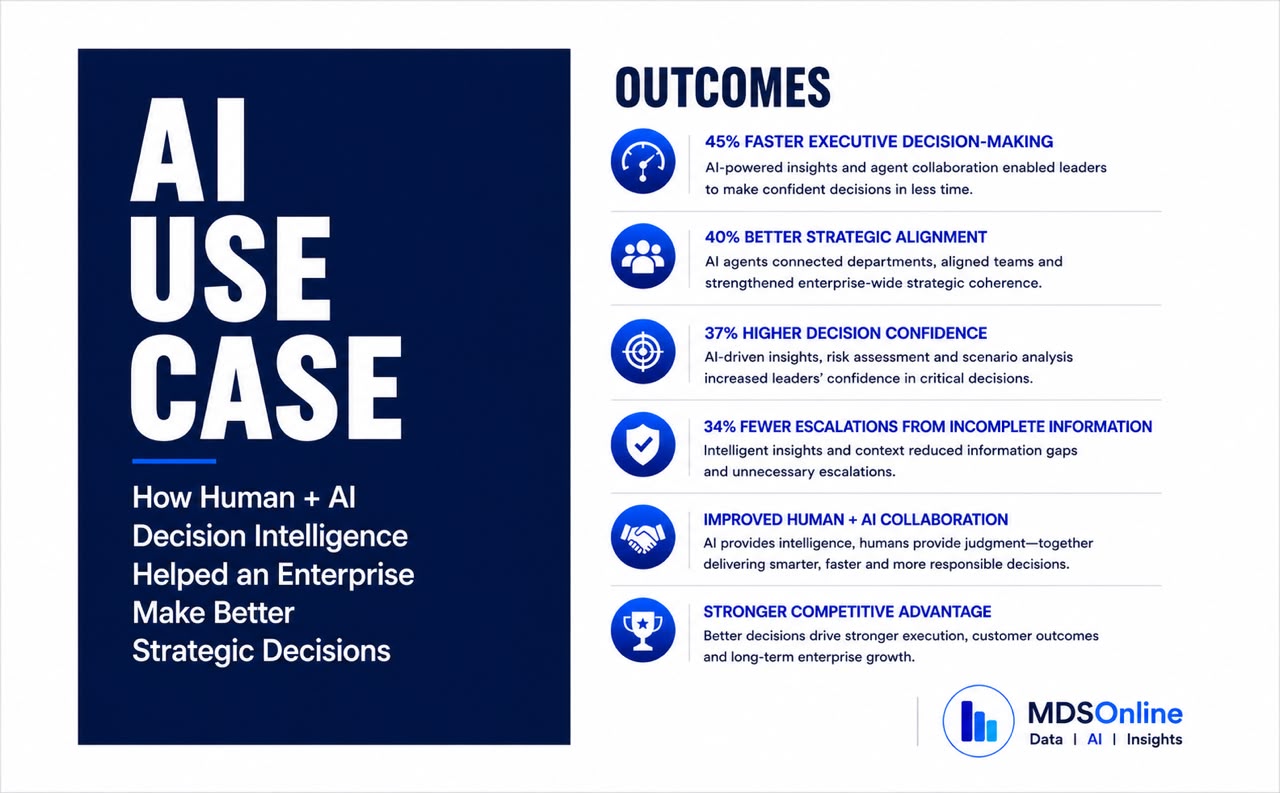
* 45% faster executive decision-making
* 40% improvement in strategic alignment across business units
* 37% increase in decision confidence
* 34% reduction in escalations caused by incomplete information
Operational Outcomes
* Faster access to trusted business intelligence
* Improved cross-functional collaboration
* Earlier identification of strategic risks
* More consistent decision processes
* Greater transparency in enterprise decision-making
Business Outcomes
* Improved customer satisfaction
* Better regulatory compliance
* Faster strategic execution
* Higher operational efficiency
* Stronger organizational resilience
* Greater competitive advantage
The Bigger Lesson
The future of business isn’t Human vs. AI.
It’s Human + AI.
AI processes information at extraordinary speed.
Humans provide judgment, purpose, ethics, and strategic direction.
Organizations that combine both capabilities won’t simply make faster decisions.
They’ll make better ones.
Final Takeaway
Ask yourself:
* Is AI helping your teams make better decisions—or just faster ones?
* Are your leaders using AI as a decision support partner or treating it as an answer machine?
* Have you designed your decision-making process so that AI contributes analytical power while people provide judgment and accountability?
The organizations that thrive won’t be those with the most advanced AI.
They’ll be the ones that combine AI’s intelligence with human expertise to make smarter, faster, and more responsible decisions.


If you’re exploring how to identify high-impact AI opportunities and build an Enterprise AI ecosystem that delivers measurable business outcomes, let’s connect. I’d be happy to discuss practical strategies that create lasting business value … not just AI adoption.
Visit MDSonline.co.in