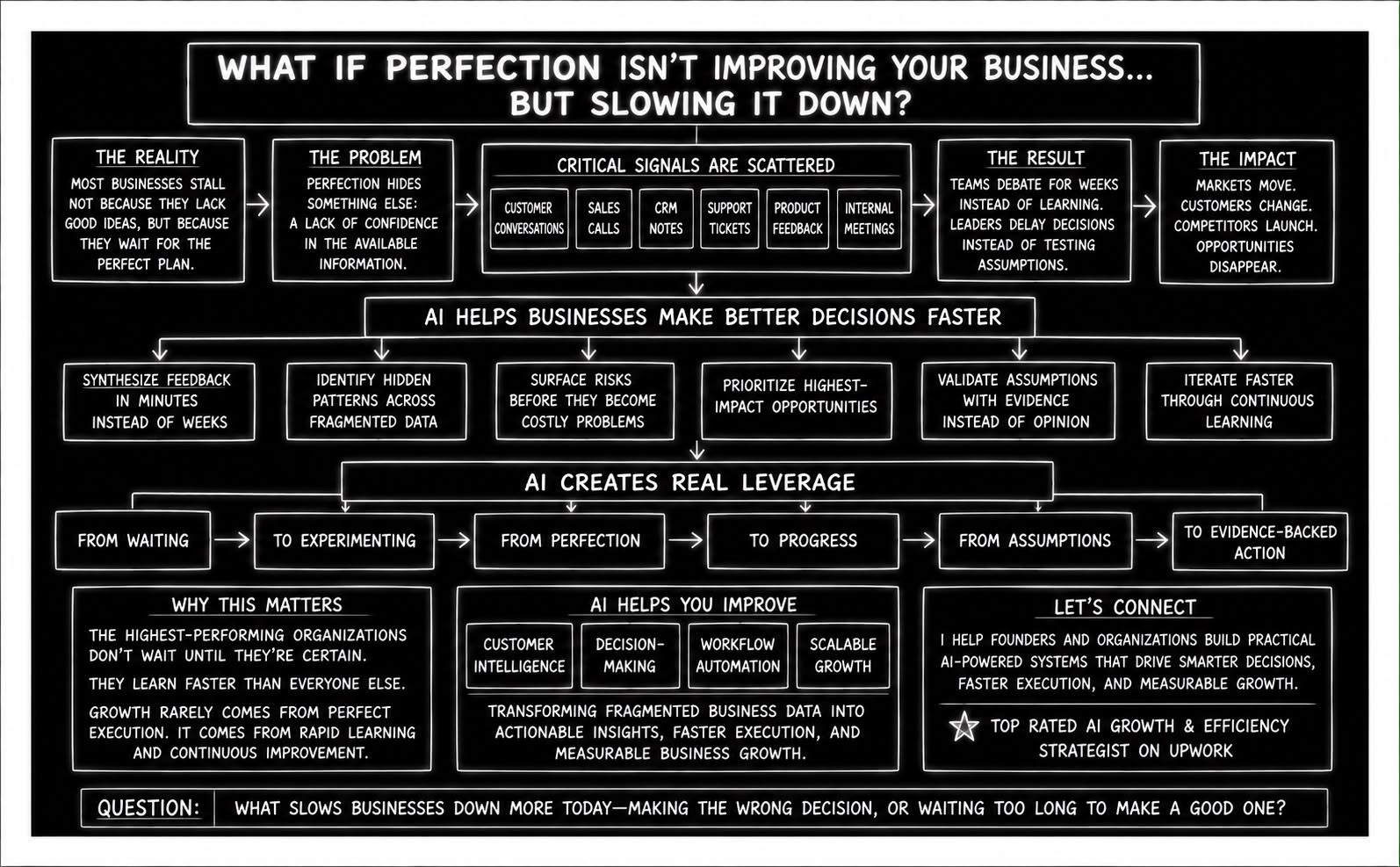
AI Decision Acceleration
Every growing business wants to make the right decisions.
The problem is that many organizations confuse making the right decision with waiting for perfect certainty.
New initiatives get delayed.
Product launches are postponed.
Marketing campaigns sit in review.
Features remain in development.
By the time the organization feels ready…
The market has already moved.
This case study explores how a growing technology company used AI to shorten decision cycles, validate assumptions faster, and create a culture of continuous learning instead of perfectionism.
Company Background
A mid-sized SaaS company with over 260 employees was experiencing rapid growth.
The company served enterprise customers across multiple industries and operated with teams including:
* Sales
* Marketing
* Product
* Customer Success
* Engineering
* Executive Leadership
Leadership encouraged thoughtful decision-making.
However, as the company grew, decisions became increasingly slow.
Product launches slipped.
Campaign approvals required multiple review cycles.
Innovation began losing momentum.
The company wasn’t suffering from poor ideas.
It was suffering from delayed execution.
The Problem
The organization faced six major decision-making challenges.
1. Slow Decision Cycles
Nearly every major initiative required multiple meetings before approval.
Teams waited for additional information instead of testing assumptions.
Decision speed declined.
2. Fragmented Customer Intelligence
Critical insights existed across numerous systems:
* Sales calls
* CRM notes
* Customer support
* Product feedback
* Marketing surveys
* Customer Success conversations
No single team had complete visibility.
3. Endless Analysis
Projects remained in planning for weeks.
New data continually triggered more discussion.
The search for certainty delayed execution.
4. Delayed Product Releases
Features were repeatedly postponed because teams wanted one more review, one more enhancement, or one more approval.
Competitors released faster.
5. Missed Market Opportunities
Customer needs evolved faster than internal decision-making.
By launch, some initiatives had already lost relevance.
6. Leadership Information Overload
Executives reviewed dozens of reports before making strategic decisions.
Finding the most important insight required significant manual effort.
Why Traditional Decision Processes Failed
The company already invested heavily in reporting and analytics.
Its technology stack included:
* Salesforce
* Tableau
* HubSpot
* Jira
* Google Analytics
The issue wasn’t access to information.
The issue was speed of learning.
Traditional analytics explained what had happened.
They couldn’t rapidly answer:
* What should we do next?
* Is there enough evidence to move forward?
* Which assumption matters most?
* Where is the biggest opportunity?
That’s where AI came in.
The AI Strategy
The company built an AI-Powered Decision Acceleration Platform.
Instead of waiting for perfect certainty, AI continuously evaluated available evidence and recommended the next best action.
The platform answered questions such as:
* Do we have enough evidence to launch?
* Which customer insights matter most?
* What risks remain unresolved?
* What experiment should we run next?
AI became a decision acceleration engine rather than a reporting tool.
AI Solution Architecture
The solution consisted of six intelligent layers.
Layer 1: Enterprise Data Integration
AI continuously collected business signals from every customer-facing system.
Connected Systems
* Salesforce CRM
* HubSpot
* Slack
* Microsoft Teams
* Jira
* Product Analytics
* Customer Support Platform
* Google Analytics
* Zoom
* Notion
Tech Stack
* REST APIs
* GraphQL
* Webhooks
* ETL Pipelines
* Apache Kafka
Purpose:
Continuously centralize customer and operational intelligence.
Layer 2: Unified Knowledge Platform
Business information was consolidated into a centralized knowledge environment.
Tech Stack
* Amazon S3
* Snowflake
* PostgreSQL
* Vector Database:
* Pinecone
Purpose:
Provide a single source of truth across the organization.
Layer 3: AI Decision Intelligence Engine
AI analyzed:
* Customer conversations
* Product feedback
* Sales calls
* CRM records
* Support tickets
* Internal discussions
* Market research
It automatically identified:
* Emerging customer needs
* High-confidence opportunities
* Decision risks
* Repeating assumptions
* Evidence gaps
Example insight:
Feature demand is increasing among enterprise customers, while SMB interest is declining.
Tech Stack
* OpenAI GPT Models
* Claude
* Retrieval-Augmented Generation using LangChain
* spaCy
Layer 4: Predictive Opportunity Engine
Machine learning evaluated future opportunities.
AI predicted:
* Feature adoption probability
* Campaign performance
* Customer demand
* Launch success probability
* Revenue impact
* Customer churn risk
Tech Stack
* Python
* Scikit-learn
* XGBoost
* PyTorch
Layer 5: Intelligent Workflow Automation
AI accelerated execution.
Examples:
* Customer trend changes → Product team alerted
* Sufficient launch confidence reached → Release recommendation
* New objection pattern detected → Marketing messaging updated
* Opportunity score increases → Executive review triggered
* High-impact experiment identified → Task created automatically
Tech Stack
* n8n
* Zapier
* APIs
* Webhooks
Layer 6: Executive Decision Dashboard
Leadership received real-time decision intelligence.
Dashboard displayed:
* Opportunity scores
* Customer trend analysis
* Assumption confidence levels
* Experiment recommendations
* Launch readiness
* Market movement alerts
* Decision priority ranking
Instead of asking, “Do we know everything?”
Leaders began asking,
“Do we know enough to move?”
What AI Discovered
Within 60 days, AI identified several hidden opportunities.
Hidden Insight #1: Product Delays Were Self-Inflicted
Nearly 38% of launch delays came from internal review cycles rather than technical limitations.
Insight
The organization wasn’t reducing risk.
It was delaying learning.
Hidden Insight #2: Customer Evidence Already Existed
Sales and support conversations consistently confirmed customer demand weeks before product approval.
Insight
The business already had enough evidence.
It simply wasn’t connected.
Hidden Insight #3: Small Experiments Outperformed Large Plans
Projects released incrementally generated customer feedback significantly faster than fully completed launches.
Insight
Learning speed created competitive advantage.
Hidden Insight #4: Executive Meetings Focused on Low-Risk Questions
AI found leadership spent excessive time debating unlikely scenarios instead of validating the highest-impact assumptions.
Insight
Perfection was creating unnecessary complexity.
Results After 120 Days
The AI implementation delivered measurable improvements.
Decision Outcomes
* 44% faster strategic decision-making
* 36% reduction in product approval cycles
* 41% faster customer insight analysis
* 33% improvement in launch readiness
Operational Outcomes
* 29% fewer delayed initiatives
* 35% faster experimentation
* 31% reduction in meeting time
* Higher cross-functional alignment
Business Outcomes
* Faster product releases
* Earlier customer validation
* Better resource allocation
* Increased innovation velocity
* Improved competitive responsiveness
The Bigger Lesson
High-performing organizations don’t wait for perfect certainty.
They create better learning systems.
They gather evidence.
Run experiments.
Adapt quickly.
And improve continuously.
That’s where AI creates real leverage.
Not by guaranteeing perfect decisions.
By helping organizations make better decisions sooner.
Final Takeaway
Ask yourself:
* Which important initiatives are waiting for “perfect” information?
* What customer evidence already exists inside your business?
* Are your teams optimizing for certainty—or for learning?
Markets don’t reward perfection.
They reward adaptation.
AI helps businesses replace hesitation with informed action.
And informed action is what drives sustainable growth.


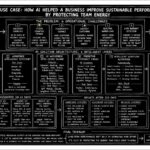
Read the full article on Linkedin
https://www.linkedin.com/pulse/ai-use-case-how-helped-business-replace-perfectionism-navin-mirania-em2lc/